
Listen to this article in summarized format
Loading...
××
Subscribe to

Unlock AI Briefing and Premium Content
New Year Offer 24 Hours Left
Subscribe NowAlready a member? Sign In
What's Included
- Exclusive Stories
- Daily ePaper Access
- Smart Market Tools
- Curated Investment Ideas
- Ad-lite Experience
Subscription

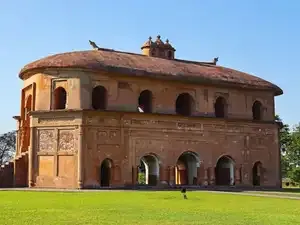
Right in the heart of Sivasagar stands Rang Ghar — a striking two-storied structure built in 1746 that once served as the entertainment hub of the Ahom kingdom. Even centuries later, the monument still feels larger than life.
Long before stadiums, VIP boxes, and sports arenas became part of modern life, Assam already had its own grand entertainment venue for royalty.
And its biggest claim to fame?
It is widely recognised as Asia’s oldest amphitheatre.
What makes Rang Ghar fascinating is not just its age, but the world it opens up. This was the place where Ahom kings, nobles, and guests gathered to watch traditional sports, performances, wrestling matches, bullfights, and cockfights unfold on the massive open grounds below.
At a time when entertainment meant gathering people together for spectacle and celebration, Rang Ghar was where the kingdom came alive.
Its name literally translates to “House of Entertainment,” and that is exactly what it was designed for.
The structure became especially vibrant during the Rangauli Bihu festival, when traditional sports and cultural programmes were organised for the Ahom royal family and invited guests.
Today, it remains one of Assam’s most recognisable historical landmarks and a lasting symbol of Ahom architecture and culture.
Unlike palaces or temples, this structure was specifically designed as a viewing gallery and entertainment arena centuries before modern amphitheatres became common in the region.
The open field in front of the structure — known as Rupohi Pathar — functioned like a performance ground, while the upper levels acted as viewing spaces for royalty and nobles.
That is why Rang Ghar is widely regarded as the oldest surviving amphitheatre in Asia.
Its curved roof resembles the shape of a royal Ahom boat, while decorative stone crocodiles guard the ceiling area.
But perhaps the most remarkable detail lies in how it was constructed.
According to historical descriptions associated with the monument, Ahom builders used a unique mixture made from rice paste, eggs, and Borali fish instead of modern cement to hold the structure together.
The monument’s exterior walls are decorated with floral and geometric carvings, while arched entrances lead visitors inside toward staircases once used by royalty to access the upper viewing gallery.
Even after more than 277 years, the structure continues to stand as a reminder of the engineering and artistic skill of the Ahom era.
From the upper floors, kings and nobles watched sporting events and entertainment programmes taking place on the grounds below. Traditional games, wrestling contests, bullfights, and cultural performances turned the venue into one of the liveliest places in the kingdom.
The structure reflected how deeply the Ahom rulers valued public celebration, architecture, athletics, and culture.
Its cultural importance became so enduring that Rang Ghar was later chosen as the official logo for the 33rd National Games hosted by Assam in 2007.
These include:
As per the details provided:
Nearest Airport: Dibrugarh Airport (DIB) – approx. 70-80 km
Alternative: Jorhat Airport (Rowriah) – approx. 55-60 km
From the airport, take a taxi or pre-booked cab to Sivasagar (1.5 to 2 hours drive).
2. By Rail
Nearest Railway Station: Sibsagar Town Railway Station – just 3 km away
Other nearby stations: Simaluguri Junction
Local auto-rickshaws, taxis, or tempos are easily available from the station to Rang Ghar.
3. By Road (By Land)
Rang Ghar is located right beside the Assam Trunk Road (NH-37), about 3 km from Sivasagar town centre.
Well-connected by road from Guwahati (approx. 350 km), Jorhat, Dibrugarh, and other major towns in Assam.
You can hire taxis, take state buses, or drive directly.
4. By Local Transport (Within Sivasagar)
Long before stadiums, VIP boxes, and sports arenas became part of modern life, Assam already had its own grand entertainment venue for royalty.
And its biggest claim to fame?
It is widely recognised as Asia’s oldest amphitheatre.
What makes Rang Ghar fascinating is not just its age, but the world it opens up. This was the place where Ahom kings, nobles, and guests gathered to watch traditional sports, performances, wrestling matches, bullfights, and cockfights unfold on the massive open grounds below.
At a time when entertainment meant gathering people together for spectacle and celebration, Rang Ghar was where the kingdom came alive.
What is Rang Ghar and why is it famous?
Rang Ghar was built during the reign of Ahom ruler Swargadeo Pramatta Singha between 1744-1751 as a royal sports pavilion and entertainment arena.Its name literally translates to “House of Entertainment,” and that is exactly what it was designed for.
The structure became especially vibrant during the Rangauli Bihu festival, when traditional sports and cultural programmes were organised for the Ahom royal family and invited guests.
Today, it remains one of Assam’s most recognisable historical landmarks and a lasting symbol of Ahom architecture and culture.
Why is Rang Ghar called Asia’s oldest amphitheatre?
What sets Rang Ghar apart from many other historical monuments is its purpose.Unlike palaces or temples, this structure was specifically designed as a viewing gallery and entertainment arena centuries before modern amphitheatres became common in the region.
The open field in front of the structure — known as Rupohi Pathar — functioned like a performance ground, while the upper levels acted as viewing spaces for royalty and nobles.
That is why Rang Ghar is widely regarded as the oldest surviving amphitheatre in Asia.
What makes Rang Ghar’s architecture unique?
Standing around 10 metres tall, Rang Ghar is considered one of the finest examples of Ahom architecture.Its curved roof resembles the shape of a royal Ahom boat, while decorative stone crocodiles guard the ceiling area.
But perhaps the most remarkable detail lies in how it was constructed.
According to historical descriptions associated with the monument, Ahom builders used a unique mixture made from rice paste, eggs, and Borali fish instead of modern cement to hold the structure together.
The monument’s exterior walls are decorated with floral and geometric carvings, while arched entrances lead visitors inside toward staircases once used by royalty to access the upper viewing gallery.
Even after more than 277 years, the structure continues to stand as a reminder of the engineering and artistic skill of the Ahom era.
How did Ahom kings use Rang Ghar?
For Ahom rulers, Rang Ghar was more than just a building — it was a royal social space.From the upper floors, kings and nobles watched sporting events and entertainment programmes taking place on the grounds below. Traditional games, wrestling contests, bullfights, and cultural performances turned the venue into one of the liveliest places in the kingdom.
The structure reflected how deeply the Ahom rulers valued public celebration, architecture, athletics, and culture.
Its cultural importance became so enduring that Rang Ghar was later chosen as the official logo for the 33rd National Games hosted by Assam in 2007.
How is Rang Ghar different from Rome’s Colosseum?
While Rang Ghar and Colosseum were both built as entertainment arenas, they belonged to very different worlds. Rome’s Colosseum was a massive stone stadium designed for gladiator battles before huge crowds, while Assam’s Rang Ghar was a smaller royal pavilion where Ahom kings watched traditional sports, Bihu celebrations, wrestling, and cultural performances. One symbolised imperial spectacle; the other reflected the festive and cultural life of the Ahom kingdom.What to see near Rang Ghar?
A visit to Sivasagar often turns into a larger journey through Ahom history because several major landmarks are located nearby.These include:
- Talatal Ghar — a seven-storey royal palace with three underground levels
- Kareng Ghar — another important Ahom royal residence
- Siva Dol — one of the tallest Shiva temples in India
What are Rang Ghar timings and entry fees?
Rang Ghar is generally open daily from 09:00 AM to 05:00 PM.As per the details provided:
- Indians and SAARC nationals: ₹25
- Foreign visitors and NRIs: ₹300
- Children below 15 years: Free
- Free Entry Days
- 18th April — World Heritage Day
- 19th to 25th November — World Heritage Week
How to reach Rang Ghar in Assam?
1. By AirNearest Airport: Dibrugarh Airport (DIB) – approx. 70-80 km
Alternative: Jorhat Airport (Rowriah) – approx. 55-60 km
From the airport, take a taxi or pre-booked cab to Sivasagar (1.5 to 2 hours drive).
2. By Rail
Nearest Railway Station: Sibsagar Town Railway Station – just 3 km away
Other nearby stations: Simaluguri Junction
Local auto-rickshaws, taxis, or tempos are easily available from the station to Rang Ghar.
3. By Road (By Land)
Rang Ghar is located right beside the Assam Trunk Road (NH-37), about 3 km from Sivasagar town centre.
Well-connected by road from Guwahati (approx. 350 km), Jorhat, Dibrugarh, and other major towns in Assam.
You can hire taxis, take state buses, or drive directly.
4. By Local Transport (Within Sivasagar)
- Auto-rickshaws
- E-rickshaws
- Taxis / Cabs
- Two-wheelers (scooters available on rent in Sivasagar)