Air India Crash: Victim's Relative Who Entered Morgue Claims Captain Sabharwal's Body Was Still Seated Holding Controls
Webdunia | May 20, 2026 2:40 PM CST
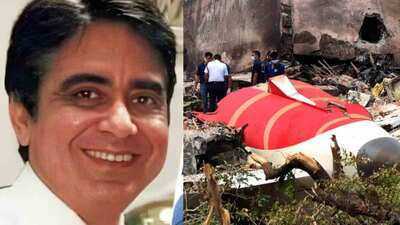
A relative of three victims killed in the Air India AI-171 crash has claimed he saw the body of the flight’s captain inside the Ahmedabad Civil Hospital mortuary in a seated position, with his hands still gripping the aircraft controls.
The claims made by Romin Vohra, a resident of Gujarat’s Kheda district, have surfaced amid ongoing debate over the circumstances surrounding the June 12 tragedy and the actions taken inside the cockpit during the flight’s final moments.
Reacting to Vohra’s account, a representative of a US-based legal firm said the crash should be investigated by “truly independent experts” before any conclusions are drawn against a “single person.”
“The families deserve the truth, not a quick conclusion that protects powerful companies or institutions,” the official said.
The London-bound Air India flight AI-171 had crashed into a hostel complex in Ahmedabad’s Meghaninagar area shortly after taking off from Sardar Vallabhbhai Patel International Airport, killing 241 people on board and 19 others on the ground. One passenger survived the crash.
The aircraft was being operated by Captain Sumeet Sabharwal and co-pilot Captain Clive Kunder.
Following the accident, the bodies of victims — many severely charred — were shifted to the mortuary at Ahmedabad Civil Hospital in Asarwa for identification and DNA matching.
Vohra, who lost his brother, niece and aunt in the crash, claimed he entered the mortuary on June 13 while searching for the bodies of his relatives and there saw the remains of Captain Sabharwal.
Speaking to PTI over the phone, Vohra, who works as a lab technician, said he was allowed inside because of his medical background.
“My brother, my brother's daughter and my aunt died in the crash. I had gone to identify them a day after the crash. Since I am from the medical field and have some contacts, I got permission to go inside the mortuary,” he said.
Vohra claimed the captain’s body had been placed separately from the others.
“At that time, the body was stiff and in a sitting position, as if he was still on his seat,” he claimed.
“His hands were holding the steering. His legs were bent the way a seated person's legs remain bent, while his arms were stretched forward,” Vohra added.
When asked whether the controls were still in the pilot’s hands, he replied, “Yes, the steering was in his hands.”
According to Vohra, the captain was still dressed in uniform, which helped him identify the body.
“The captain's uniform was there. There was only one captain's body there, which was that of Sumeet Sabharwal sir. I recognised him from the uniform,” he said.
He further claimed that the front side of the body had comparatively fewer burn injuries.
“He was burnt more on the backside. The front side and face were not burnt that much. I do not remember every detail exactly, but one could clearly tell it was the captain's body,” he said.
Vohra said he later confirmed the identity after seeing photographs of the pilot in public reports.
“Being from the medical field, we can identify bodies from height, weight and physical structure. Later, when I saw photographs of Captain Sabharwal, I became sure that the body I saw was indeed his,” he said.
Meanwhile, US-based law firm Chionuma Law, which claimed to represent families of 115 crash victims, called for an independent investigation into the incident.
“The reported account that Captain Sumeet Sabharwal was found in a seated position, still gripping the yoke, raises serious questions that cannot be ignored,” Ayush Rajpal, case manager at the firm, said in a statement.
“A pilot who is holding the controls until the final moment should not be judged by speculation, especially when he is no longer alive to defend himself,” he said.
Rajpal added that “every technical, mechanical, electrical and human factor” related to the crash must be examined by “truly independent experts” before blaming a “single person” for the disaster.
“The families deserve the truth, not a quick conclusion that protects powerful companies or institutions,” the statement added.
In a preliminary report released in July last year, the Aircraft Accident Investigation Bureau (AAIB) stated that the aircraft’s engine fuel control switches were turned off seconds after take-off. According to the cockpit voice recording cited in the report, one pilot was heard asking the other why he had cut off the fuel, while the second pilot responded that he had not done so.
The report added that the engine N1 and N2 values began dropping from take-off levels after fuel supply to the engines was cut off.
In November last year, the Supreme Court observed that no one had blamed the aircraft’s chief pilot for the crash and advised Captain Sabharwal’s 91-year-old father not to carry any emotional burden over the tragedy.
READ NEXT
-
Rupee slumps to all-time low of 96.9 against US dollar

-
Tamil Nadu Class 10 results declared, 94.31 pc pass

-
NHAI: This machine can determine exactly how many potholes are on any given road—in just minutes..
-
Karan Johar ventures into Gujarati cinema with 'Jindagi Once More'

-
Rheumatoid Arthritis Warning Signs: Early Symptoms, Risk Factors, and Ways to Manage Joint Pain