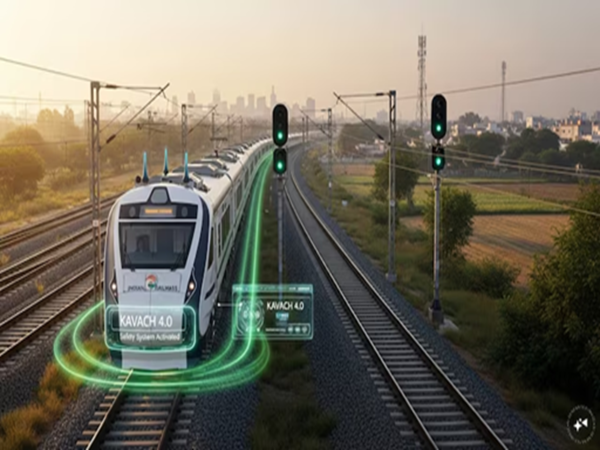
Indian Railways has taken a significant step toward further strengthening train safety. The Railways have successfully completed the commissioning of the KAVACH 4.0 system on the Delhi-Palwal route. This advanced safety system has been operationalized within the New Delhi (Ex) Junction Cabin section. With this development, the TKJ (Tilak Bridge) to PWL (Palwal) section of the New Delhi-Mumbai corridor—which falls under the jurisdiction of Northern Railway—is now fully covered by the KAVACH safety network. According to railway officials, New Delhi Railway Station itself has not yet been included in this coverage, but work on the remaining sections has been completed. Under this project, the KAVACH system has been installed across a section spanning approximately 21.6 route kilometers and covering about 86 kilometers of track.
The Railways stated that several advanced technologies were utilized throughout this entire project. The STCAS (Station-based Train Collision Avoidance System) has been installed at a total of four stations. Additionally, over 1,200 RFID (Radio-Frequency Identification) tags have been installed to ensure the precise tracking of train locations and movements.
**What is the KAVACH 4.0 System?**
As part of the project, the Railways has fully completed the wiring, testing, and communication infrastructure for the entire KAVACH network. To achieve this, 1,326 electronic relays were installed to transmit information regarding signals and train movements to the system. Furthermore, the system underwent rigorous testing across 653 routes and 2,510 distinct signal conditions to ensure that KAVACH activates instantly in critical situations—such as potential train collisions, overspeeding, or passing a red signal. To facilitate enhanced communication, four new towers and a 42-kilometer-long optical fiber network have also been deployed. Additionally, a Network Management System has been established at the New Delhi Control Center, enabling railway officials to monitor the entire KAVACH network in real-time.
**How Does the System Work?**
The KAVACH system continuously monitors a train's speed, location, and signal status by utilizing a combination of microprocessors, GPS (Global Positioning System), radio communication, and RFID technology. If a Loco Pilot attempts to pass a red signal or if the train exceeds the prescribed speed limit, this system can automatically apply the brakes. It also aids in preventing head-on and rear-end collisions. According to railway officials, this system proves to be highly effective even during foggy conditions and adverse weather. This is precisely why the Railways is rapidly deploying it across the country's high-density and Golden Quadrilateral routes.
**The KAVACH Network is Expanding Rapidly**
In recent months, Indian Railways has rapidly expanded the coverage of KAVACH 4.0. According to the Railways, this system has already been commissioned across more than 1,300 route kilometers. Its expansion is also progressing rapidly along busy rail corridors such as Delhi-Mumbai and Delhi-Howrah. The Railways believes that in the coming years, the KAVACH system will play a pivotal role in making train operations nationwide safer, smarter, and more reliable.
Disclaimer: This content has been sourced and edited from NDTV India. While we have made modifications for clarity and presentation, the original content belongs to its respective authors and website. We do not claim ownership of the content.
-
CBSE Re-evaluation and Re-checking Application Process Begins, How to Apply and What is the Fee?

-
DRDO Internship 2026: Internship Opportunity for Engineering Students at DRDO—Find Out How Much the Stipend Will Be..

-
Changes to CA Syllabus: AI to be Introduced; ICAI Forms Committee..

-
DU Admissions 2026: Delhi University Releases BA LLB and BBA LLB Admission Schedule..

-
CBSE Extends Application Deadline for Class 12 Re-evaluation; Portal Troubles Students on Day One..