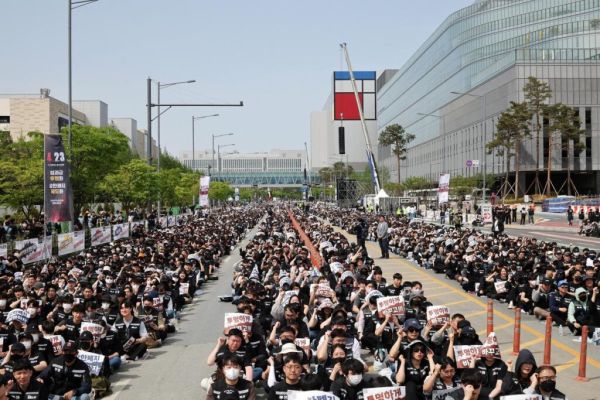
South Korean tech giant Samsung Electronics has won a crucial partial court injunction ahead of a planned large-scale labor strike that could have disrupted operations at one of the world’s biggest semiconductor manufacturers.
The ruling, delivered Monday by the Suwon District Court, places significant restrictions on the Samsung Electronics Company Union’s planned industrial action, which is scheduled to begin Thursday and continue for 18 days. While the court stopped short of banning the strike altogether, it imposed strict conditions aimed at protecting Samsung’s critical manufacturing facilities and semiconductor operations.
The development highlights growing tensions between Samsung management and its workers at a time when the global semiconductor industry is becoming increasingly competitive and strategically important.
Credits: Asia News Network
Safety And Chip Production Become Key Focus
At the heart of the court’s decision was the concern over protecting Samsung’s highly sensitive chipmaking facilities. Semiconductor manufacturing plants operate around the clock and require constant monitoring to prevent equipment failures, product deterioration, and safety risks.
The court ordered the union to maintain normal staffing levels for essential safety and facility protection work during the strike period. According to the ruling, the union cannot interfere with the maintenance and operation of safety facilities under any circumstances.
The court specifically stated that operations involving staffing, operating hours, duty management, and facility oversight must continue at the same level as before the strike, including during weekends and holidays.
This decision is particularly important because semiconductor wafers are extremely sensitive during production. Even a minor interruption in environmental control systems or maintenance operations can lead to massive financial losses and damaged inventory.
The court also prohibited the union from obstructing work designed to prevent wafer deterioration or facility damage, ensuring Samsung’s manufacturing lines can continue operating despite the industrial action.
Restrictions Extend Beyond Factory Operations
In addition to protecting production facilities, the court imposed several operational restrictions on the union itself.
The Samsung Electronics Company Union and its leader, Choi Seung-ho, were barred from occupying Samsung facilities, blocking entrances, installing locks, or preventing employees from accessing workplaces.
These restrictions appear aimed at preventing the kind of aggressive labor demonstrations that could disrupt production or create safety concerns at Samsung campuses.
The ruling came just three days before the planned strike, increasing pressure on both management and labor representatives to reach a compromise before tensions escalate further.
Union Pushes For Bigger Bonuses
The labor dispute largely revolves around compensation and Samsung’s performance-based bonus system.
The union has demanded the removal of the existing cap on performance bonuses, which currently limits payouts to 50 percent of annual salary. Workers are also pushing for a more transparent and institutionalized compensation structure tied directly to company performance.
One of the union’s key demands is the codification of a bonus system that would allocate 15 percent of Samsung Electronics’ operating profit toward employee bonuses.
Union leaders argue that workers deserve a larger share of Samsung’s profits, especially after years of contributing to the company’s dominance in memory chips, smartphones, and consumer electronics.
The planned strike was expected to involve around 50,000 employees, making it one of the most significant labor actions in Samsung’s recent history.
Samsung Management Holds Its Ground
Samsung management, however, has resisted the union’s proposal to institutionalize the removal of the bonus cap.
Company executives reportedly told negotiators that Samsung would continue offering “industry-leading compensation” and special rewards if the company regains the top position in the semiconductor sector. However, management maintains that permanently removing bonus limits could create long-term financial and operational risks.
The dispute comes at a sensitive moment for Samsung, which is battling fierce global competition in semiconductors, particularly in advanced AI chips and memory technologies.
As the strike deadline approaches, Samsung management and union representatives have entered what is expected to be their final round of negotiations at the National Labor Relations Commission in Sejong, with government officials mediating discussions.
Credits: Financial Times
A Critical Moment For Samsung
The outcome of this labor dispute could have wider implications not only for Samsung but also for South Korea’s broader technology industry.
Samsung remains one of the country’s most influential corporations and a critical player in the global semiconductor supply chain. Any prolonged disruption could impact production schedules, global chip supplies, and investor sentiment.
For now, the court ruling gives Samsung temporary operational protection. But whether it can prevent a deeper conflict between management and workers remains uncertain as both sides continue negotiations under mounting pressure.
-
Sonu Nigam’s ‘The Revolution’ world tour to kick off in Abu Dhabi

-
Religious conversion is like throwing salt on Sanatan tree: IRS officer

-
Centre offers Article 371-style safeguards, legislative body for Ladakh
-
Five Record-Breaking Moments And Stats From IPL That Still Remain Iconic

-
WWE Star Arrested For Allegedly Beating Up Neighbor Over Elevator Kissing Comment