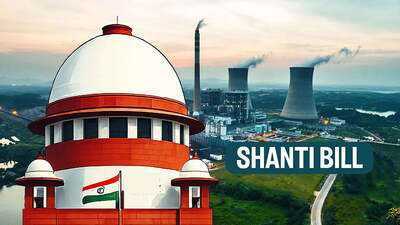
New Delhi | This is a "very sensitive legislative policy issue", the Supreme Court said on Tuesday while hearing a plea challenging the provisions of a 2025 law that caps the liability at Rs 3,000 crore in the event of any unfortunate incident at a nuclear power plant.
A bench of Chief Justice of India (CJI) Surya Kant and Justices Joymalya Bagchi and Vipul M Pancholi observed that the issues raised in the plea challenging various provisions of the Sustainable Harnessing and Advancement of Nuclear Energy for Transforming India (SHANTI) Act, 2025, touches on the "economic policy".
"Our concern is that if an unfortunate event or any accident takes place and any person suffers an injury or damage, do we have a robust compensatory mechanism for that purpose," the bench said during the hearing.
Representing the petitioners in the court, advocate Prashant Bhushan said there are three main issues, including the capping of the total liability.
"If a nuclear accident takes place, the damage done is hundreds of times higher than that," Bhushan argued, while referring to the Fukushima Daiichi Nuclear Power Plant accident that occurred in Japan in 2011.
He argued that the government can do whatever it wants by way of a policy, but it cannot sacrifice the rights of citizens.
"This is a very sensitive legislative policy issue," the bench said.
It also observed that technology has to come from outside and wondered that if the liability is not capped, then who will come to operate here.
It said the State will also compensate if any such unfortunate incident takes place.
The bench observed that the capping on liability does not tinker with the court's power to determine the compensation to be awarded to a victim of any such incident.
"Nobody can curtail the power of even a tribunal when the tribunal wants to assess compensation and suitably award it to a person who is entitled," it said.
Bhushan argued that the cost of setting up a nuclear power plant is much higher than that of setting up a solar power plant.
"I am not asking the court to interfere with any policy of the government. But that policy cannot sacrifice the safety of the citizens," he said, alleging that some of the provisions of the Act are unconstitutional.
The bench said, "You tell us a single nation, whether developed or developing, who is not having production of power through nuclear power plants." Bhushan said countries like Japan and Germany have stopped energy production through nuclear power plants and they have no cap on the liability.
He added that in the United States, the cap is Rs 1.54 lakh crore, which is more that 100 times the cap imposed in India.
Bhushan claimed that the Act encourages foreign suppliers to cut corners on safety.
The bench said it would hear the matter in detail.
"Some of your apprehensions may require attention. We will try to clarify those apprehensions," it said while posting the matter for hearing in July.
While hearing the plea on February 27, the court said the main dispute raised was between an actual, visible and tangible national interest versus an unfortunate hypothetical loss.
Bhushan had then argued that the Act, which replaced the Civil Liability for Nuclear Damage Act of 2010, allows private companies to set up civil nuclear power plants but exempts them from liability beyond Rs 3,000 crore.
He had said in case of nuclear accidents, the loss is more than Rs 10 lakh crore, as was the case of the Chernobyl nuclear power plant accident of 1986 and the Fukushima nuclear power plant accident of 2011.
Bhushan had said the Act goes against the absolute-liability principle for hazardous industries laid down by the Supreme Court in the Oleum gas leak case in 1987.
"The SHANTI Act, 2025, brought into force recently, while allowing private sector and foreign companies to operate nuclear power plants in India, has also capped the liability of these operators at an absurdly low level and exempted the supplier from any liability," the plea says.
It further says that the repealed Civil Liability for Nuclear Damage Act, 2010, had expressly provided for the operator's right of recourse against the supplier.
The public interest litigation (PIL) plea points out that instances like the Chernobyl nuclear disaster, which occurred in the erstwhile Soviet Union, led to enormous damage to life and property.
It also cites the example of the Fukushima Daiichi Nuclear Power Plant accident that caused enormous socio-economic impacts on lives and livelihood.
"In contrast to this, the SHANTI Act, 2025, caps the liability of the largest plant operator in India at a mere Rs 3,000 crores (i.e., approximately USD 331 million, amounting to less than 0.1 per cent of the cost of damage caused by the accidents at Chernobyl or Fukushima)," the plea says.
-
Meghan Markle slammed over 'embarassing' Prince Harry move: 'So cringe'

-
Emergency services swarm French street as 'three police officers attacked with knife'

-
Brush Fire in Jurupa Valley Consumes 15 Acres Amidst Challenging Conditions
-
Kroger Croutons Recalled Due to Salmonella Risk

-
Aldi confirms potatoes will last longer without mould if stored away from 1 kitchen item