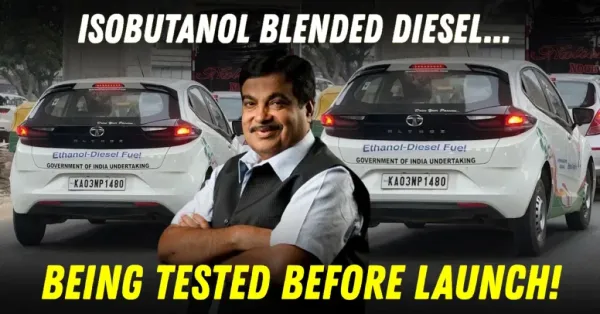
The government’s attempt to blend biofuels with diesel has a history of false starts. Ethanol-diesel blending, tried first under the ED-5 programme, produced unsatisfactory results in vehicle compatibility and fuel stability tests. Isobutanol is now the second attempt, and this time the approach is more structured.
ARAI, the Automotive Research Association of India, and Praj Industries have jointly deepened their validation programme, with a 10-month testing phase that began in June 2025 and involves major vehicle manufacturers and oil companies.
The results so far, up to a 10 percent isobutanol blend in diesel, have been described as promising by Praj Industries’ senior leadership. The next step is a semi-commercial demonstration plant that Praj expects to have operational within 12 to 18 months.
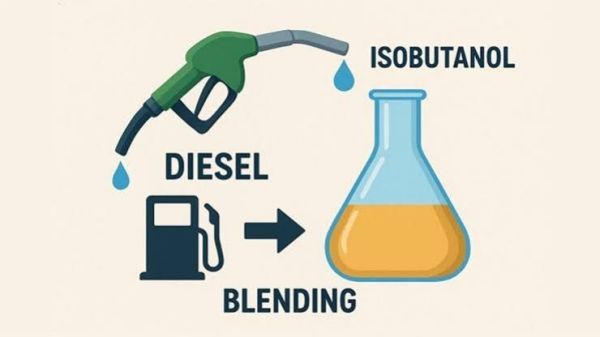
Isobutanol is a four-carbon alcohol produced from fermentation of biomass, including agricultural waste. Unlike ethanol, which has historically caused phase separation and ignition problems when blended with diesel in meaningful quantities, isobutanol is more compatible with diesel chemistry.
It has a higher energy density than ethanol, which means less mileage penalty when blended. It can be transported and stored using existing fuel pipelines and storage tanks without modification, which is a critical infrastructure advantage that ethanol did not have for diesel blending.
Ethanol’s compatibility with petrol is well established, and India has successfully scaled petrol blending from 5 percent to 20 percent over a decade. Diesel is a different challenge.
Diesel engines use compression ignition, meaning fuel ignites under pressure rather than from a spark plug. Ethanol’s ignition characteristics are not well suited to this system in high blend ratios, and the fuel’s tendency to absorb water caused phase separation in storage tanks under field conditions.
Isobutanol avoids these specific problems. Its ignition delay characteristics are closer to diesel’s own profile, it does not absorb atmospheric moisture the way ethanol does, and its energy content per litre is significantly higher than ethanol, at approximately 29.2 MJ per litre versus 21.3 MJ for ethanol. At a 10 percent blend, the impact on energy content and mileage is therefore much smaller than a comparable ethanol blend would produce.
Road Transport Minister Nitin Gadkari confirmed in April 2026 that testing is under way, noting that the programme makes this country the first to conduct real-world isobutanol-diesel blending trials at this scale.
The ARAI programme is running across multiple vehicle classes, including passenger cars, commercial vehicles, and tractors, which matters because diesel engine designs vary significantly between applications and a blend that works in a BS6 passenger car diesel may behave differently in a high-compression commercial vehicle engine.
The current ARAI trial involves a controlled set of vehicles across OEM partners. The semi-commercial demonstration plant Praj is setting up will expand the data set to near-commercial conditions. This will answer questions about real-world fuel stability, long-term component compatibility, and logistics feasibility.
If those results hold up, the government could formally consider a structured isobutanol blending mandate for diesel, similar to how E20 was mandated for petrol.
For existing diesel vehicle owners, the practical concerns include the key question:
Will a mandated isobutanol blend damage fuel system components such as seals, injectors, or filters designed for standard diesel? The current trials are specifically designed to answer that.
At a 10 percent blend, initial data suggests compatibility is not a concern for modern BS6 diesel engines with metal and synthetic fuel system components.
Older vehicles with rubber components not rated for alcohol contact are a separate question, and one the trials will need to address before any mandate is considered.
-
Top Skills Students Must Learn Before College to Land High-Paying Jobs and Bigger Salary Packages
-
Suriya Opens Up On ‘Karuppu’ Release Delay, Financial Struggles; Hints At Sequel After Rs 200 Cr Success

-
JEE Advanced 2026 Answer Key To Be Out Tomorrow; Check Objection Window, Download Steps And Result Date
-
Over 23,000 Candidates Opt For 3 Newly Added Centres In UPSC Civil Services (Preliminary) Examination-2026
-
Aishwarya Rai Bachchan Continues To Rule Cannes Film Festival 2026 In Embellished Gown With Flowing Feather Cape