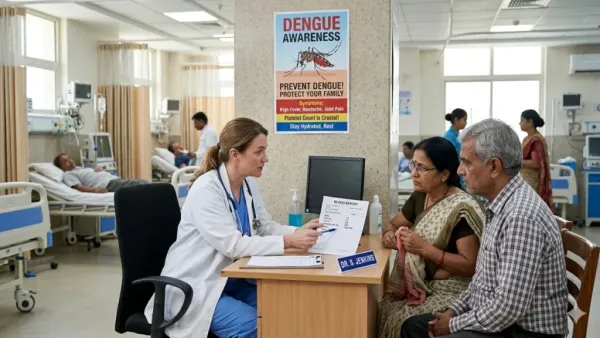
Negligence can prove costly once dengue fever subsides— Health experts and senior doctors have issued a big alert regarding the treatment of dengue. After analyzing the cases coming in government and private hospitals, doctors say that the most dangerous and critical phase of dengue starts when the patient’s fever starts going down. People consider the reduction of fever as recovery, but in reality this is the time when the patient needs the strictest monitoring. If you are careless, the patient’s condition may suddenly deteriorate.
Negligence can prove costly as soon as dengue fever subsides, doctors warn – this is the most critical phase
The risk increases between the third and seventh day: the whole truth about platelets
According to data received from hospitals, the time between the third to seventh day of dengue infection is the most critical for the patient. During this time, the body temperature starts becoming normal, which the family takes as a sign of recovery. According to doctors, in this phase platelets can fall rapidly and the risk of bleeding or shock syndrome increases.
It is often seen that as soon as the platelet count decreases, the attendants become nervous and start pressurizing them for transfusion of platelets from outside. Medical experts have made it clear that the decision to transfuse platelets cannot be taken just by looking at a number (count). For this, it is necessary to assess the complete physical condition of the patient.
Expert Opinion: Do not take the decision of transfusion of platelets just by looking at the numbers.
Important guidelines for family members: Keep an eye on these symptoms
The Health Department has issued some important guidelines for the safety and awareness of citizens. Even after the fever subsides, if the patient shows the following symptoms, immediately contact the nearest hospital or doctor:
- Persistent vomiting or severe stomach pain.
- Bleeding from the gums, nose or bleeding during defecation.
- Extreme weakness, dizziness or sudden drop in blood pressure.
- Lack of water in the body (dehydration) and less urination.
- Emergence of red rashes or marks on the skin.
The administration has also directed all local clinics and nursing homes to continuously check the blood pressure and hydration level of dengue patients. Even after the fever is cured, it is considered safe to keep the patient under medical consultation for at least 48 hours.
-
Finally! Arjun Tendulkar Makes LSG Debut In Final Game Of IPL 2026 Season

-
Hai Jawani Toh Ishq Hona Hai Trailer: 'WTF Is This Casting?'; Netizens React To 40-Year-Old Mouni Roy Playing Mother To 39-Year-Old Varun Dhawan

-
Bruno Fernandes named Premier League Player of the Season for 2025/26

-
Bruno Fernandes wins Premier League Player of the Season as Arsenal champions miss out

-
Ipswich Town vs Middlesbrough Live: TV Broadcast, Streaming Options and Match Preview for Key Championship Promotion Battle