
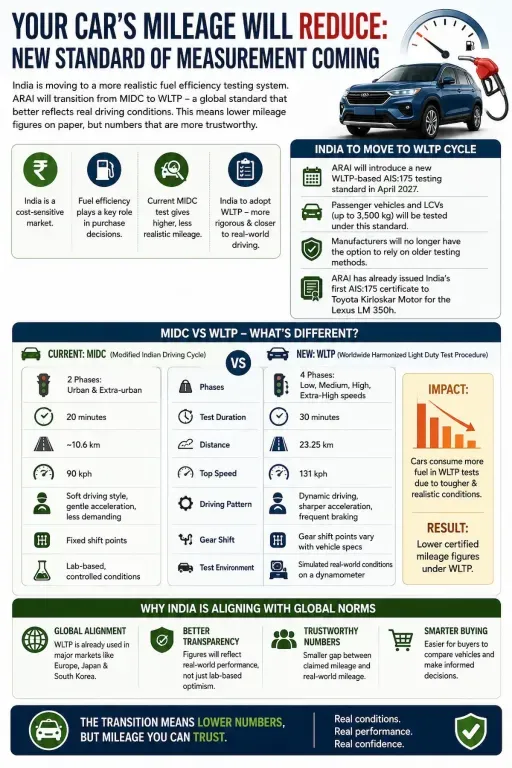
India is a cost-sensitive market. Both vehicle prices and operating costs (mainly fuel efficiency) play key roles in shaping purchase decisions. Most people take the manufacturer-supplied efficiency figures as the baseline for their math. Such buyers will soon start seeing lower mileage figures on paper, as a more realistic testing system is set to be introduced. ARAI, the body responsible for automotive- research, testing, and certification is now preparing to transition from the Modified Indian Driving Cycle (MIDC) to the Worldwide Harmonized Light Duty Test Procedure (WLTP). MIDC is a relatively simple, lab-based test, while WLTP is more rigorous and better mimics real driving conditions. This means WLTP mileage figures can be lower than MIDC figures for the same vehicle.
Automotive Research Association of India (ARAI) is set to introduce a new WLTP-based AIS:175 testing standard in April 2027. There on, passenger vehicles and light commercial vehicles weighing up to 3,500 kilograms will be tested under this standard. Manufacturers will no longer have the option to rely on older testing methods. Every new vehicle will have to be evaluated under this updated, globally aligned protocol.
With time still left for the same, ARAI has already issued the country’s first certificate under the AIS:175 standard to Toyota Kirloskar Motor for the Lexus LM 350h, a high-end luxury MPV.
The biggest visible impact of the transition will be in the fuel efficiency figures claimed by manufacturers. The current testing cycles are more or less lab-based. Mileage figures in these often appear higher because the tests are conducted in controlled and less-demanding settings.
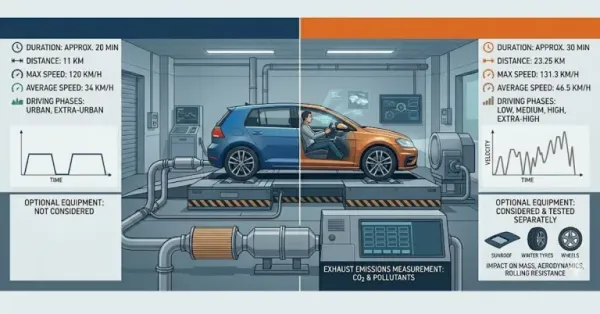
Firstly, it has two phases- Urban and extra-urban. Testing is done for 20 minutes over a distance of approximately 10.6 km. The top speed in these tests is 90 kph. Even the test driver will have a soft driving style and fixed shift points.
WLTP changes that completely. It introduces more dynamic driving patterns, includes higher speeds, accounts for sharper acceleration, and factors in real-world variables such as additional equipment that can increase a car’s weight or affect its aerodynamics.
WLTP tests have four phases- low, medium, high, extra-high-speeds. The test itself is carried out in simulated real-world conditions on a dynamometer. These tests are carried out for 30 minutes over 23.25 km. The top speed in this case is 131kph, and the acceleration is harder and braking more frequent than MIDC cycle’s. Gear shift points would vary with vehicle specs.
Because the test itself is tougher and more realistic, cars end up consuming more fuel during WLTP evaluation. This means lower certified mileage figures.
India is not the only country making this shift. WLTP is already used in major automotive markets such as Europe, Japan, and South Korea. By adopting this standard, India is aligning itself better with global testing benchmarks and ensuring comparable and consistent vehicle performance data.
This shift also improves transparency. Buyers will have access to figures that better reflect how a car will perform in everyday conditions, rather than relying on optimistic lab-based numbers.
The transition will mean a change in perception for end users. The WLTP mileage figures may be lower than MIDC numbers, but will be closer to what they will actually get- meaning, more trustworthy. The gap between claimed mileage and real-world figures will reduce significantly. This will make it easier to make informed decisions during the purchase journey.
-
PM Modi lands in Rome, to meet Italian PM Meloni

-
Himachal government's Rs 25 lakh incentive pays off; 131 panchayats elected unopposed

-
UP: HC grants anticipatory bail to one Bareilly violence accused

-
SP MP Iqra Hasan protests in Saharanpur over arrest of party leaders; Akhilesh attacks BJP govt

-
CBSE Launches Class 12 Revaluation Process for 2026: Key Details and Steps