In Toaster, a new Bollywood film, Rajkummar Rao plays an extreme miser. When his wife buys a toaster as a wedding present, but the wedding is abruptly cancelled and the gifts given away to charity, Rao’s character feels impelled to get the toaster back, setting in motion a chain of darkly comic series of events.
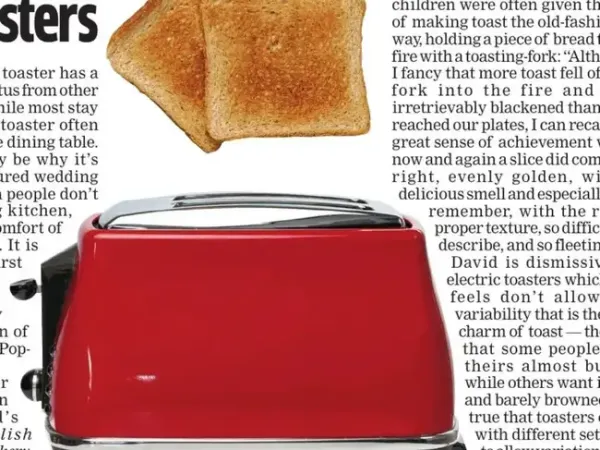
As it happens, it’s been exactly 100 years since the standard pop-up model electric toaster, the kind shown in the film, became widely available. Using radiant heat from electricity to toast bread was possible since the 1890s, but it only became practical around 1905 when an engineer named Alfred Marsh created wires of a nickel-chromium alloy that wouldn’t fuse at high heat.
This caused an explosion of devices. 'There were Pinchers, Swingers, Flatbeds, Droppers, Tippers, Perchers and Floppers: The names refer to different manual techniques for expelling the toast,' writes Bee Wilson in Consider the Fork, her history of culinary tools.
Finally, Charles Strite, a mechanic working in Minnesota, who was annoyed by how often the toast in his factory canteen got burnt, figured out a way to add a timer and springs to eject the toast when done. The first models were aimed at restaurant kitchens, but in 1926, a consumer model was launched. The design of the Toastmaster, as Strite called his device, has remained iconic, with tweaks added over the years, like a recent glass-walled design so you can see the toast brown.
Despite its simple, single-purpose nature, the electric toaster has a slightly different status from other cooking gadgets. While most stay in the kitchen, the toaster often stays out, next to the dining table. This visibility may be why it’s always been a favoured wedding present. Even when people don’t have a functioning kitchen, they can have the comfort of freshly made toast. It is also probably the first cooking device that kids learn to use, especially when they also have the option of toaster pastries like Pop-Tarts.
It may go deeper than that. I n Elizabeth David’s magisterial English Bread and Yeast Cookery, she recalls how in the days of open fires, children were often given the job of making toast the old-fashioned way, holding a piece of bread to the fire with a toasting-fork: “Although I fancy that more toast fell off the fork into the fire and was irretrievably blackened than ever reached our plates, I can recall the great sense of achievement when now and again a slice did come out right, evenly golden, with a delicious smell and especially, as I remember, with the right, proper texture, so difficult to describe, and so fleeting.”
David is dismissive of electric toasters, which she feels don’t allow the variability that is the real charm of toast — the fact that some people like theirs almost burnt, while others want it soft and barely browned. It’s true that toasters come with different settings to allow variations, but somehow always get stuck at just one. They also become less functional as they fill up with crumbs — one of the consequences of not being in the kitchen seems to mean that toasters get cleaned less than other cooking gadgets. Eventually, all electric toasters tend to malfunction, yet we never lose our hope that the next one will work better.
The British in India were huge lovers of toast — it was essential for the savoury snacks that formed part of their meals, or the buttered toast that was imperative for their breakfast. But there was also frustration with toast being made by khansamahs in distant kitchens: “Usually it is sent to the table either burnt to a cinder or so pallid-looking that it kills any remnant of appetite,” complained an aggrieved writer in The Times of India in 1935.
The answer was an electric toaster, so the toasting could be directly supervised. It is a sentiment that Indians inherited and now has made it to Bollywood as well.
As it happens, it’s been exactly 100 years since the standard pop-up model electric toaster, the kind shown in the film, became widely available. Using radiant heat from electricity to toast bread was possible since the 1890s, but it only became practical around 1905 when an engineer named Alfred Marsh created wires of a nickel-chromium alloy that wouldn’t fuse at high heat.
This caused an explosion of devices. 'There were Pinchers, Swingers, Flatbeds, Droppers, Tippers, Perchers and Floppers: The names refer to different manual techniques for expelling the toast,' writes Bee Wilson in Consider the Fork, her history of culinary tools.
Finally, Charles Strite, a mechanic working in Minnesota, who was annoyed by how often the toast in his factory canteen got burnt, figured out a way to add a timer and springs to eject the toast when done. The first models were aimed at restaurant kitchens, but in 1926, a consumer model was launched. The design of the Toastmaster, as Strite called his device, has remained iconic, with tweaks added over the years, like a recent glass-walled design so you can see the toast brown.
Despite its simple, single-purpose nature, the electric toaster has a slightly different status from other cooking gadgets. While most stay in the kitchen, the toaster often stays out, next to the dining table. This visibility may be why it’s always been a favoured wedding present. Even when people don’t have a functioning kitchen, they can have the comfort of freshly made toast. It is also probably the first cooking device that kids learn to use, especially when they also have the option of toaster pastries like Pop-Tarts.
It may go deeper than that. I n Elizabeth David’s magisterial English Bread and Yeast Cookery, she recalls how in the days of open fires, children were often given the job of making toast the old-fashioned way, holding a piece of bread to the fire with a toasting-fork: “Although I fancy that more toast fell off the fork into the fire and was irretrievably blackened than ever reached our plates, I can recall the great sense of achievement when now and again a slice did come out right, evenly golden, with a delicious smell and especially, as I remember, with the right, proper texture, so difficult to describe, and so fleeting.”
David is dismissive of electric toasters, which she feels don’t allow the variability that is the real charm of toast — the fact that some people like theirs almost burnt, while others want it soft and barely browned. It’s true that toasters come with different settings to allow variations, but somehow always get stuck at just one. They also become less functional as they fill up with crumbs — one of the consequences of not being in the kitchen seems to mean that toasters get cleaned less than other cooking gadgets. Eventually, all electric toasters tend to malfunction, yet we never lose our hope that the next one will work better.
The British in India were huge lovers of toast — it was essential for the savoury snacks that formed part of their meals, or the buttered toast that was imperative for their breakfast. But there was also frustration with toast being made by khansamahs in distant kitchens: “Usually it is sent to the table either burnt to a cinder or so pallid-looking that it kills any remnant of appetite,” complained an aggrieved writer in The Times of India in 1935.
The answer was an electric toaster, so the toasting could be directly supervised. It is a sentiment that Indians inherited and now has made it to Bollywood as well.