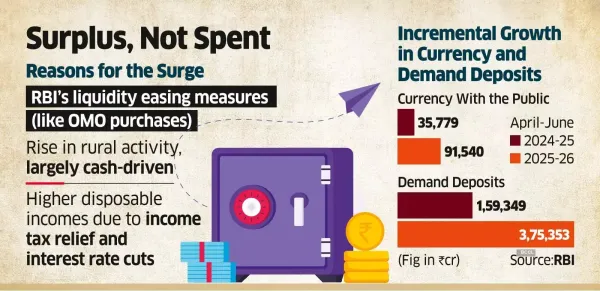
Mumbai: Banking system funds in liquid demand deposits-often seen as a proxy for cash-more than doubled to ₹3.79 lakh crore at the end of the June quarter, indicating significant liquidity in both the lending mechanism and the real economy.
Similarly, currency with the public surged to ₹91,000 crore from ₹31,000 crore, the latest Reserve Bank of India (RBI) data showed.
This rise reflects the impact of policy measures such as liquidity easing by the central bank, a pickup in rural activity that is largely cash-driven, and possibly higher disposable incomes due to tax sops.
"The rise in currency leakage was seen since Q4FY'25 onward, which coincided with a rise in rural consumption," said Gaura Sengupta, chief economist, IDFC First Bank. "The pickup in deposits reflects substantial liquidity infusion by the Reserve Bank via Open Market Operations-OMO purchases. Banking system liquidity has turned positive from April 2025 onwards."
The government raised the Income Tax eligibility limit to ₹12 lakh per annum for FY '25-26 from ₹7 Lakh per annum earlier, releasing more than ₹1 lakh crore at a system level.
An interest rate cut also makes the cost of money cheaper.
The RBI has cumulatively lowered the benchmark repo rates by 100 bps since February 2025.
"Disposable income, especially with urban consumers, is likely to increase by 0.6% of GDP on 100 bps interest rate cut and income tax cut" said Anubhuti Sahay, head, India Economic Research, Standard Chartered Bank." However, this is unlikely to translate fully into higher spending as households are likely to deleverage. Household saving at 18% is at a historical bottom and we usually observe rebuilding of savings at such levels."
"The significant increase in currency in circulation points to a strong recovery in rural economic activity" said Dilip Modi, founder and CEO, Spice Money. "This growth is fueled by multiple factors, including improved agricultural output, higher wages from employment schemes like MGNREGA, and government subsidies being delivered directly to Jan Dhan accounts." Additionally, the easing of inflation in essential goods has enhanced rural purchasing power, leading to greater cash flow and consumption. While cash is still widely used in rural India, digital payments like UPI are becoming more popular, Dilip Modi said.
Similarly, currency with the public surged to ₹91,000 crore from ₹31,000 crore, the latest Reserve Bank of India (RBI) data showed.
This rise reflects the impact of policy measures such as liquidity easing by the central bank, a pickup in rural activity that is largely cash-driven, and possibly higher disposable incomes due to tax sops.
"The rise in currency leakage was seen since Q4FY'25 onward, which coincided with a rise in rural consumption," said Gaura Sengupta, chief economist, IDFC First Bank. "The pickup in deposits reflects substantial liquidity infusion by the Reserve Bank via Open Market Operations-OMO purchases. Banking system liquidity has turned positive from April 2025 onwards."
The government raised the Income Tax eligibility limit to ₹12 lakh per annum for FY '25-26 from ₹7 Lakh per annum earlier, releasing more than ₹1 lakh crore at a system level.
An interest rate cut also makes the cost of money cheaper.
The RBI has cumulatively lowered the benchmark repo rates by 100 bps since February 2025.
"Disposable income, especially with urban consumers, is likely to increase by 0.6% of GDP on 100 bps interest rate cut and income tax cut" said Anubhuti Sahay, head, India Economic Research, Standard Chartered Bank." However, this is unlikely to translate fully into higher spending as households are likely to deleverage. Household saving at 18% is at a historical bottom and we usually observe rebuilding of savings at such levels."
"The significant increase in currency in circulation points to a strong recovery in rural economic activity" said Dilip Modi, founder and CEO, Spice Money. "This growth is fueled by multiple factors, including improved agricultural output, higher wages from employment schemes like MGNREGA, and government subsidies being delivered directly to Jan Dhan accounts." Additionally, the easing of inflation in essential goods has enhanced rural purchasing power, leading to greater cash flow and consumption. While cash is still widely used in rural India, digital payments like UPI are becoming more popular, Dilip Modi said.