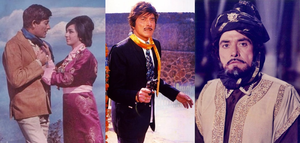
The opening couplet of Urdu poet Jigar Moradabadi’s ghazal, which places man at the center of the universe, has become an iconic Bollywood dialogue, performed by an unlikely hero whose spare frame, unconventional looks, and signature diction were all offset by an obvious aura of over-the-top superiority. Jigar Moradabadi could never have imagined that his ghazal would achieve such fame.
Making the sher his own, Raaj Kumar exclaimed, “Hamko mita sake ye zamaane mein dam nahi/Hamse zamana khud hai zamaane se ham nahi,” in the academic criminal thriller “Bulundi” (1981). It would be another one of his signature, heartwarming one-liners that he had delivered over fifty years into his cinematic career.
Raaj Kumar was unique in an industry notorious for eccentrics. Born on this day, October 8, in Balochistan, to a Kashmiri Pandit family, he served as a sub-inspector of police in Bombay’s Colaba or Mahim before entering the film business.
In addition to his irritating and convoluted, but inoffensive speaking manner, which was preceded by “Jaani,” he had a fondness for his flashy attire, particularly his white shoes, the way the camera presented him on screen, and the decision of who he would collaborate with or not. According to a legend, he turned down an opportunity to play the part that Amitabh Bachchan would go on to become famous in “Zanjeer” because he did not like his face or could not stand the scent of the oil the director, Prakash Mehra, had put in his hair!
But master director B. R. Chopra, who made Raaj Kumar famous with his epics about a lost and recovered love, “Waqt” (1965) and “Hamraaz” (1967), called him “an absolute delight to work with.”
He was a true director’s actor, adding that last touch that only the greatest can muster. The first phase is the only little challenge that arises. It took him precisely forty-eight hours to talk with the authors about the screenplay. He would sign on right away if he was happy with the job. It was always necessary to approach him correctly. He was consistently on time and well-prepared for his arrivals. I used to laugh to myself when I heard about his issues with other directors. After the actor passed away in 1996, he penned an article for a film magazine that said, “They must have allowed themselves to be taken for granted.”
His roles throughout the years, whether he portrayed a helpless peasant, a debauched nawab, or a zamindar with skeletons in his closet, a devoted doctor or a patient who had given up, all spoke to that.
Raaj Kumar was apparently persuaded to enter the film industry by his buddies during his time as a Bombay police officer in the 1940s, and he eventually complied. But somewhere in the late 1940s, he is said to have turned down an offer from the renowned Sohrab Modi, who contacted him after seeing him in the crowd at a movie theater and being pleased. After making his film debut in 1952 with “Rangeeli,” Raaj Kumar went on to make three more films.
His breakthrough roles were as the unfortunate disabled husband of Nargis in Mehboob Khan’s 1957 film “Mother India,” the disobedient older son of the virtuous Sultan of Iran in Sohrab Modi’s 1957 film “Naushervan-e-Adil” (which demonstrated that the director had pardoned him for his previous rejection), and finally as Dilip Kumar’s older brother in 1959’s “Paigham.”
Raaj Kumar went on to further establish his reputation with the heartbreaking drama ‘Dil Apna Aur Preet Parai’ (1960)—the first of four successful films he would make with the gifted Meena Kumari until ‘Pakeezah’ (1972), in which he also became renowned for his observations about the heroine’s feet—the romantic drama ‘Dil Ek Mandir’ (1963), for which he won a Filmfare Award for Best Supporting Actor, and ‘Godaan’ (1963), which was based on the life of Munshi Premchand.
But it was ‘Waqt’ that catapulted him to stardom with lines like “Ye bachchon ki khelne ki cheez nahin, haath kat jaaye to khoon nikalne lagta hai” and “Chinoy seth, jinke apne ghar sheeshe ke hote hain, woh doosron pe patthar nahin phenka karte” and “Chinoy seth, jinke apne ghar sheeshe ke hote hain, woh doosron pe patthar nahin phenka karte” cemented his rise to fame.
Other highlights of his career included the war drama ‘Hindustan Ki Kasam’ (1973), in which he vows revenge on the enemy in the opening scenes; ‘Mere Huzoor’ and ‘Neel Kamal’ (1968); ‘Heer Raanjha’ (1970), in which he shone as the entire dialogue was in verse; the gloomy ‘Lal Patthar’ (1971); and the reincarnation drama ‘Kudrat’ (1982).
While Raaj Kumar provided bombastic phrase after bombastic dialogue during the 1980s and mid-1990s, most notably on the purpose, location, and timing of retribution in ‘Saudagar’ (1991), they overshadow the rest of his work.
-
Fact Check: Did Hardik Pandya Unfollow Mumbai Indians On Instagram After MI's IPL 2026 Exit?
-
FIFA World Cup 2026: Nora Fatehi, Lisa, Katy Perry & More To Perfom At Opening Ceremony

-
KEAM 2026 Results Announced At cee.kerala.gov.in/keam2026/; Here's How To Access Results
-
NCERT Defends Withdrawal Of 1759 Maratha Empire Map From Class 8 Textbook After Jaisalmer Royals & Historians Object
-
MTV Splitsvilla X6 Finale Introduces Fan Voting Twist, Audience To Help Decide Winners