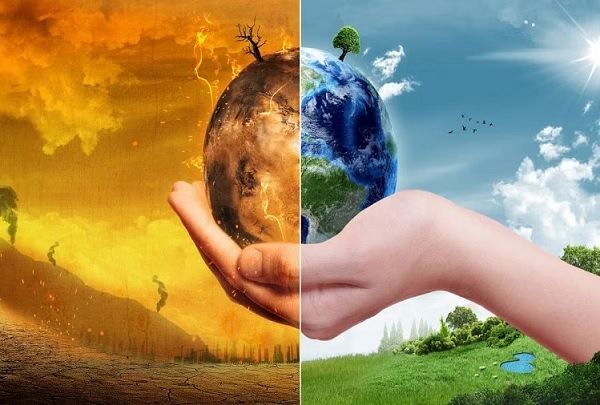
London/Geneva. The world is rapidly moving towards a deepening climate crisis. Recent scientific studies warn that if greenhouse gas emissions continue at the current pace, global temperature rise could exceed the critical limit of 1.5 degrees Celsius by 2030. Scientists say that it can have a serious impact on the ocean, agriculture, food security, biodiversity, economy and human health.
According to experts, the Earth is warming faster than before and anthropogenic activities are the main reason behind this. The increasing use of fossil fuels, industrial carbon emissions and large-scale deforestation have made the situation more serious.
-
Read this also MP: Heavy rain and storm expected in 35 districts, heat will scorch Gwalior-Chambal
Earth System Science Data According to a study published in, the average temperature of the Earth in the year 2025 will be recorded about 1.39 degrees Celsius higher than the level before the industrial era. Scientists believe that this additional increase in temperature is entirely linked to human activities. Also, in the last few years, the pace of temperature rise has become faster as compared to earlier decades.
For this reason, the possibility of crossing the 1.5 degree Celsius limit is now considered stronger than before. took place in the year 2015 Paris Agreement Under this, the world’s countries had set a goal of keeping the temperature rise below 2 degrees Celsius and, if possible, limiting it to 1.5 degrees, so that the most serious effects of climate change can be prevented.
Rising sea level is increasing danger
The study reports that global sea level has risen by approximately 23 centimeters since 1901. Due to this, the danger to the coastal areas is continuously increasing. Due to increase in sea temperature, the incidence of marine heatwaves has also increased rapidly, the effect of which is clearly visible on coral reefs, fishes and marine biodiversity. According to scientists, the number of sea heat days has more than tripled compared to 1991.
Big challenge before the world
Experts say increasing heat, sea level rise and extreme weather events are now being felt in almost every part of the world. Although scientists believe that the situation can still be prevented from worsening, but this will require countries to sharply cut greenhouse gas emissions, strengthen climate monitoring mechanisms and move rapidly towards clean energy.
-
Brazil 2026 FIFA World Cup Kits: Home and Away Designs, Launch Dates & Prices

-
When will Neymar’s World Cup campaign begin? Latest injury update as Brazil prepare to face Morocco under Carlo Ancelotti

-
From Bukayo Saka’s Fitness Concerns to Jude Bellingham’s Pressure: Six Reasons Why England May Fall Short at the World Cup

-
Former Arsenal star Sead Kolasinac pulls off stunning goal-line save in Canada clash

-
Swiss to vote on whether to cap population at 10 million