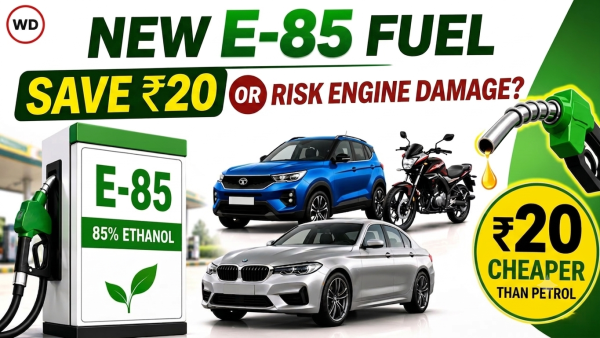
In Delhi, E-85 is priced at approximately Rs. 82.12 per litre, compared to around Rs. 102.12 per litre for E20 petrol. But while the lower price tag is attractive, motorists need to understand whether their vehicles are compatible before making the switch.
What Is E-85 Fuel?
E-85 is a high-ethanol fuel blend containing around 80-85% ethanol and 15-20% petrol. It is part of India's broader ethanol-blending initiative aimed at reducing crude oil imports, lowering emissions, and promoting the use of renewable fuels.
The government plans to make E-85 available at around 500 fuel stations by 2026 and nearly 5,000 petrol pumps by 2027. Currently, the fuel is available at 48 outlets.
Benefits of E-85 Fuel
Lower Fuel Prices
The biggest attraction of E-85 is its cost. At roughly Rs. 20 less per litre than E20 petrol, it has the potential to reduce fuel expenses for eligible vehicle owners.
Environment-Friendly Alternative
E-85 produces significantly lower greenhouse gas emissions than conventional petrol. Some studies suggest emissions could be reduced by as much as 50-60%, making it a greener fuel option.
Boost for Farmers
Since ethanol is produced from sugarcane, maize, and other agricultural products, increased demand can create additional income opportunities for farmers and support the rural economy.
Reduced Oil Imports
Expanding ethanol usage can help India reduce its dependence on imported crude oil, strengthening the country's energy security.
The Biggest Challenge: Lower Mileage
Despite its lower price, E-85 has a drawback. Ethanol contains less energy than petrol, which means vehicles typically deliver 25-30% lower fuel efficiency when running on E-85.
As a result, drivers should compare the cost per kilometre rather than simply looking at the price per litre. While the fuel is cheaper, the reduction in mileage may offset some of the savings.
Which Vehicles Can Use E-85?
This is the most important point for vehicle owners. E-85 can only be used in Flex-Fuel Vehicles (FFVs).
If your vehicle is not designed for E-85, it may face several issues:
1. Fuel System Corrosion
Ethanol can be more corrosive than petrol and may damage certain rubber seals, fuel lines, and metal components.
2. Reduced Fuel Efficiency
Ethanol contains less energy per litre than petrol. As a result, vehicles running on E-85 often consume more fuel to travel the same distance.
3. Cold Start Problems
In colder conditions, E-85 may make starting the engine more difficult compared to conventional petrol.
4. Increased Wear on Fuel Components
Fuel pumps, injectors, and other components may experience additional stress if they are not designed for high-ethanol blends.
Why Are Flex-Fuel Vehicles Different?
Flex-fuel vehicles are specially engineered to handle fuels with high ethanol content. Their fuel tanks, pipes, injectors, seals, and engine management systems are designed to withstand ethanol concentrations of up to 85% or even 100%.
Standard petrol vehicles do not have these modifications, making them unsuitable for E-85 fuel.
Flex-Fuel Vehicles Available in India (As of 2026)
Several manufacturers have already started introducing flex-fuel models:
- Maruti Suzuki WagonR Flex Fuel – India's first flex-fuel car.
- Hero MotoCorp Splendor+ Flex Fuel – Expected to be available from July 2026.
- Hero HF Deluxe Flex Fuel – Expected from July 2026.
More automakers are expected to launch flex-fuel models in the coming years.
Vehicles That Should NOT Use E-85
The following vehicles are generally not compatible with E-85:
- Most existing petrol cars, including many E20-compliant models.
- Older motorcycles and scooters.
- Most conventional two-wheelers.
- All diesel vehicles.
Using E-85 in incompatible vehicles may lead to fuel-system corrosion, engine damage, reduced performance, and even warranty issues.
Is E-85 Really Cheaper?
The answer depends on your vehicle and driving habits.
Although E-85 costs around Rs. 20 less per litre, its lower mileage means the actual savings vary. For flex-fuel vehicle owners who drive long distances regularly, E-85 could still provide meaningful cost benefits.
The government has priced the fuel keeping this mileage difference in mind.
Government's Long-Term Plan
India has already rolled out E20 fuel nationwide and is now moving toward higher ethanol blends.
Key goals include:
- Expanding E-85 availability across the country.
- Increasing overall ethanol blending levels to around 26% by 2030-31.
- Encouraging manufacturers to develop more flex-fuel vehicles.
- Reducing carbon emissions and crude oil imports.
E-85 fuel represents a significant step toward cleaner and more sustainable transportation in India. It offers lower fuel prices, reduced emissions, and greater energy independence.
However, the fuel is currently beneficial only for owners of flex-fuel vehicles. Drivers of conventional petrol or diesel vehicles should avoid using E-85, as it can damage the engine and fuel system.
As more flex-fuel cars and motorcycles enter the market, E-85 is expected to become a more practical and widely used fuel option. If you're planning to buy a new vehicle in the coming years, considering a flex-fuel model could help you take advantage of the growing ethanol fuel ecosystem.
-
Zojila Tunnel Breakthrough Paves Way For All-Weather Access To Ladakh From Kashmir

-
'As Long As Didi Is There’: TMC MP Dev Breaks Silence On Exit Speculation

-
Amit Shah Launches Digital Platform to Modernize Land Ports in India

-
Call for Independent Investigation into Malviya Nagar Fire Incident

-
Court Seeks CBI Response on NEET-UG Paper Leak Bail Request