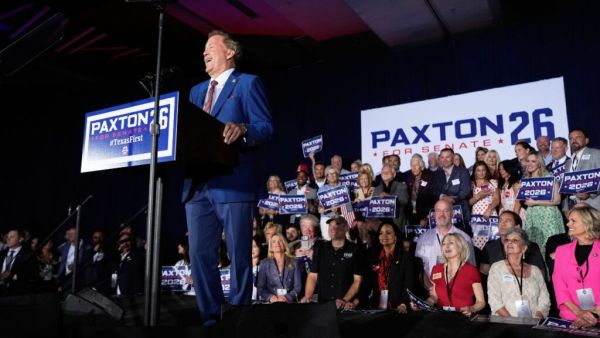
In a stunning political upset that could reshape the future of the Republican Party, Texas attorney general Ken Paxton has defeated four-term Senator John Cornyn in the state’s Republican Senate primary runoff. The result marks a major triumph for the MAGA wing of the party over its old establishment leadership and underlines the continuing dominance of President Trump within Republican politics.
Paxton, a hardline conservative who built his campaign on populist fury and an unshakeable allegiance to Trump, pulled off something few had thought possible: bringing down one of the most powerful figures in Texas Republican politics. Cornyn had given 23 years to Congress and climbed to the senior ranks of Senate leadership. That counted for precious little in a party that has steadily drifted towards devotion to Trump.
The Texas race was one of the bitterest and most expensive fights of the ongoing election cycle. It also exposed the widening divide inside the Republican Party between traditional conservatives and the Trump-aligned movement that now dominates its grassroots base.
Although both candidates shared broadly conservative voting records, they represented very different styles of Republican politics. Cornyn embodied the older, business-friendly and institutional wing of the Texas GOP. Over the years, he cultivated a reputation as a pragmatic lawmaker willing to negotiate and govern. But in the modern Republican Party, compromise has become politically dangerous. Cornyn’s role in helping negotiate a bipartisan gun safety bill after the 2022 Uvalde school massacre became a major liability among MAGA voters, many of whom viewed the move as a betrayal of conservative principles.
Paxton, by contrast, campaigned as an anti-establishment warrior. Supporters often described him as “Trump before Trump”, reflecting his long history of confrontational politics and legal battles against Democratic administrations. As Texas attorney general, Paxton launched lawsuits over abortion restrictions, immigration policies, gender-affirming care and the results of the 2020 presidential election.
While Cornyn voted to certify Joe Biden’s victory in 2020, Paxton’s relentless defence of Trump became the defining feature of his campaign. In the end, that loyalty proved decisive.
What makes Paxton’s landslide victory particularly remarkable is that he survived political scandals that would normally destroy a candidate’s career. In 2023, Paxton was impeached by the Republican-controlled Texas House on allegations of corruption and abuse of office, though he was later acquitted by the state Senate. He also faced a long-running felony securities fraud indictment and intense public scrutiny surrounding his personal life after his wife filed for divorce, citing adultery.
Yet none of it significantly weakened his standing with Republican primary voters. Many either dismissed the controversies or viewed them as politically motivated attacks from enemies of the conservative movement. For large sections of the Republican base, Paxton’s aggressive legal fights against the Obama and Biden administrations outweighed concerns about ethics or personal conduct.
The scale of Cornyn’s defeat also demonstrated the declining power of money and establishment networks in Republican primaries shaped by Trump-era politics.
The contest became the most expensive Senate primary campaign in American history, with roughly $128 million spent on advertising. Cornyn and allied super PACs poured more than $90 million into the race, vastly outspending Paxton. Television screens across Texas were flooded with attack advertisements portraying Paxton as corrupt, unethical and unelectable.
But the spending barrage failed to break Paxton’s connection with grassroots conservative voters. The race showed that financial superiority alone can no longer guarantee victory inside a Republican Party driven increasingly by populist energy and ideological identity.
Ultimately, the decisive factor was Trump himself. After the initial March primary left Cornyn narrowly ahead of Paxton, both candidates aggressively sought Trump’s endorsement. Cornyn made repeated attempts to win over the president, including supporting symbolic gestures such as proposals to name infrastructure after him.
But only a week before the runoff, Trump endorsed Paxton, which transformed the race almost overnight. Counties that had previously backed Cornyn flipped decisively towards Paxton in the runoff, illustrating Trump’s ability to shape Republican voting behaviour. Trump framed his support in personal terms, accusing Cornyn of failing to stand by him “when times were tough”. The Texas result reflects a wider pattern across the Republican Party, where Trump-backed challengers have increasingly targeted sitting lawmakers seen as insufficiently loyal to the MAGA movement.
Cornyn’s defeat reflects a broader wave of political retribution orchestrated by Trump, who has successfully weaponised his endorsements to oust establishment Republicans deemed insufficiently loyal. Just weeks before the Texas primary, Louisiana Senator Bill Cassidy—who voted to convict Trump during his 2021 impeachment—failed to even advance to his state’s runoff after Trump endorsed his challengers. Similarly, in Kentucky, Representative Thomas Massie was ousted by Trump’s handpicked candidate, Ed Gallrein, after Massie clashed with the president over foreign policy. This ongoing purge has also claimed several incumbent lawmakers in Indiana and Georgia, proving that traditional conservative tenure offers virtually no protection against Trump’s total dominance over the Republican base.
While Paxton’s victory thrilled the Republican base, it also triggered anxiety among establishment conservatives who fear he could endanger a Senate seat that Republicans normally consider safe.
Paxton will now face Democratic state Representative James Talarico in the November general election. Democrats believe Paxton’s long list of scandals and ethical controversies could alienate suburban moderates, independents and college-educated Republican voters, particularly women.
Talarico has already moved quickly to define the race as a referendum on corruption and integrity. A former public school teacher and Presbyterian seminarian, he has emerged as one of the Democratic Party’s most promising young figures in Texas politics. His campaign has raised more than $40 million, giving Democrats unusual optimism about competing seriously in a state they have failed to win at the statewide level since 1994.
The Democrat has framed the election as “The People vs. Ken Paxton”, repeatedly branding his opponent “the most corrupt politician in America”. His strategy aims to contrast Paxton’s scandals with a message focused on morality, faith and economic frustration, particularly around affordability and cost-of-living concerns.
Paxton, meanwhile, has begun portraying Talarico as a dangerous progressive. Republicans are expected to focus heavily on some of Talarico’s past statements on religion and gender issues in an effort to energise conservative voters.
The consequences of the primary extend far beyond Texas. Republicans may now be forced to spend heavily defending a Senate seat in a state that was never expected to become competitive. That could divert valuable financial resources away from other battleground races across the country as both parties fight for control of the Senate.
Whether Texas will remain firmly Republican or emerge as a genuine electoral battleground is uncertain. But one conclusion from the primary is unmistakable. In today’s Republican Party, loyalty to Trump and the MAGA movement has become more important than seniority, institutional influence or traditional conservative pragmatism.
-
‘Won’t contest elections if…’: Ponguleti challenges KTR over Indiramma houses

-
Karnataka CM Siddaramaiah may resign in one or two days

-
AHINDA groups warn Congress against removing Siddaramaiah as Karnataka CM

-
Celebrations in Ramanagara as DKS supporters cheer possible CM elevation

-
Farmers protest after Muslims boycott cow slaughter in Karnataka’s Hassan