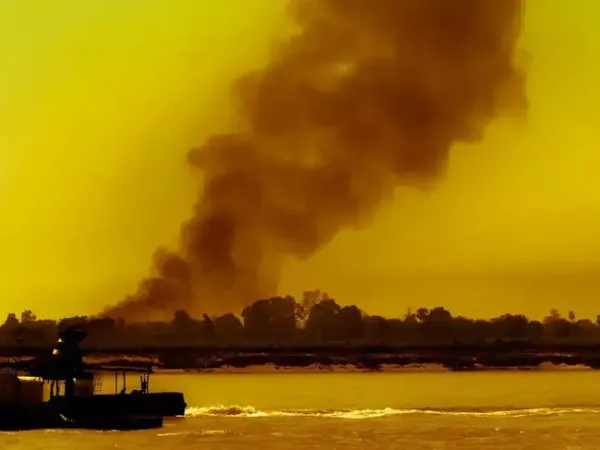
Pollution levels in North India and the Himalayas have risen sharply
New Delhi: The overall particulate matter pollution in the Indo-Gangetic Plain, the Himalayan region, and North-East India increased by more than 20 per cent during the 2010-2019 period compared to the 2000-2009 baseline, according to a new study.
It also revealed that in the eastern Indo-Gangetic Plain, carbonaceous aerosols, particles from the burning of crop residue, wood, and other organic material, showed strong and increasing trends between 2000 and 2024 (the period the study analysed).
According to the study, the sharp rise in particulate matter (PM) in North-East India is attributed to intensified slash-and-burn agricultural practices and extensive use of biomass for domestic energy in rural households during this period.
The study, "Decadal shifts in aerosol hotspots and source attribution over IGP, north-east India and Himalayas: A 25-year (2000-2024) study", was published in the journal Atmospheric Environment and released on Monday.
In a statement, Abhijit Chatterjee, co-author of the study and professor at the Bose Institute in Kolkata, said, "The eastern Indo-Gangetic Plain, and increasingly North-East India, are carrying a disproportionate pollution burden and it is being driven almost entirely by biomass burning. That is the signal that stands out most clearly across 25 years of data."
The analysis also found that IGP emissions are reaching the Himalayas.
While pollution from Punjab and Delhi affects the western ranges, emissions from Bihar and West Bengal influence the eastern Himalayas.
Soumen Raul, a senior research fellow at the Bose Institute, in a statement, said, "Our trajectory analysis shows that what is emitted in Punjab or Bihar does not stay there. It travels into the mountains. These are ecologically and climatically sensitive zones, and they are currently outside the scope of any structured clean air intervention in India."
It also revealed that in the eastern Indo-Gangetic Plain, carbonaceous aerosols, particles from the burning of crop residue, wood, and other organic material, showed strong and increasing trends between 2000 and 2024 (the period the study analysed).
According to the study, the sharp rise in particulate matter (PM) in North-East India is attributed to intensified slash-and-burn agricultural practices and extensive use of biomass for domestic energy in rural households during this period.
The study, "Decadal shifts in aerosol hotspots and source attribution over IGP, north-east India and Himalayas: A 25-year (2000-2024) study", was published in the journal Atmospheric Environment and released on Monday.
In a statement, Abhijit Chatterjee, co-author of the study and professor at the Bose Institute in Kolkata, said, "The eastern Indo-Gangetic Plain, and increasingly North-East India, are carrying a disproportionate pollution burden and it is being driven almost entirely by biomass burning. That is the signal that stands out most clearly across 25 years of data."
The analysis also found that IGP emissions are reaching the Himalayas.
While pollution from Punjab and Delhi affects the western ranges, emissions from Bihar and West Bengal influence the eastern Himalayas.
Soumen Raul, a senior research fellow at the Bose Institute, in a statement, said, "Our trajectory analysis shows that what is emitted in Punjab or Bihar does not stay there. It travels into the mountains. These are ecologically and climatically sensitive zones, and they are currently outside the scope of any structured clean air intervention in India."