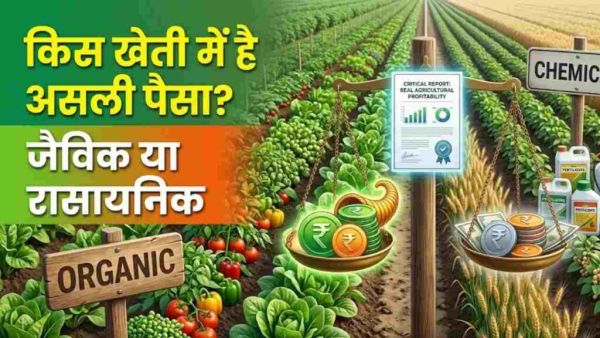
Organic vs Chemical farming cost comparison: In today’s era, when the cost of farming is continuously skyrocketing, the country’s food provider has come to a very serious and tough crossroads. Today only one question is echoing in the mind of every farmer that where is the ‘real money’? Is it in traditional chemical farming, which once created record production during the Green Revolution era, or in the emerging organic model, which today the whole world is considering as the new standard of health and sustainability?
From the perspective of a grassroots reporter, this is not just a fight for bumper yields, but a fight for ‘net profits’ directly in your pocket and the long-term prosperity of the land.
The attraction of chemical farming and its hidden truth
The biggest attraction of chemical farming is its ‘instant growth’ i.e. immediately visible results. By spraying urea, DAP and chemical pesticides in the fields, crops grow very fast. Seeing this lush green blanket of fields, the farmer immediately gets mental satisfaction. This method has always been a safe and tried and tested option for traditional farmers who have been farming in the same manner for decades.
But behind this immediate shine lies a bitter and worrying reality. The indiscriminate use of chemicals has gradually sapped away the natural vitality and vigorous fertility of our soil.
Bitter reality of soil: Today the ground situation is such that every next year the farmer has to apply more expensive fertilizers and medicines than before. The direct result of this is that the input cost of farming is continuously increasing and the profit margin of the farmer is continuously shrinking. Also, these dangerous chemicals are not only making our land barren but are also poisoning the food reaching human plates.
Organic farming: a new economic model of self-reliance and savings
On the other hand, organic and natural farming is no longer just a hobby of some people, but has emerged as a very practical and strong economic model. The biggest strength of organic farming is its ‘low-cost’ strategy.
In this method, farmers are not dependent on expensive chemical fertilizers available from the market and pesticides from foreign companies. Instead, he prepares the best nutrition and strong protective shield for the crops from the natural resources available in his home and farm itself – like desi cow dung, cow urine, vermicompost, jeevamrit and neem leaves. When your financial dependence on the market is completely eliminated or reduced to zero, the extravagance out of pocket automatically stops. It is this hidden savings which manifests as huge and ‘net profit’ of the farmer at the end of the season.
Chemical vs. Organic Farming: The stark difference at a glance
| Farming Scale (Parameters) | Chemical Farming | Organic Farming |
| Input Cost | extremely high due to fertilizers, seeds and pesticides | Very minimal or zero due to household resources |
| Soil Health | Due to continuous chemical use the land gradually becomes barren. | Earthworms and organic matter make the soil more fertile. |
| Production | High in early years, but stable or decreasing later | Long-term sustainable production after initial decline |
| Market Price | General Government Mandi Rate or Minimum Support Price (MSP) | 1.5 to 2 times premium price in cities and export markets |
Main challenges of organic farming and test of patience
Of course, the path of organic farming also has its own practical challenges, which cannot be ignored. Its biggest and toughest challenge is its ‘transition period’.
When organic supplements are suddenly given to soil that has been accustomed to chemical fertilizers and medicines for decades, a partial decline in crop yields can be seen in the first two to three years. This is the time when both the farmer’s patience and his steadfastness are severely tested. Additionally, the organic method requires more physical effort and regular monitoring, as you have to prepare everything from organic fertilizers to pest control potions with your own hands. But the progressive farmers who overcome this difficult phase of initial 2-3 years, prove to be the horses of long race in future.
Premium Marketing: Real money will come from proper branding of produce
If we understand the mathematics of profit a little deeper, the total production in chemical farming may appear high in terms of quintals, but the huge investment that is done to achieve that production in the form of tractors, electricity, water, expensive fertilizers and pesticides, ultimately reduces the net profit of the farmer.
In contrast, organic produce has a firm and premium quality of its own. Today, in big cities, modern malls and international markets, a large class of health-conscious consumers has emerged, who are happily ready to pay higher than normal prices for pure and chemical-free grains, fruits and vegetables without any bargaining. If the farmer directly connects with these stores or customer base, he can charge arbitrary and fantastic prices for his crop.
Conclusion: Leaving the crutch of chemicals is the only bright future
Ultimately, the real and hard profits of modern farming cannot be measured just by how many quintals of grain you produce, but by how well you keep your farm costs to a minimum and how well you brand your crop.
If today’s Indian farmer breaks out of the traditional box and develops some understanding of digital marketing, directly associates himself with consumer groups or organic startups, then organic farming can provide him many times more net economic benefits than chemical farming, a debt-free life and a better standard of living. The future definitely belongs to that visionary farmer, who will learn to trust the real strength of his soil, leaving behind this artificial crutch of chemicals.
-
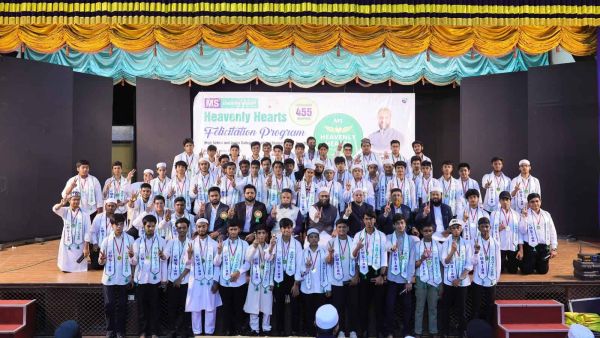
MS Education Academy felicitates 466 orphan students for SSC, inter success
-
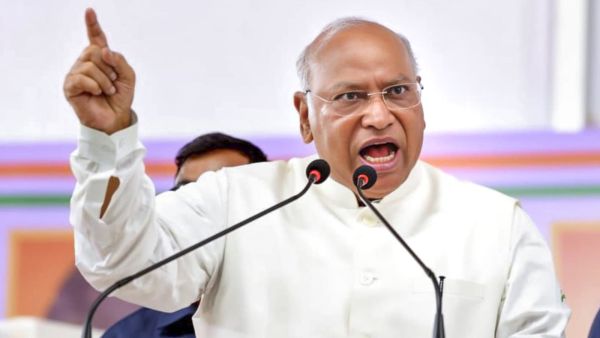
When crude oil prices fell, why did petrol, diesel become more expensive: Kharge
-
No forceful possession of Delhi Gymkhana Club land on June 5: Solicitor General

-
Cockroach Janta Party founder moves Delhi HC against blocking of X handle

-
Divyanka Tripathi, Vivek Dahiya welcome twins: ‘Mere Karan Arjun aagaye’