For many Indians living in the UK, the arrival of mango season is more than just a food trend, it is pure nostalgia packed inside a cardboard box.
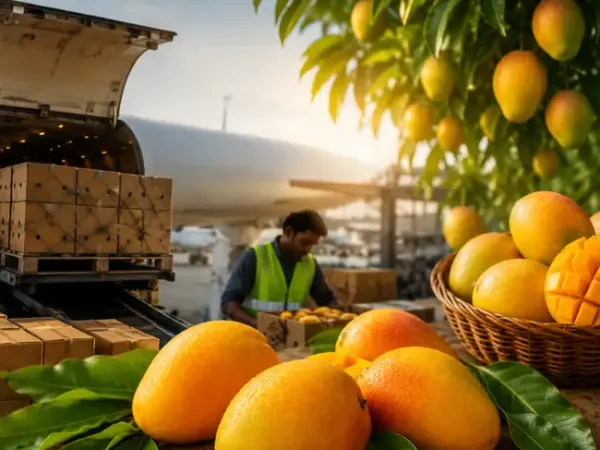
Every year, crates of Kesar and Alphonso mangoes flown in from Gujarat land at Heathrow Airport, and according to importer Digvijaysinh Gohil, the scent alone instantly grabs attention.
Read more: Anand Mahindra is impressed by this Jaipur technique
“When the cargo doors open at London’s Heathrow Airport and the boxes of Kesar and Alphonso mangoes arriving from Gujarat are unloaded, their fragrance wafts across the entire cargo area, making you feel immensely proud as an Indian,” Gohil said.
Based in England, Gohil travels to Gujarat personally every year to supervise mango purchases and exports.
Kesar Mangoes Are Becoming A Favourite Beyond The Indian Community
While Indian families in cities like London, Leicester and Birmingham eagerly wait for mango season every year, the craze is no longer limited to the Indian diaspora.
Gohil said even British and European consumers are now developing a taste for premium Indian mangoes, especially Gujarat’s famous Kesar variety and Maharashtra’s Alphonso mangoes.
“For the Gujaratis and Indians living in London, Leicester, and Birmingham, this is not just a fruit, it is a tangible memory of their homeland. People are willing to buy them regardless of the price. Now, even European consumers have developed a taste for Indian mangoes,” he explained.
He also claimed that although mangoes are grown across the world, the sweetness and aroma of Indian Kesar and Alphonso varieties remain unmatched.
Why Indian Mangoes Stand Out In Global Markets
According to exporters, mangoes from countries such as Brazil, Peru and parts of South America may look attractive from the outside, but often lack flavour.
Indian Kesar mangoes, on the other hand, are known for their rich sweetness, strong fragrance and deep saffron-coloured pulp.
The fruit is sourced only from orchards certified by Agricultural and Processed Food Products Export Development Authority (APEDA), after which it goes through strict scientific processing before export.
Inside Gujarat’s High-Tech Mango Export System
At APEDA-approved facilities such as Kunj Cold Ware Solution Pack House in Rajkot’s Kuvadava area, mangoes are carefully cleaned, sorted and prepared for international markets including the UK, USA, UAE, Australia and Canada.
Pack house owner Sameer Sapariya explained, “We handle the entire export processing pipeline at our pack house. We process and pack mangoes customised to the specific requirements of the USA, UK, UAE, Australia, Canada, European countries, and the Gulf nations.”
He added that different countries require different treatment methods before the fruit can be exported.
For example, mangoes sent to the United States undergo specialised hot water treatment, while exports to the UK and Canada combine hot water treatment with controlled ripening processes.
How Mangoes Are Prepared Before Export
The process begins early in the morning when ripe mangoes are carefully picked from APEDA-registered orchards in places like Junagadh, Talala and Kutch.
Workers make sure the fruit does not get bruised during harvesting, as even minor damage can affect export quality.
Once the mangoes reach the pack houses, they go through a process called desapping, where excess sap is completely drained to improve shelf life.
The fruits are then sorted based on size, shape, colour and weight, while damaged or blemished mangoes are removed.
One of the most important stages is hot water treatment, where raw mangoes are dipped in water heated between 48°C and 52°C.
This treatment helps kill harmful fungi, fruit fly larvae and bacteria that could spoil the fruit during transport.
Immediately afterwards, the mangoes are rapidly cooled using chilled water to preserve freshness and maintain firmness.
Gujarat Farmers Now Eye Bigger Global Exports
Exporters believe Gujarat’s agricultural exports are only going to grow from here.
With the same cold-chain and pack house infrastructure already in place, farmers are now preparing to export vegetables such as okra, bitter gourd, ridge gourd and green chillies to western markets later this year.
Sapariya believes the success of Kesar mangoes proves that Indian farmers can compete globally when quality farming is backed by proper technology.
“When a product possesses genuine quality and is backed by modern technology, it achieves global recognition. The Kesar mango, born in the orchards of Gir and Kutch, has successfully transformed into an elite global brand through the power of cold-chain technology,” he said.
Inputs from ANI
Every year, crates of Kesar and Alphonso mangoes flown in from Gujarat land at Heathrow Airport, and according to importer Digvijaysinh Gohil, the scent alone instantly grabs attention.
Read more: Anand Mahindra is impressed by this Jaipur technique
“When the cargo doors open at London’s Heathrow Airport and the boxes of Kesar and Alphonso mangoes arriving from Gujarat are unloaded, their fragrance wafts across the entire cargo area, making you feel immensely proud as an Indian,” Gohil said.
Based in England, Gohil travels to Gujarat personally every year to supervise mango purchases and exports.
Kesar Mangoes Are Becoming A Favourite Beyond The Indian Community
While Indian families in cities like London, Leicester and Birmingham eagerly wait for mango season every year, the craze is no longer limited to the Indian diaspora.Gohil said even British and European consumers are now developing a taste for premium Indian mangoes, especially Gujarat’s famous Kesar variety and Maharashtra’s Alphonso mangoes.
“For the Gujaratis and Indians living in London, Leicester, and Birmingham, this is not just a fruit, it is a tangible memory of their homeland. People are willing to buy them regardless of the price. Now, even European consumers have developed a taste for Indian mangoes,” he explained.
He also claimed that although mangoes are grown across the world, the sweetness and aroma of Indian Kesar and Alphonso varieties remain unmatched.
Why Indian Mangoes Stand Out In Global Markets
According to exporters, mangoes from countries such as Brazil, Peru and parts of South America may look attractive from the outside, but often lack flavour.Indian Kesar mangoes, on the other hand, are known for their rich sweetness, strong fragrance and deep saffron-coloured pulp.
The fruit is sourced only from orchards certified by Agricultural and Processed Food Products Export Development Authority (APEDA), after which it goes through strict scientific processing before export.
Inside Gujarat’s High-Tech Mango Export System
At APEDA-approved facilities such as Kunj Cold Ware Solution Pack House in Rajkot’s Kuvadava area, mangoes are carefully cleaned, sorted and prepared for international markets including the UK, USA, UAE, Australia and Canada.Pack house owner Sameer Sapariya explained, “We handle the entire export processing pipeline at our pack house. We process and pack mangoes customised to the specific requirements of the USA, UK, UAE, Australia, Canada, European countries, and the Gulf nations.”
He added that different countries require different treatment methods before the fruit can be exported.
For example, mangoes sent to the United States undergo specialised hot water treatment, while exports to the UK and Canada combine hot water treatment with controlled ripening processes.
How Mangoes Are Prepared Before Export
The process begins early in the morning when ripe mangoes are carefully picked from APEDA-registered orchards in places like Junagadh, Talala and Kutch.Workers make sure the fruit does not get bruised during harvesting, as even minor damage can affect export quality.
Once the mangoes reach the pack houses, they go through a process called desapping, where excess sap is completely drained to improve shelf life.
The fruits are then sorted based on size, shape, colour and weight, while damaged or blemished mangoes are removed.
One of the most important stages is hot water treatment, where raw mangoes are dipped in water heated between 48°C and 52°C.
This treatment helps kill harmful fungi, fruit fly larvae and bacteria that could spoil the fruit during transport.
Immediately afterwards, the mangoes are rapidly cooled using chilled water to preserve freshness and maintain firmness.
Gujarat Farmers Now Eye Bigger Global Exports
Exporters believe Gujarat’s agricultural exports are only going to grow from here.With the same cold-chain and pack house infrastructure already in place, farmers are now preparing to export vegetables such as okra, bitter gourd, ridge gourd and green chillies to western markets later this year.
Sapariya believes the success of Kesar mangoes proves that Indian farmers can compete globally when quality farming is backed by proper technology.
“When a product possesses genuine quality and is backed by modern technology, it achieves global recognition. The Kesar mango, born in the orchards of Gir and Kutch, has successfully transformed into an elite global brand through the power of cold-chain technology,” he said.
Inputs from ANI