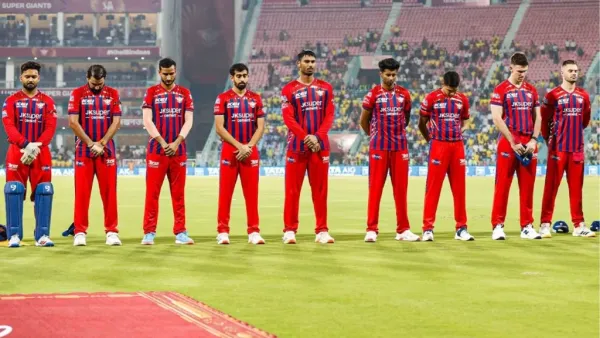
Lucknow Super Giants did not just finish last in IPL 2026, they finished last after building a squad that was supposed to look powerful on paper and ruthless on the field. That is why this season feels heavier than a normal bad campaign.
Four wins, ten defeats, and a tenth-place finish would embarrass any franchise, but for LSG it raises deeper questions because this was meant to be the beginning of the Rishabh Pant era.
Sparks were there: Mitchell Marsh batted like the one man army, Josh Inglis arrived late and instantly exposed how much intent the batting order had been missing, and Prince Yadav gave a collapsing bowling unit some spine. But the season never came together.
By the end, Lucknow looked more like a franchise forced to confront the uncomfortable truth that money had bought names, not a working team.
What went wrong for LSG in IPL 2026
The biggest batting problem was intent. Mitchell Marsh was the only regular top-order batsman who consistently played at a modern T20 tempo. Around him, the innings often became heavy. Pant scored 312 runs in 14 matches at a strike rate of 138.05, with only one fifty.
Those are acceptable support-player numbers, not marquee captain numbers. As the ₹27 crore face of the franchise, he was expected to be the tempo-setter. Instead, he often became the tempo-blocker.
Nicholas Pooran’s season hurt even more. Pooran is one of the most destructive T20 batters in the world, but he produced only 234 runs in 14 matches at a strike rate of 127.87. He hit only 19 sixes all season. For a ₹21 crore player whose primary job is to change games in ten balls, that return is close to disastrous.
Aiden Markram was another issue. He made 231 runs in 12 matches at 138.32 without a fifty. That is not awful in isolation, but in this LSG batting order, it made the middle overs feel even slower. Abdul Samad also failed as a finisher, scoring only 116 runs in eight innings at 131.82.
Then Josh Inglis arrived and made the earlier batting choices look worse. He scored 266 runs in just five matches at a strike rate of 186.01, with three fifties. His timing, intent and clarity showed exactly what Lucknow had been missing. If he had been available earlier, the season may have looked different. But LSG also did not adapt quickly enough when he did arrive.
Bowling was equally messy. Avesh Khan leaked at 11.07 an over. Mayank Yadav went wicketless in four matches and conceded at 11.38. Mohammed Shami took 12 wickets but went at 9.00 and struggled in high-pressure phases. Digvesh Rathi got ten matches but averaged 79.40 with the ball. The death bowling was a recurring weakness and close games kept slipping away.
LSG’s best bowler was Prince Yadav, who took 16 wickets in 14 matches at an economy of 8.83. That is a great sign for the future, but also a damning comment on the expensive senior attack.
Full Lucknow Super Giants Player Ratings
1. Mitchell Marsh – 9.5/10
Marsh was the undisputed spine of LSG’s season. He scored 563 runs in 13 matches at an average of 43.31 and a strike rate of 163.19. He hit 51 fours and 36 sixes, with a highest score of 111. He was the only batsman who consistently combined volume with violence. When he fired, LSG looked like a proper T20 side. When he was absent late in the season, the top order looked hollow.
2. Josh Inglis – 9/10
Inglis played only five matches, but he was sensational. He scored 266 runs at an average of 53.20 and a strike rate of 186.01, with 32 fours, 12 sixes and three fifties. His best score was 85. He missed the first eight games due to prior commitments, but once he came in, he looked like a player LSG should build around. His short campaign was a serious selection lesson for the franchise.
3. Prince Yadav – 8/10
Prince was Lucknow’s biggest bowling positive. He played all 14 matches and finished as their leading wicket-taker with 16 wickets. His economy of 8.83 was respectable in a season where LSG’s bowling often collapsed around him. He showed composure, discipline and tactical maturity. For an uncapped domestic pacer to carry this much load in a bottom-placed side is impressive.
4. Mohsin Khan – 7.5/10
Mohsin’s season was limited by availability, but his impact was strong. In seven matches, he took 11 wickets at an economy of 8.14 and an average of 20.73. His 5/23 was LSG’s best bowling performance of the season. If fit, he remains one of the most important Indian pace options in this squad.
5. Mukul Choudhary – 6.5/10
Mukul was one of the better domestic batting finds. He scored 170 runs in 10 innings at an average of 28.33 and a strike rate of 141.67, with a highest score of 54. He offered middle-order composure and showed signs of development. He is not yet a finished IPL player, but there is enough to work with.
6. Mohammed Shami – 6/10
Shami took 12 wickets in 13 matches, but the control was not always there. His economy rate of 9.00 and bowling average of 38.25 showed how difficult the season became for him, especially at the death. There were flashes of the old Shami with the new ball, but LSG needed more from a ₹10 crore senior pacer.
7. Ayush Badoni – 5.5/10
Badoni scored 215 runs in 10 matches at a strike rate of 152.48, with a highest score of 54. His tempo was good, but his consistency was not. He had moments where he looked dangerous, followed by dismissals that stopped him from turning cameos into match-winning innings.
8. Shahbaz Ahmed – 5.5/10
Shahbaz had an odd season. With the bat, he made 58 runs in five matches at an average of 58 and a strike rate of 141.46, helped by unbeaten innings. With the ball, he took five wickets but went at 11.64 an over. That made him useful in theory but difficult to trust in practice.
9. Manimaran Siddharth – 5.5/10
Siddharth played four matches and took six wickets at an average of 24.17. His economy of 9.67 was high, but he did offer wickets in limited opportunities. He was used mainly as a matchup and powerplay option, and did enough to remain in squad discussions.
10. Himmat Singh – 5/10
Himmat made 92 runs in six matches at an average of 30.67 and a strike rate of 133.33. He brought some stability and stayed unbeaten twice, but he did not score quickly enough to change games. For a middle-order role, LSG needed more pressure on opposition bowlers.
11. Aiden Markram – 5/10
Markram scored 231 runs in 12 matches at an average of 25.67 and a strike rate of 138.32. His highest score was 45, and he failed to score a fifty. He was not terrible, but he was too flat for an overseas batter occupying a key role.
12. Abdul Samad – 4.5/10
Samad’s role was clear: finish innings with high intent. He did not do it until the last game vs PBKS. He scored 116 runs in eight innings at an average of 19.33 and a strike rate of 131.82. A top score of 37* is not enough for a designated finisher.
13. Akash Singh – 4/10
Akash played two matches and took four wickets, which looks useful, but his economy of 11.43 made him hard to carry. He showed wicket-taking instinct but lacked control.
14. George Linde – 4/10
Linde played three matches, scored 31 runs at 147.62 and took one wicket at an economy of 8.92. He did not get enough games to build a proper case, but he also did not make a strong enough all-round impact.
15. Akshat Raghuwanshi – 3.5/10
Akshat played three matches and scored 29 runs at a strike rate of 116.00. He looked short of rhythm and struggled to force his way into the tournament.
16. Nicholas Pooran – 3/10
Pooran’s campaign was one of LSG’s biggest failures. He scored 234 runs in 14 matches at an average of 18.00 and a strike rate of 127.87. For a batter retained at ₹21 crore, this is a brutal return. He never imposed himself, rarely cleared the ropes and repeatedly slowed LSG’s middle overs.
17. Rishabh Pant – 3/10
Rishabh Pant carries the heaviest accountability. He scored 312 runs in 14 matches at an average of 28.36 and a strike rate of 138.05, with a highest score of 68. But the bigger issue was his role. As captain and marquee signing, he needed to lead the batting tempo and decision-making. Instead, he looked burdened. His bowling changes often failed, and the team finished last.
18. Arshin Kulkarni – 3/10
Arshin played two matches and scored 17 runs at a strike rate of 68.00. It was a hard introduction and he looked rushed into a level he was not ready to dominate yet.
19. Arjun Tendulkar – 3/10
Arjun played one match, scored five runs and took one wicket while conceding at 9.00. It was a basic outing, not enough to judge long-term, but not enough to demand more chances either.
20. Digvesh Rathi – 2.5/10
Digvesh got ten matches but took only five wickets. His economy was 10.18 and his average was 79.40. That is a very poor return for someone given such an extended run.
21. Avesh Khan – 2/10
Avesh had a brutal season. He took six wickets in seven games at an economy of 11.07 and average of 45.50. His death bowling fell apart too often, and his price tag made the underperformance even louder.
22. Mayank Yadav – 2/10
Mayank was supposed to be the express pace weapon, but the season never got going. He played four matches, took no wickets and went at 11.38 an over. For an ₹11 crore investment, this was a major failure.
23. Anrich Nortje – 1/10
Nortje played only one match, took no wickets and went at 9.75. He was brought in for pace, but offered neither control nor threat.
What LSG must change for IPL 2027
First call is captaincy. Pant may still be worth backing as a batter, but the leadership burden looked too heavy this season. Removing him as captain could help him rediscover his natural batting freedom.
Second call is retention. LSG cannot keep paying premium prices for players who are not delivering premium output. Pant, Pooran, Mayank, Avesh and Samad alone represent nearly ₹72.95 crore in auction value. Even releasing some of them would give Lucknow huge flexibility.
Third call is overseas strategy. Marsh and Inglis should be central to the batting plan. Markram and Pooran cannot be automatic picks unless roles and form justify it.
LSG are not hopeless. LSG have Marsh, Inglis, Prince, Mohsin and a few domestic pieces worth developing. But they need a hard reset in leadership, bowling roles and auction thinking. IPL 2026 proved one thing clearly: LSG have money, but now they need courage.
-
Thieves steal gold ornaments from woman killed in accident near Kollur

-
Plea filed in SC seeking CBI probe against ‘Cockroach Janata Party’
-
Top 10 | ABP LIVE Evening Bulletin: Top News Headlines from 24 May 2026 - Evening

-
Lawyer moves SC against Cockroach Janta Party for allegedly misusing courts' observations for commercial purposes
-
IPL 2026 Memes: Hilarious Reactions from MI vs RR, Match 69 at Wankhede Stadium