The developments that came to light in the press briefing during the visit of Indian Prime Minister Narendra Modi to Norway have sparked a new debate regarding Indian politics, media and international journalism.
Jaydev Rathi, Advocate
Recently, the developments that came to light in a press briefing during the visit of Indian Prime Minister Narendra Modi to Norway have sparked a new debate regarding Indian politics, media and international journalism. The questions asked by Norwegian journalist Helle Ling, the reaction of Foreign Secretary CB George and then the political noise created on social media did not allow this entire matter to be limited to just one press conference. This controversy has now turned into bigger questions like ‘Journalism vs Agenda’, ‘Democracy vs Political Polarisation’ and ‘India’s Global Image’. During this program organized in Norway, the journalist raised questions about press freedom in India. It was told that Prime Minister Modi did not consider it appropriate to answer those questions and later Foreign Secretary Sibi George presented the Indian side. During this time the atmosphere became somewhat tense and the journalist left the press conference midway. This video quickly went viral on social media.
In democratic countries, asking questions to those in power is considered the basic religion of journalism. It is not unusual for any Prime Minister or Government to be asked questions on human rights, freedom of expression or democracy. America, Britain, France or India – in every democracy the media asks sharp questions to the government, so merely asking questions cannot be called wrong in itself, but the other side of this whole controversy is whether the question was asked out of impartial curiosity or with a preconceived notion? This is the point where the debate deepens.
The way the tone of questions was seen in the video, it felt more like accusations rather than merely seeking information. ‘Why trust India?’ Questions like these seemed more like political commentary than normal diplomatic dialogue. Critics say that if the objective of a journalist is less to hear answers and more to question the image of a country on the global stage, then journalism seems to go beyond the bounds of impartiality.
India’s supporters argue that the Western media has long held a special view of India. When India is gaining a strong position economically, strategically and globally, some international media organizations appear uneasy. For this reason, issues of democracy and human rights are raised selectively.
On the other hand, it is also true that the strength of a democracy lies in listening and responding to criticisms. Dismissing every question by merely calling it ‘foreign agenda’ also cannot be considered as healthy democratic thinking. Foreign Secretary Sibi George, while presenting India’s side in the press conference, said that India is a vibrant democracy, where the media is free and the people choose the government through regular elections. He also emphasized that India’s democratic institutions are strong.
His response was seen by many in India as ‘diplomatic firmness’. A large number of people on social media said Indian authorities responded with restraint and clarity. At the same time, some people believed that by answering such questions in more detail, India could have strengthened its position. The most interesting aspect of this controversy was the political reaction within India. The opposition and some intellectuals praised the journalist and said that in a democracy it is necessary to ask difficult questions to those in power. Whereas government supporters called it ‘anti-India mentality’.
A new trend has been seen in Indian politics in the last few years – the line between anti-government and anti-national is becoming blurred. Many times such statements or reactions come out against the government, which the general public starts considering as against the image of India. On the other hand, the pro-government class dismisses every criticism as ‘anti-national’. This polarization was clearly visible in this entire controversy also.
The question is whether the Indian opposition should support a foreign journalist when he questions India? From a democratic point of view, the job of the opposition is to criticize the government, but when the issue is to the country’s image on the international stage, then political balance is also expected. It has been seen in America, China, Russia or many countries of Europe that no matter how intense the internal politics may be, there is relative unity regarding national interests on international forums. This tradition still appears weak in India. (These are the personal views of the author.)
-
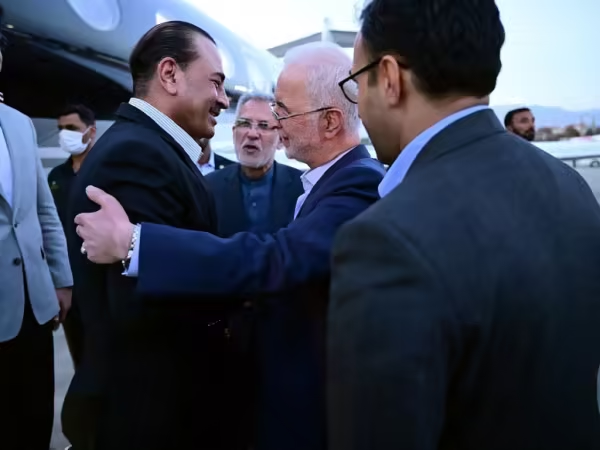
When will the US-Iran war end? Pakistani Army Chief Asim Munir suddenly arrived in Tehran, efforts for grand agreement in the Middle East intensified
-
Cannes waits for a winner

-
Buttermilk is a boon for hair, know how it makes hair healthy and shiny…

-
The Weekly Tarot Horoscope For May 25 – 31, 2026 Is Here With Your Zodiac Sign’s Reading

-
Which is Southeast Asia’s worst-rated dish?