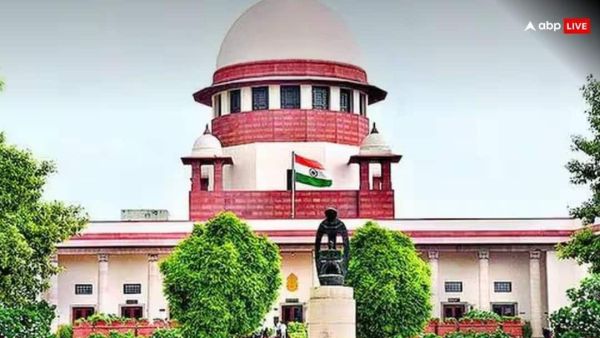
The Supreme Court on Friday questioned whether children from families that have already achieved educational and economic advancement through reservation should continue to avail benefits under the Other Backward Classes (OBC) quota.
“If both parents are IAS officers, why should they have reservations? With education and economic empowerment, there is social mobility. So then again to seek reservation for the children, we will never get out of it,” Justice BV Nagarathna observed during the hearing.
‘They Should Get Out Of Reservation’: Justice Nagarathna
The bench of Justices BV Nagarathna and Ujjal Bhuyan was hearing a petition challenging a Karnataka High Court judgment that upheld the exclusion of a candidate from reservation benefits on grounds of creamy layer status.
“That is a matter we have to be concerned about. Also, what is the use then? You are giving a reservation. The parents have studied, they are in good jobs, they are getting good income, and the children want reservation again. See, they should get out of reservation,” Justice Nagarathna said.
The court was hearing the case of a candidate belonging to the Kuruba community, classified under category II(A) among Karnataka’s backward classes, who had been selected for appointment as assistant engineer (electrical) in Karnataka Power Transmission Corporation Ltd under the reserved category.
Caste Validity Certificate Denied Over Creamy Layer Status
The District Caste and Income Verification Committee denied the candidate a caste validity certificate after concluding that he fell within the creamy layer category.
According to the authorities, the candidate’s family income was approximately Rs 19.48 lakh annually.
Officials noted that both parents were government employees and that their combined income exceeded the prescribed creamy layer threshold.
Court Raises Concerns Over Social Mobility
During the hearing, Justice Nagarathna repeatedly highlighted concerns that reservation benefits continued even after families had progressed socially and economically.
“There has to be some balance. Socially and educationally backward, yes, but once the parents have attained a level because of taking advantage of reservation, if they are both IAS officers, both are in government service, they are very well placed. Social mobility is there. Now they are questioning the exclusion. This also has to be kept in mind,” she said.
The judge also noted that the petitioner’s father was drawing a basic pay of Rs 53,900 per month, while the mother was drawing a basic pay of Rs 52,650 per month.
Lawyer Argues Salary Is Not Sole Criterion
Appearing for the petitioner, lawyer Shashank Ratnoo argued that salary income alone was not the determining factor for identifying creamy layer status among government employees.
He submitted that creamy layer exclusion depended on the status of parents, such as whether they belonged to Group A or Group B services, and not merely on salary income.
“If salary were treated as the sole criterion, even drivers, peons, clerks and other lower-ranking government employees could be excluded from reservation benefits,” he argued.
Ratnoo also contended that income from salary and agriculture could not be considered, and that only income generated through business or other sources should be taken into account.
He further said that divergent judicial views existed on the issue and that the matter required deeper examination.
Karnataka High Court Had Upheld Creamy Layer Exclusion
The petition stems from a Karnataka High Court division bench judgment that overturned an earlier single-judge order favouring the candidate.
The division bench held that the rule excluding salary income while determining creamy layer status applied only to reservations under the Union government and not to reservations in Karnataka.
Referring to Karnataka’s creamy layer policy, the High Court ruled that the candidate’s family income exceeded the applicable threshold and that he fell within the creamy layer category.
-
Tulsi Gabbard To Resign As Director Of National Intelligence: Here’s Why
-
UP Admin Goes Digital: 5.41 Lakh Employees Trained Under Mission Karmayogi
-
Angkrish Raghuvanshi RULED Out After Injury; KKR Suffer Big Blow In IPL 2026 Playoffs Race
-
NEET-UG 2026 Paper Leak: CBI Arrests Pune-Based Expert Manisha Havaldar, Accused of Leaking Physics Questions

-
Fake DigiLocker Website Using CISCE Name Detected Online; MeitY Issues Fake Website Alert