
Listen to this article in summarized format
Loading...
××
Subscribe to

Unlock AI Briefing and Premium Content
New Year Offer 24 Hours Left
Subscribe NowAlready a member? Sign In
What's Included
- Exclusive Stories
- Daily ePaper Access
- Smart Market Tools
- Curated Investment Ideas
- Ad-lite Experience
Subscription

At its annual accessibility preview, Apple announced a broad set of accessibility updates coming later this year across iPhone, iPad, Mac, Apple TV, and Apple Vision Pro. Many of the new features are powered by Apple Intelligence, the company’s on-device AI system, and focus on improving navigation, visual assistance, reading, hearing accessibility, and mobility support.
The updates include more detailed image descriptions in VoiceOver, natural language voice navigation, AI-generated subtitles for uncaptioned videos, and new eye-tracking controls for power wheelchair users on Apple Vision Pro.
For users who are blind or have low vision, Apple is adding more advanced visual understanding capabilities to VoiceOver and Magnifier.
VoiceOver’s new “Image Explorer” uses Apple Intelligence to provide richer descriptions of photos, scanned documents, bills, and other visual content. Users will also be able to ask follow-up questions about what appears in the camera viewfinder using natural language. Apple says this can be triggered quickly through the iPhone’s Action button.
Magnifier, which is designed for users with low vision, is also receiving AI-powered scene descriptions and spoken interaction support. Users can ask spoken questions such as what is in front of them, while voice commands like “zoom in” or “turn on flashlight” can control the app directly.
Apple is also updating Voice Control with more flexible natural language interaction for users with physical disabilities.
Instead of requiring users to memorise exact labels or numbered overlays, the system will now allow conversational commands such as “tap the purple folder” or “open the restaurant guide.” The feature is designed to work across apps including Maps and Files, and may also help in situations where app elements are not properly labelled for accessibility.
Accessibility Reader, Apple’s custom reading interface designed for users with dyslexia, low vision, and other reading disabilities, is being expanded to support more complex layouts including scientific articles, tables, and multi-column text.
New AI-powered summaries will allow readers to get a quick overview before reading full articles. Apple is also adding built-in translation support that preserves formatting, colours, and fonts while displaying content in the user’s preferred language.
One of the major additions announced is on-device generated subtitles for videos that do not already include captions.
The feature can automatically create subtitles for personal videos, clips shared by friends and family, or online streamed content. Apple says subtitle generation happens privately on-device using speech recognition and will work across iPhone, iPad, Mac, Apple TV, and Apple Vision Pro.
Users will also be able to customise subtitle appearance through playback settings.
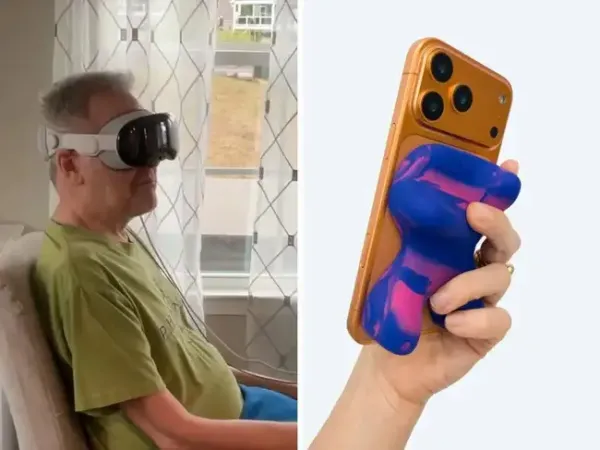
Apple is introducing a new accessibility feature for Apple Vision Pro that allows users to control compatible power wheelchairs using eye tracking.
The feature is aimed at users who cannot operate traditional joystick controls and instead rely on alternative drive systems. Apple says Vision Pro’s eye-tracking system works in varying lighting conditions without frequent recalibration.
At launch, the feature will support Tolt and LUCI alternative drive systems in the United States through Bluetooth and wired accessory support. Apple says it plans to expand compatibility with more wheelchair systems over time.
Apple also announced several smaller accessibility improvements across its ecosystem:
Apple also announced wider availability for the Hikawa Grip & Stand, an adaptive MagSafe accessory for iPhone designed for users with limited grip strength or mobility challenges.
The accessory, created by Los Angeles-based designer Bailey Hikawa in collaboration with PopSockets, is now available globally through Apple’s online store in three new colour options.
Apple says all of the newly announced accessibility features will roll out later this year as part of upcoming software updates.
The updates include more detailed image descriptions in VoiceOver, natural language voice navigation, AI-generated subtitles for uncaptioned videos, and new eye-tracking controls for power wheelchair users on Apple Vision Pro.
AI Enhancements Coming to VoiceOver and Magnifier
For users who are blind or have low vision, Apple is adding more advanced visual understanding capabilities to VoiceOver and Magnifier.
VoiceOver’s new “Image Explorer” uses Apple Intelligence to provide richer descriptions of photos, scanned documents, bills, and other visual content. Users will also be able to ask follow-up questions about what appears in the camera viewfinder using natural language. Apple says this can be triggered quickly through the iPhone’s Action button.
Magnifier, which is designed for users with low vision, is also receiving AI-powered scene descriptions and spoken interaction support. Users can ask spoken questions such as what is in front of them, while voice commands like “zoom in” or “turn on flashlight” can control the app directly.
Voice Control Gains Natural Language Navigation
Apple is also updating Voice Control with more flexible natural language interaction for users with physical disabilities.
Instead of requiring users to memorise exact labels or numbered overlays, the system will now allow conversational commands such as “tap the purple folder” or “open the restaurant guide.” The feature is designed to work across apps including Maps and Files, and may also help in situations where app elements are not properly labelled for accessibility.
Accessibility Reader Adds Summaries and Translation
Accessibility Reader, Apple’s custom reading interface designed for users with dyslexia, low vision, and other reading disabilities, is being expanded to support more complex layouts including scientific articles, tables, and multi-column text.
New AI-powered summaries will allow readers to get a quick overview before reading full articles. Apple is also adding built-in translation support that preserves formatting, colours, and fonts while displaying content in the user’s preferred language.
Automatic Subtitles for Uncaptioned Videos
One of the major additions announced is on-device generated subtitles for videos that do not already include captions.
The feature can automatically create subtitles for personal videos, clips shared by friends and family, or online streamed content. Apple says subtitle generation happens privately on-device using speech recognition and will work across iPhone, iPad, Mac, Apple TV, and Apple Vision Pro.
Users will also be able to customise subtitle appearance through playback settings.
Apple Vision Pro Adds Wheelchair Eye Controls
Apple is introducing a new accessibility feature for Apple Vision Pro that allows users to control compatible power wheelchairs using eye tracking.
The feature is aimed at users who cannot operate traditional joystick controls and instead rely on alternative drive systems. Apple says Vision Pro’s eye-tracking system works in varying lighting conditions without frequent recalibration.
At launch, the feature will support Tolt and LUCI alternative drive systems in the United States through Bluetooth and wired accessory support. Apple says it plans to expand compatibility with more wheelchair systems over time.
Additional Accessibility Updates Across Apple Devices
Apple also announced several smaller accessibility improvements across its ecosystem:
- Vehicle Motion Cues are coming to visionOS to help reduce motion sickness while using Apple Vision Pro in moving vehicles.
- Face gestures will allow Vision Pro users to perform taps and system actions without hand input.
- Larger text support is being added to tvOS for users with low vision.
- Name Recognition, which alerts deaf or hard of hearing users when someone says their name, is expanding to more than 50 languages.
- A new API will allow sign language interpretation apps to add interpreters directly into FaceTime calls.
- Support for the Sony Access controller is coming to iPhone, iPad, and Mac for users with limited mobility.
Adaptive MagSafe Accessory Expands Availability
Apple also announced wider availability for the Hikawa Grip & Stand, an adaptive MagSafe accessory for iPhone designed for users with limited grip strength or mobility challenges.
The accessory, created by Los Angeles-based designer Bailey Hikawa in collaboration with PopSockets, is now available globally through Apple’s online store in three new colour options.
Apple says all of the newly announced accessibility features will roll out later this year as part of upcoming software updates.