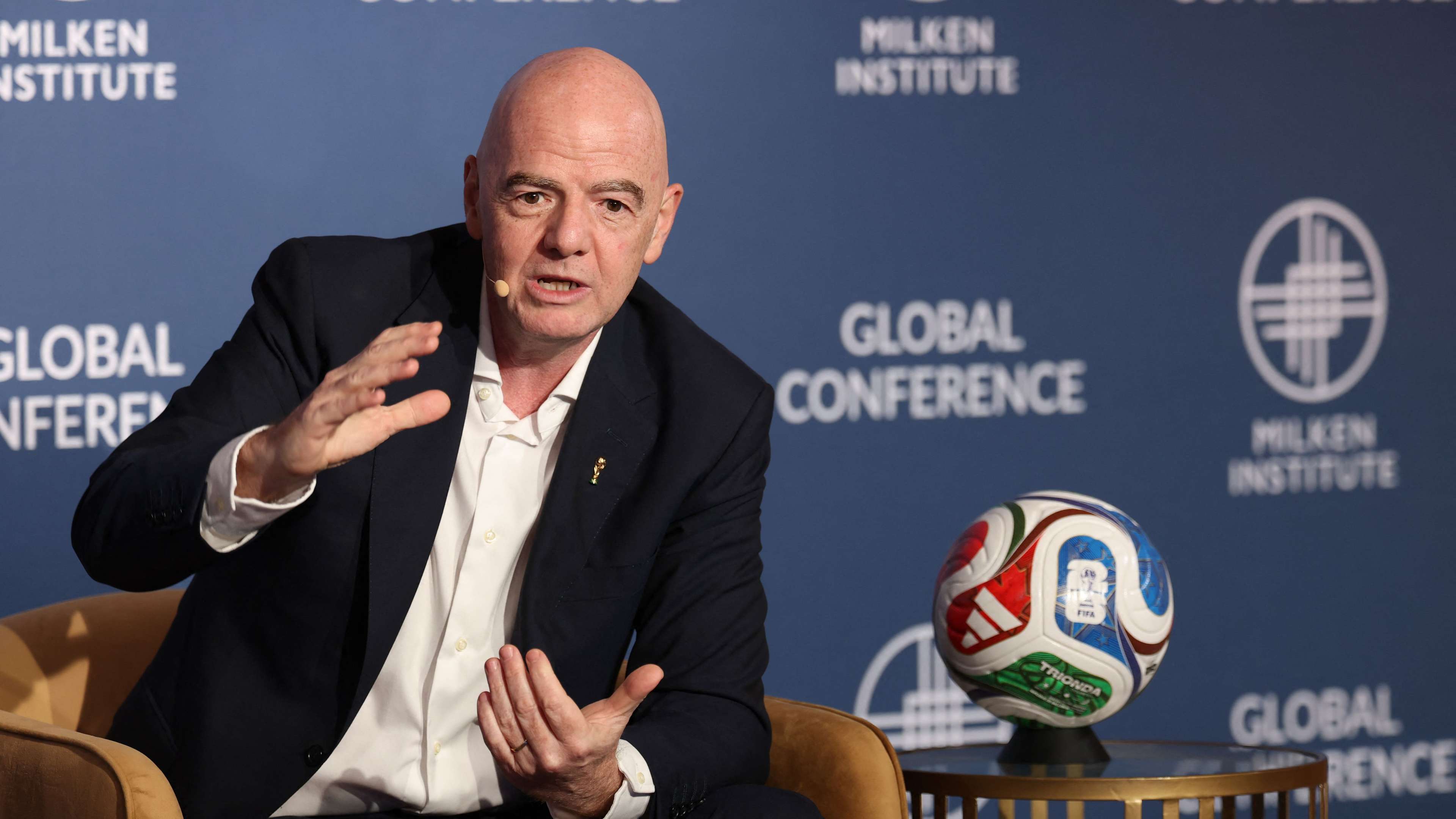
With the World Cup less than a month away, the excitement that usually surrounds the biggest event in global football seems noticeably absent this time.
Almost three decades ago, artist Robert Wyland, popularly known as Wyland, created a massive mural in downtown Dallas. The artwork, which spanned an entire building, became a source of pride for the city — a blend of charm and artistic grandeur.
That mural, however, no longer exists. In preparation for the World Cup, organisers chose to paint over it to make way for a new tournament-themed mural. Wyland has claimed he was never informed of this decision, and he has initiated legal proceedings against FIFA and the North Texas host committee, citing a 1990 law that protects public art from destruction. A courtroom battle now seems inevitable.
Symbolically, the disappearance of the mural reflects the broader mood surrounding this World Cup. With less than three weeks to go before the opening whistle, the replacement of a cherished piece of art — reportedly without its creator’s consent — has drawn national attention and become another reason for public discontent. It is, in many ways, emblematic of how this World Cup has unfolded so far.
This tournament, held every four years, is meant to celebrate the sport at its finest — its players, its fans, and its spirit. At this stage, headlines should be about football: the teams, the tactics, the excitement. Instead, as squads are announced and training camps begin, much of the focus remains on what isn’t working.
What a World Cup should represent
To understand what’s missing, it’s worth reflecting on what the World Cup should truly stand for. Ask any player, and the answer will almost always come back to the same thing: football. It’s the ultimate stage — where the best compete against each other, with the world watching. Nothing compares to that.
“I’ve always wanted to play at the highest possible level,” Brazil’s Raphinha told GOAL in April. “That level demands so much from a person. It’s something I’ve been preparing for since childhood.”
For athletes, it’s about competition and validation — the opportunity to prove oneself, to declare: I belong.
The World Cup also ignites national pride. Think of the images that linger — Argentina’s emotional triumph led by Lionel Messi in 2022, or Neymar’s tears when Brazil fell to Croatia in that same tournament.
For fans, the meaning differs. Some see it as a patriotic celebration, others as a chance to unite and revel in shared hope. For nations like Curacao, who have qualified this year, participation alone is a victory.
“No matter what happens, we’ll celebrate. A corner, a red card, a yellow card, the first penalty or an offside — everything. We’ll celebrate and enjoy the tournament,” said Brenton Balentien, leader of Curacao’s foremost fan group.
There’s also the adventure — travelling, meeting new people, discovering new cities. The World Cup has always offered fans a reason to explore, with football as the perfect excuse.
These are the traditions that give the event its magic. Before a ball is even kicked, every World Cup carries potential for unforgettable stories. Yet right now, genuine enthusiasm for the upcoming weeks seems hard to find.
Ticket pricing challenges
Ticketing expert Jim McCarthy believes FIFA misjudged things from the outset. Having seen both successful and disastrous approaches to event sales, he suggests this tournament falls closer to the latter.
The numbers back him up. Ticket prices have fluctuated since they were first released late last year. As of this week, the average resale price for a group-stage game is around $550 — with some reaching beyond $2,000.
“If you want to maximise event revenue, you need to find that perfect price point where supply meets demand,” McCarthy told GOAL. “Once you go past that, fans start dropping out.”
Of course, North America is very different from host nations like Qatar. But these sky-high prices have effectively excluded many local supporters. The idea of football as a sport for everyone feels increasingly outdated. The World Cup has grown more commercialised — and in the U.S., higher costs are almost expected.
Yet attributing this purely to “capitalism” — and echoing FIFA president Gianni Infantino’s claim that Americans are just “willing to pay more” — oversimplifies the issue. After all, the U.S. is just one of 48 teams competing. While U.S. fans may pay top dollar for matches or events like the 2024 Copa America, most have rarely faced prices of this magnitude.
FIFA maintains that ticket sales have broken records, surpassing even the 1994 tournament. And yes, this will be the most attended World Cup ever. But with 104 matches across 16 cities, and an average stadium capacity of 65,000, those figures were almost guaranteed. Filling those seats at the right price, however, remains a major challenge.
Logistical headaches
Another concern is accessibility. The U.S. has a population of roughly 350 million, many of whom will want to attend matches. But the World Cup’s magic lies in its global mix — fans travelling across borders to support their teams.
That journey won’t be easy. Teams will move between venues during the group stage, forcing fans to follow. England’s group schedule, for instance, takes them from Dallas to New Jersey to Boston. A BBC study estimated that attending all three games could cost at least £6,000 ($8,000), even with budget flights.
Visa requirements add another layer of difficulty. While most travel authorisations are approved quickly, fans from certain countries were, until May 19, required to post bonds of up to $15,000.
There are also delicate political factors. Supporters from four participating nations currently face travel bans to the U.S., and U.S. Immigration and Customs Enforcement has said it will take a “pivotal role” in tournament security. Given the national debate on immigration, this could become a contentious topic in several host cities.
Transportation woes
Getting around is another hurdle. The U.S. is vast, and public transport in many regions is limited. Fans will likely need to fly between games to follow their teams.
Moreover, unlike Europe, most American stadiums are located far from city centres, making access difficult. Some host cities have taken proactive measures — Kansas City, for example, will operate $15 bus shuttles for ticket-holders. Philadelphia and Atlanta have also made transport more convenient, with trains to Lincoln Financial Field costing $2.90 and Atlanta’s Mercedes-Benz Stadium easily reachable by metro.
Others, however, have struggled. The trip from New York’s Penn Station to MetLife Stadium in New Jersey is particularly problematic. Initial ticket prices for the train route were a staggering $150 (normally $13), later reduced to $98 after sponsor intervention. In Boston, fans will pay around $80 for a round-trip to Foxboro Station.
Compared to previous tournaments, this is a steep change. Qatar offered free public transport for fans with a special ID, while Russia’s 2018 edition provided complimentary train services. In the U.S., such connectivity simply doesn’t exist — driving from Dallas to Boston, for example, takes over 27 hours.
Assigning responsibility
So, who is to blame? FIFA is certainly under scrutiny. Host committees told GOAL last year that they were still awaiting clear guidance from the governing body on several key matters. Months later, not much has changed. Infantino’s pricing strategy hasn’t helped either.
Meanwhile, host cities have also sought to maximise revenue, often at the expense of fan accessibility. And the U.S. government’s immigration policies have added further complications for international supporters.
Can fans still enjoy it?
The frustration stems from how these issues have come to dominate the conversation. Every World Cup faces challenges beyond the pitch: Qatar’s human rights concerns, Brazil’s policing controversies, Russia’s political scrutiny. Yet, in each case, the football eventually took centre stage.
This time, though, the chatter in the U.S. remains largely off-field. Media discussions are consumed by logistics and politics rather than the matches themselves. With attention spans shrinking and news cycles accelerating, the game risks being drowned out.
Adding to this, the tournament spans three nations — the U.S., Mexico, and Canada. While Mexico faces its own internal issues, and Canada has largely stayed out of controversy, the U.S. hosts have absorbed most of the criticism.
Ultimately, journalists have a duty to tell these stories — it’s part of responsible coverage. But the World Cup should also be about joy, unity, and the love of football. At the moment, that spirit feels buried beneath everything else that’s gone wrong.
-
Daily Tarot Horoscopes For Each Zodiac Sign On Friday, May 22, 2026

-
How To Find Sky Lanterns In Forza Horizon 6

-
Google I/O 2026 Turns Gemini Into the Company’s New Operating System

-
Who will benefit most from SpaceX IPO? Mostly Elon — and a few from his inner circle
-
Adobe Creativity: Adobe Gemini AI Turns Chat Into Creative Automation