According to data released last week by the Educational Opportunity Project, students across most of the U.S. are achieving lower test scores than they were a decade ago.
The data showed that reading scores last year fell below decade-earlier levels in 83% of districts with available results, while math scores declined in 70%. The downturn was widespread, affecting affluent and low-income districts alike, across different racial groups and regions, as analyzed by The New York Times.
The findings showed that by 2025, reading scores had fallen by the equivalent of around 0.6 grade levels compared to 2015, while math scores dropped by about 0.4 grade levels. In practical terms, students were performing roughly 60% of a school year behind their counterparts from a decade earlier in reading, and about 40% of a school year behind in math, according to the Time Magazine.
“Learning recession”
|
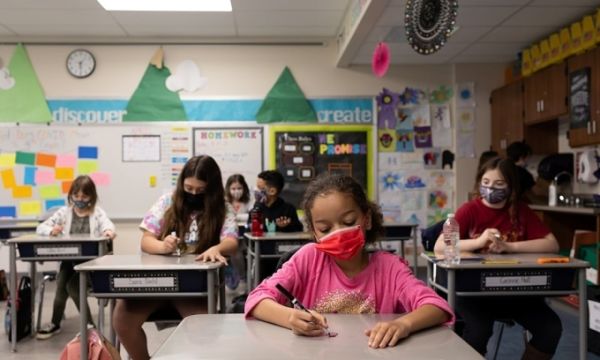
Students at Kratzer Elementary School in Allentown, Pennsylvania, U.S. in 2021. Photo by Reuters |
The findings were released as part of the fourth edition of the annual “Education Recovery Scorecard,” published by researchers from Harvard University, Stanford University, and Dartmouth College. First launched in 2022, the scorecard tracks the pace of post-pandemic academic recovery in communities across the U.S.
The report analyzed reading and math test results for students in grades 3 to 8 across more than 100 school districts in the United States between 2009 and 2025.
From 1990 to 2013, student performance in both math and reading showed consistent gains. However, the U.S. “entered a learning recession” in 2013, when progress in both subjects began to level off or decline, it said. This stagnation continued into and through the Covid-19 pandemic period.
A post-pandemic evaluation of academic performance between 2022 and 2025 indicates a modest recovery in math scores, while reading performance has continued to deteriorate over the same period.
In reading, average yearly declines in achievement were already as large in the pre-pandemic period (2017-2019) as they were during the pandemic years (2019-2022).
On the federal National Assessment of Educational Progress (NAEP) scale, Grade 8 reading scores have now fallen to their lowest level since 1990, while Grade 4 scores have dropped back to levels last seen before 2003, according to the report.
Math scores declined more steeply during pandemic school closures but then began rebounding more quickly, with the annual rate of improvement returning to pre-2013 levels in 2022-2024.
“The pandemic was the mudslide that followed seven years of erosion in student achievement,” said Professor Tom Kane, faculty director of the Center for Education Policy Research at Harvard University and a lead author of the report.
“The ‘learning recession’ started a decade ago… The recovery of U.S. education has begun. But it’s up to the rest of us to spread it,” he said, as quoted by Harvard’s Center for Education Policy Research.
What might be the cause
The report points to two major factors that may have contributed to the decline in test performance, noting that “the slowdown in learning coincided with a dismantling of test-based accountability and a rise in social media use.”
“It is not clear which was most influential. At the least, the phasing out of test-based accountability made the pre-pandemic losses harder to recognize,” it said.
Test-based accountability under the No Child Left Behind (NCLB) Act, signed into law in 2002, mandated that public schools meet strict yearly benchmarks in reading and math. Designed to close achievement gaps for disadvantaged students, it forced schools to measure performance or face penalties, but it also sparked major debates over “teaching to the test” and narrowed curricula.
As schools attempt to recover from a decade-long decline in learning outcomes, the report finds that progress since 2022 has been uneven. The strongest gains are concentrated at both ends of the income spectrum—in the wealthiest and the poorest school districts.
Researchers describe this as a “U-shaped” recovery, driven by widening resource differences. High-poverty districts, which experienced the steepest learning losses during the pandemic, received substantial federal relief funding, which the study identifies as a key factor behind their improvement. According to the researchers, without this support, average high-poverty districts would likely have seen little to no academic recovery since 2022. In contrast, affluent districts were able to leverage their own financial capacity and community resources to support student learning.
Regarding the possible impact of social media, the report said the decline in achievement that preceded the pandemic was likely partially due to social media exposure.
“The decline started around the time that social media use among teens was exploding, and this was also occurring in a number of other countries,” Kane told Time Magazine.
In the coming year, researchers across the country are expected to report on the impact of various cell phone bans.
It said: “The federal government should coordinate efforts to reach consensus and reconcile any differences in findings. Early results suggest positive, but small, impacts on student achievement. If further research confirms this, we should be evaluating new approaches to reducing cell phone use in school and social media use outside of school.”
-
Indian economist cites India's sustainable agriculture push as PM Modi receives FAO Agricola Medal

-
Paradise Biryani plans 100 new outlets in 3 years as Samara Capital backs expansion

-
Bill Gates loves this Indian food and it's one of the world's most popular dishes

-
Hardik Pandya Bluntly Advised To Quit Mumbai Indians, Join This Team As Captain: "Fresh Start"

-
SpaceX IPO bets $2 trillion on Musk's ambitious rockets-to-AI vision