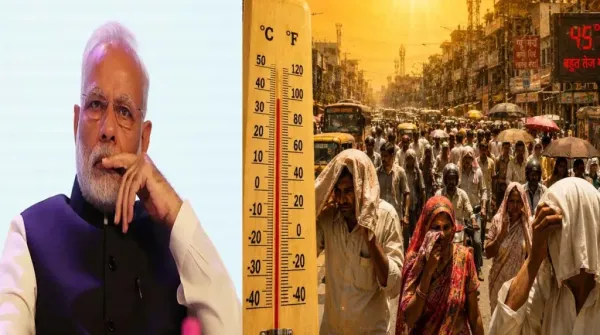
The heat has worsened the condition of the common people of the country at this time. The situation has become so serious that India has currently become the hottest country on earth. According to the shocking data of real-time global temperature ranking, 95 to 98 of the top 100 hottest cities in the world are from India alone.
On the other hand, in the live ranking of Aqi.in, only Indian cities have been placed in the list of all 100 cities of the world in terms of extreme heat. Talking about the geographical conditions of the country, especially in Uttar Pradesh, Vidarbha region of Maharashtra, Rajasthan, Telangana, Odisha and Chhattisgarh, the situation is continuously getting worse due to this scorching heat.
Intensity of heatwave has increased dangerously in two decades
According to a scientific research recently published in the journal ‘Nature’, in the last two decades (20 years), there has been a significant increase in the intensity and duration of heat waves within India. This research has found that summer hotspots are now spreading rapidly in new areas of the country. Along with this, seasonal and global events like ‘El Nino’ are making this situation worse.
This is the reason why every year with the beginning of April and May, this deadly heat starts troubling people. If we look at the old data, there has been an increase of about 2.5 days in the number of heatwave days from 1961 to 2021. According to meteorologists, the number of heat waves may increase by 12 to 18 days in the coming years. Apart from this, a record breaking increase is also being seen in the maximum temperature of the country. In the season of 2024, the maximum temperature in Mungeshpur area of Delhi had reached a dreadful level of 52.3 degrees Celsius.
Why is the heat continuously increasing in India? Know these 6 main reasons
1. Special geographical position of the country
The main reason for the continuous increase in heat in India is considered to be its geographical location. Actually, our country is situated in the tropical zone. The area falling between the Tropic of Cancer and the Tropic of Capricorn is called the tropical region, where direct rays of the sun fall more. Because of this, the temperature here remains higher than normal and the coolness in the weather lasts for a very short period. Apart from this, the Thar Desert spread over North-West India (especially Rajasthan, Haryana and Punjab) becomes extremely hot in summer and the dry hot winds rising from here become ‘heatwave’ and scorch the entire India.
2. Indiscriminate urbanization and heat island effect
The pace of urbanization is increasing very rapidly in all the states of India, due to which the green areas (trees and plants) are continuously decreasing. This has created a serious problem of ‘heat island effect’ in cities. Skyscrapers, concrete structures and asphalt (tar) roads built in urban areas absorb the sun’s heat throughout the day and retain it in the atmosphere even during the night. This is the reason why the temperature in urban areas is many times higher than in rural areas. Big cities like Delhi, Nagpur and Ahmedabad are regularly recording temperatures several degrees higher than their surrounding rural areas. Actually, due to concrete, heat gets trapped inside and is not able to rise into the atmosphere, due to which the air becomes even hotter.
3. Rapid reduction of forests and green areas
Trees are considered the natural air conditioner of the earth, but deforestation in the name of infrastructure development in India has completely broken this natural shield. According to a report by ‘Climate Impact Tracker’, expansion of agricultural land and heavy industrialization in India has led to large-scale deforestation. Due to the destruction of forests, the balance of nature which was maintained by trees has completely ended. According to Forest Survey reports, due to the expansion of infrastructure, urban green cover has decreased rapidly in many metros of the country, which is playing the biggest role in increasing the surface temperature.
4. Climate change and global warming outbreak
Climate change and global warming happening at the global level is also a big reason for India’s boiling. India has seen the period between 2014 and 2023 as the hottest decade in its history. During this period, carbon dioxide levels in the atmosphere reached a new and worrying high of 425 ppm. According to the Intergovernmental Panel on Climate Change (IPCC), global average temperatures have already risen by about 1.1°C above pre-industrial levels. In the year 2024, the heat of the oceans had reached the highest level in the last 65 years. The report of the World Meteorological Organization says that the rate of warming of the oceans has more than doubled in the last two decades compared to 1960 to 2005, which is having a direct impact on the weather in India.
5. Continued delay in monsoon and impact of El Nino
In the states of Eastern and Central India, severe heat wave conditions persist for a long time due to the monsoon not arriving on time i.e. arriving late. This delay in monsoon creates drought-like conditions in many parts of the country, which increases the heat further by absorbing moisture from the soil. Historical data clearly shows that whenever El Nino conditions occur in the Pacific Ocean, there is a huge reduction in monsoon rains in India. History is witness to the fact that due to ‘Super El Nino’ in the year 1877, there was a severe drought in India and lakhs of people lost their lives.
6. Heavy industrialization and excessive energy consumption
Along with development in the country, industrialization is also spreading rapidly, due to which the greenhouse gases emitted are continuously accumulating in the environment. Additionally, the demand for electricity for cooling reaches record highs during the summer season. To escape the heat, people extensively use AC and refrigerator in their homes. But these air conditioners, refrigerators and cars running on the roads provide coolness inside, but in return increase the temperature of the outside environment many times more. That means, the more we are trying to avoid heat, the faster the heat of the outside world is increasing.
Serious effects of extreme heat on normal life
This increasing outbreak of extreme heat and heat waves not only torments people, but it also proves to be extremely fatal. According to a detailed report by ‘Research Gate’, between 1992 and 2015, more than 24 thousand deaths were recorded in India due to heatstroke alone. Considering the seriousness of the situation, recently an international group of experts has made an official demand to the World Health Organization (WHO) that this growing climate crisis should now be declared a ‘Global Health Emergency’. The biggest reason behind this demand has been the continuously increasing heat waves and deaths due to heat.
Apart from health, this extreme temperature is having a direct and very bad impact on the farming and labor class of the country. According to various reports, due to extreme heat and water shortage, the country’s total agricultural production is continuously decreasing, the health expenditure of the general public is increasing and there is a huge decline in the daily income of businesses and workers dependent on outdoor activities (under the sun and open sky).
-
Health Tips: The risk of kidney stones will be reduced, drink this healthy juice daily, you will get relief from the problem

-
Lenovo Legion 5 15IAX11 brings together OLED visuals, RTX 5070 power and fast charging

-
Indian Railways To Use AI-Based Surveillance, Drones, And Advanced CCTV Systems To Enhance Passenger Safety
-
Meta keeps an eye on children’s online activity, launches new tools for Instagram-Facebook

-
Users are surprised by a bug in Gmail! Many people can’t open emails, what exactly happened?