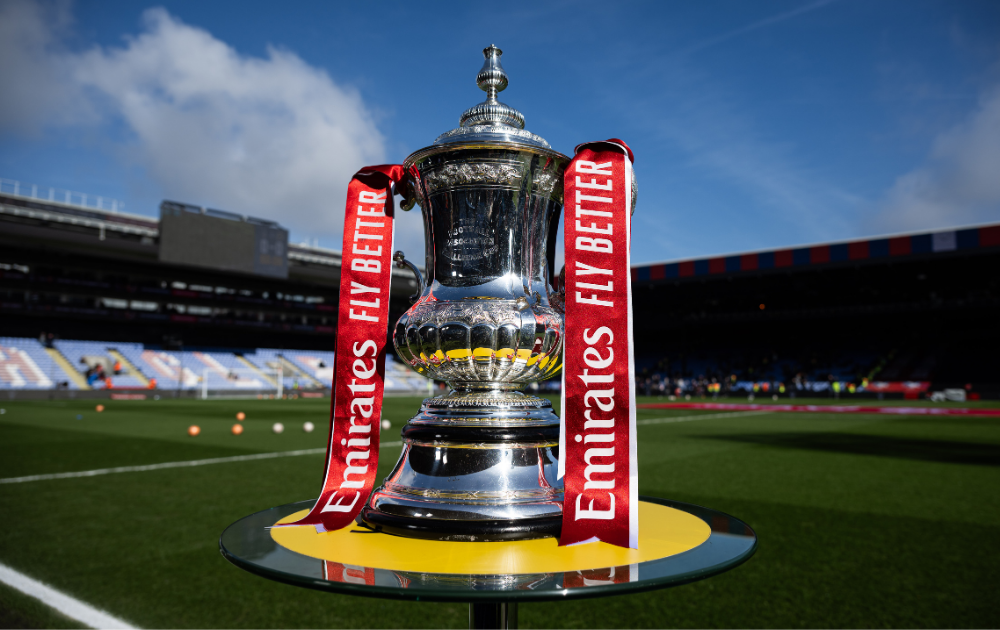
When referee Darren England walks out at Wembley on Saturday alongside Reece James and Bernardo Silva, he might feel a sense of relief to be back on the pitch.
England, who will officiate the FA Cup final, was the video assistant referee (VAR) during Arsenal’s victory over West Ham United in the Premier League last weekend. His intervention led to Callum Wilson’s equaliser for the Hammers being ruled out, a decision that significantly influenced both the title race and the relegation battle.
Referee Chris Kavanagh ultimately disallowed the goal, and the decision has since been dissected and debated endlessly. So much for VAR eliminating unnecessary controversy from key decisions.
England will take charge of Saturday’s FA Cup final between Chelsea and Manchester City, with Peter Bankes overseeing the VAR duties from elsewhere.
The notion of a VAR ‘trial’ was misleading from the very start. Its introduction was always inevitable, and even as we approach a decade since its first proper match in 2016, the system continues to create confusion wherever it’s used.
Interestingly, England’s first experience officiating a VAR match came not in the Premier League but in the FA Cup, when Brighton & Hove Albion faced Crystal Palace in January 2018. That match marked the competition’s first taste of VAR involvement.
Since the 2019-20 season, VAR has been a permanent fixture in the Premier League, and the FA Cup has been pulled along into this technological experiment.
Instead of using the FA Cup’s unique traditions and quirks to differentiate itself by rejecting VAR, the Football Association embraced it wholeheartedly, effectively undermining the competition’s individuality. They really should have known better.
The FA Cup’s approach to VAR has been inconsistent and often absurd. For a time, it was deployed only at Premier League stadiums and at Wembley for the semi-finals and final, leaving other venues in the same round without it. Now, even that pattern varies – some rounds have VAR, others do not.
Newcastle United’s fourth-round win over Aston Villa earlier this season highlighted the inconsistencies. Kavanagh, who was refereeing that game, didn’t have the benefit of England or any VAR team to correct a few glaring mistakes. Yet, in the very next round, VAR was in operation at Port Vale.
This season marked the first time VAR technology was required to be installed at non-Premier League grounds for the FA Cup. While that ensured consistency within each round, the variation between rounds remains a major argument against VAR’s inclusion in the competition.
The FA often describes the FA Cup in reverent tones – as the world’s oldest football competition, featuring 747 teams from England, Wales, and the Channel Islands this season, all contributing to a rich, historic football tapestry.
What the governing body fails to admit is that VAR, along with goal-line technology, has introduced the biggest divide in the competition’s 155-year history, shattering the very idea of uniformity that makes the tournament special.
If VAR is used in the fifth round, why not the fourth? Why not the third? If it’s introduced once Premier League clubs enter in the third round, why shouldn’t it be there from the first or second rounds? Are matches from November onwards really more important than those played in August’s extra preliminary rounds? The answer, of course, is money.
Financial constraints, however, should not justify creating inequality between rounds. The truth is simple – the FA Cup cannot afford VAR, and that limitation could have been turned into a strength.
In FourFourTwo’s view, that was a missed opportunity. The FA Cup stands apart for its tradition and magic, unmatched by any other competition in world football. The organisers could have made a statement by rejecting VAR entirely, declaring, “Not here!”
Despite the ongoing debates over refereeing in the final months of the season, the FA Cup’s significance begins in August, not April or May. That continuity is its charm, not a flaw.
In a football landscape dominated by endless reviews and discussions, the FA Cup could have offered the perfect refuge – the purest form of the game, unaltered by technology. Anyone who has watched months of football with VAR and then experienced a single match without it understands the difference.
Football’s governing bodies are rarely known for introspection, but it’s not too late for the FA Cup to reclaim its identity. Every season, fans question whether the magic still exists or if the wealth of elite clubs has eroded the competition’s essence.
While the inconsistent use of replays has been another frustration for lower-league clubs, removing VAR entirely from the FA Cup could be the bold move that breathes new life into the cherished tournament.
-
Twisted former youth leader jailed again after abusing children dozens of times

-
Monty Don gives essential piece of advice for anyone with small garden

-
Doc Martin star hospitalised in brutal attack: 'Serious assault'

-
UK households urged to put bowl of water in garden on Sunday

-
Murder Trial of Vickrum Digwa: The Tragic Case of Henry Nowak