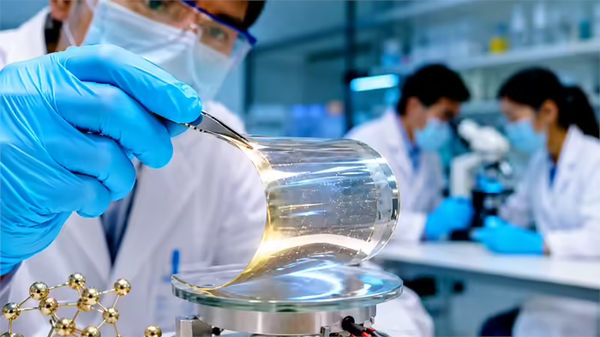
New Delhi. Scientists of the country have developed such new technology that in future, sensors and wearable smart gadgets can be made without batteries. Scientists at Mohali’s Institute of Nano Science and Technology have prepared an extremely thin and flexible film, which can generate electricity even with slight changes in temperature. This technology can play a big role in health monitoring, environmental monitoring and energy saving electronic devices.
-
Read this also India’s indigenous Bhargavastra: Counter-drone system will now release 64 mini rockets in 10 seconds, in its final test…
This research was done in an institute working under the Department of Science and Technology. The research team was led by Professor Dipankar Mandal. Along with him, scientist Sudeep Naskar and other researchers developed this technology. Pro. Dipankar told that our team mixed a very small amount of nano gold i.e. microscopic particles of gold in a special flexible polymer named PVDF. After this, such an ultra-thin film was prepared, whose thickness is less than 100 nanometers. The pyroelectric potential of the film increased significantly. Pyroelectric potential means that a material can generate electricity when its temperature changes.
Scientists have created an extremely thin and flexible film with a thickness of less than 100 nanometers.
This film can generate electricity even with changes in temperature between 21 and 28 degrees Celsius.
Effective even at room temperature
According to researchers, this film works even at normal room temperature. It can generate electricity even with a slight change in temperature between 294 to 301 Kelvin i.e. about 21 to 28 degrees Celsius. This is the reason why it is being considered as a self-powered technology of the future.
Possible use in making wearable devices
Scientists say this technology can be used in the future to create smart photodetectors, low-energy sensors, wearable health devices and electronic systems powered by body heat. This will reduce dependence on batteries and small, light and energy-efficient devices can be developed. This research has been published in the international journal Advanced Functional Materials.
-
IPL 2026: Why is Vaibhav Suryavanshi, who beat the world’s biggest bowlers, silent against Mohsin Khan?

-
Where Could Pep Guardiola Go After Leaving Manchester City? The Top Candidates for His Next Managerial Role

-
Silver Tax: Buying Jewellery Or Coins? Here’s Your Complete Guide To Tax Rules

-
Government employees have no right to ask for promotion; Supreme Court gave a big decision – News Himachali News Himachali

-
Supreme Court angry over waiver of Yes Bank bonds, summons cabinet records