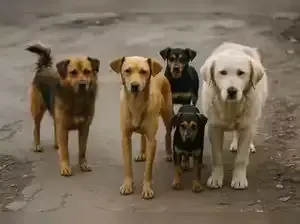
The Supreme Court on Tuesday refused to recall its directions passed in November that stray dogs picked up from public places - such as hospitals, bus stands, schools, railway stations, etc - should not be released back into the same areas after vaccination or sterilisation.
A three-member bench of justices Vikram Nath, Sandeep Mehta and NV Anjaria dismissed a clutch of applications seeking modifications to the directions issued by the court in November. The bench had earlier issued a series of directions to curb stray dog attacks.
The court ruled that people have a right to life under Article 21 of the Constitution, which includes the right to move freely in public spaces without the constant fear of dog bites. The bench said state authorities may take measures as may be legally permissible, including euthanasia in the case of rabid or dangerous dogs, to address the threat to human life.
The bench blamed state authorities for failing in their duty to protect citizens from dog attacks. Referring to various media reports, the court said the menace of dog bites had spread to critical public spaces, including airports and residential areas.
The bench further observed that the menace of dog bites had assumed a "staggering dimension" and that the "continued recurrence of such incidents" reflected a deficiency in the implementation of directions. It warned that officials failing to comply with the directions would be liable for contempt and disciplinary action.
The judgement said: "The Constitution of India does not envisage a society where children, elderly persons and vulnerable citizens are compelled to survive at the mercy of physical strength, chance or circumstance due to the failure of the state machinery."
The bench further ordered that officials of local bodies and institutions, who are duty-bound to implement the directions to secure public places from dogs, should be entitled to due protection while performing their duties. No FIRs or criminal complaints should be ordinarily registered against such officials for actions taken in the discharge of their duties, the bench ordered. The high courts were directed to register suo motu cases to monitor compliance with the directions. The court also issued directions to NHAI to secure highways from the menace of stray cattle.
A three-member bench of justices Vikram Nath, Sandeep Mehta and NV Anjaria dismissed a clutch of applications seeking modifications to the directions issued by the court in November. The bench had earlier issued a series of directions to curb stray dog attacks.
The court ruled that people have a right to life under Article 21 of the Constitution, which includes the right to move freely in public spaces without the constant fear of dog bites. The bench said state authorities may take measures as may be legally permissible, including euthanasia in the case of rabid or dangerous dogs, to address the threat to human life.
The bench blamed state authorities for failing in their duty to protect citizens from dog attacks. Referring to various media reports, the court said the menace of dog bites had spread to critical public spaces, including airports and residential areas.
The bench further observed that the menace of dog bites had assumed a "staggering dimension" and that the "continued recurrence of such incidents" reflected a deficiency in the implementation of directions. It warned that officials failing to comply with the directions would be liable for contempt and disciplinary action.
The judgement said: "The Constitution of India does not envisage a society where children, elderly persons and vulnerable citizens are compelled to survive at the mercy of physical strength, chance or circumstance due to the failure of the state machinery."
The bench further ordered that officials of local bodies and institutions, who are duty-bound to implement the directions to secure public places from dogs, should be entitled to due protection while performing their duties. No FIRs or criminal complaints should be ordinarily registered against such officials for actions taken in the discharge of their duties, the bench ordered. The high courts were directed to register suo motu cases to monitor compliance with the directions. The court also issued directions to NHAI to secure highways from the menace of stray cattle.