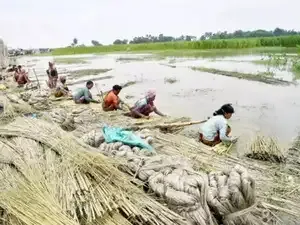
Kolkata, Amid an acute shortage of raw material and spiralling prices, jute millers in West Bengal are seeking the new BJP government's intervention to avert large-scale mill closures and job losses, industry sources said.
At least 14 mills across the Hooghly industrial belt have either suspended operations or are facing severe production disruptions due to non-availability of raw jute and unviable costs, according to Indian Jute Mills Association (IJMA) sources.
"With the last JBA (Jute Balers' Association) rate frozen at Rs 17,100 per quintal, trade banned, and the new crop ten weeks away, Bengal's mills are being asked to run operations without raw material," a former IJMA chairman told PTI.
Millers hope that the new government will act for the "release of residual stocks, permission for emergency imports, and restoration of a viable price corridor to support mills where two lakh workers are engaged", he said.
According to the millers' estimates, around 75,000 workers are already facing "involuntary unemployment" because of partial shutdowns, curtailed production and irregular operations in mills located across North 24 Parganas and Hooghly districts and adjoining industrial belts.
Industry representatives said the crisis has intensified sharply over the past four months, with the Jute Balers' Association (JBA) quotation - the raw jute trade's benchmark rate - rising from Rs 11,600 per quintal on January 1 to Rs 17,100 per quintal on May 6, more than three times the minimum support price (MSP) of Rs 5,650.
The Jute Commissioner recently ordered traders and balers to maintain zero stock from May 5 in a bid to improve raw jute availability for mills. But millers and traders said the move has aggravated the problem.
The JBA stopped publishing quotations from May 7 after the Jute Commissioner's Office (JCO) trade ban came into force, effectively removing the market's main reference price, they said.
In a representation to the Union textiles secretary, the JBA said the trade restrictions and absence of any official benchmark rate had pushed the market into "complete uncertainty", with mills unable to assess procurement costs or secure adequate supplies for operations.
The association also warned that the present crisis was not merely a seasonal shortage but the outcome of "prolonged speculative hoarding, distorted market conditions and administrative inaction", which had pushed raw jute prices far beyond viable industrial levels.
"Years of unchecked hoarding have left mills unable to buy. West Bengal voted for regime change. The jute industry only asks that the positive impact of this change be visible at the mill gate before the end of May," a jute mill owner said, expressing hope that the new dispensation will act swiftly.
Industry insiders alleged that a large portion of the available crop had already been cornered by stockists and traded earlier at inflated prices, leaving only around 2-3 lakh bales available in the market at the fag end of the season.
JBA member Om Soni said the market had effectively become dysfunctional after the suspension of trading activity and benchmark publication.
"The 'zero-stock' order is a double-edged sword. The move is aimed at releasing hoarded raw jute, but is also hurting mills, and suppliers are caught between rising costs, unpaid dues and strict stock mandates," Soni told PTI.
"Our only request is that the government withdraw or extend the deadline so that remaining raw jute stocks reach the market and struggling mills can avoid closure for some time," he added.
The industry is entering a "dangerous vacuum" where mills have neither raw material nor a transparent reference price, mill sources said.
Without urgent corrective measures, closures and labour distress may deepen across the jute belt, they cautioned.
Mill owners alleged that operations have become economically unsustainable as government-controlled B-Twill sacking prices have not kept pace with the steep increase in raw jute prices. The gap between raw material costs and regulated jute bag prices has further squeezed working capital and forced mills to cut shifts, they said.
The timing of the crisis has further deepened concerns. The Jute Commissioner's order on trade restrictions is scheduled to remain in force till June 30, and the new jute year will begin on July 1. Fresh crop arrivals are expected only towards the end of July, creating a supply gap that many mills may not survive, the industry stakeholders said.
They also said the new BJP government's response would be closely watched, particularly in light of its 'Sankalp Patra' promise to revive Bengal's traditional industries. The jute sector has welcomed the change of guard in the state, while pressing for quick, on-the-ground relief for mills and workers.
Former IJMA chairman Sanjay Kajaria said the industry was hopeful of a more responsive policy environment under the new dispensation.
"The jute sector welcomes the new BJP government in West Bengal, and we look forward to working closely with Chief Minister Suvendu Adhikari to stabilise raw jute supplies and protect livelihoods in the industry," he told PTI.
He added that industry expectations from the "double-engine" arrangement are focused on stability and consultation rather than confrontation.
"Our expectation from the 'double-engine' government is very clear: a predictable policy framework, timely consultations with stakeholders and swift action on de-hoarding and imports so that mills can keep running and workers' jobs are secure," Kajaria said.
Industry sources said immediate steps such as "unlocking residual stocks, easing trade restrictions and facilitating emergency imports from Bangladesh" might provide temporary relief and help keep mill gates open in Titagarh, Bhadreswar, Hazinagar and Jagatdal, millers added.
At least 14 mills across the Hooghly industrial belt have either suspended operations or are facing severe production disruptions due to non-availability of raw jute and unviable costs, according to Indian Jute Mills Association (IJMA) sources.
"With the last JBA (Jute Balers' Association) rate frozen at Rs 17,100 per quintal, trade banned, and the new crop ten weeks away, Bengal's mills are being asked to run operations without raw material," a former IJMA chairman told PTI.
Millers hope that the new government will act for the "release of residual stocks, permission for emergency imports, and restoration of a viable price corridor to support mills where two lakh workers are engaged", he said.
According to the millers' estimates, around 75,000 workers are already facing "involuntary unemployment" because of partial shutdowns, curtailed production and irregular operations in mills located across North 24 Parganas and Hooghly districts and adjoining industrial belts.
Industry representatives said the crisis has intensified sharply over the past four months, with the Jute Balers' Association (JBA) quotation - the raw jute trade's benchmark rate - rising from Rs 11,600 per quintal on January 1 to Rs 17,100 per quintal on May 6, more than three times the minimum support price (MSP) of Rs 5,650.
The Jute Commissioner recently ordered traders and balers to maintain zero stock from May 5 in a bid to improve raw jute availability for mills. But millers and traders said the move has aggravated the problem.
The JBA stopped publishing quotations from May 7 after the Jute Commissioner's Office (JCO) trade ban came into force, effectively removing the market's main reference price, they said.
In a representation to the Union textiles secretary, the JBA said the trade restrictions and absence of any official benchmark rate had pushed the market into "complete uncertainty", with mills unable to assess procurement costs or secure adequate supplies for operations.
The association also warned that the present crisis was not merely a seasonal shortage but the outcome of "prolonged speculative hoarding, distorted market conditions and administrative inaction", which had pushed raw jute prices far beyond viable industrial levels.
"Years of unchecked hoarding have left mills unable to buy. West Bengal voted for regime change. The jute industry only asks that the positive impact of this change be visible at the mill gate before the end of May," a jute mill owner said, expressing hope that the new dispensation will act swiftly.
Industry insiders alleged that a large portion of the available crop had already been cornered by stockists and traded earlier at inflated prices, leaving only around 2-3 lakh bales available in the market at the fag end of the season.
JBA member Om Soni said the market had effectively become dysfunctional after the suspension of trading activity and benchmark publication.
"The 'zero-stock' order is a double-edged sword. The move is aimed at releasing hoarded raw jute, but is also hurting mills, and suppliers are caught between rising costs, unpaid dues and strict stock mandates," Soni told PTI.
"Our only request is that the government withdraw or extend the deadline so that remaining raw jute stocks reach the market and struggling mills can avoid closure for some time," he added.
The industry is entering a "dangerous vacuum" where mills have neither raw material nor a transparent reference price, mill sources said.
Without urgent corrective measures, closures and labour distress may deepen across the jute belt, they cautioned.
Mill owners alleged that operations have become economically unsustainable as government-controlled B-Twill sacking prices have not kept pace with the steep increase in raw jute prices. The gap between raw material costs and regulated jute bag prices has further squeezed working capital and forced mills to cut shifts, they said.
The timing of the crisis has further deepened concerns. The Jute Commissioner's order on trade restrictions is scheduled to remain in force till June 30, and the new jute year will begin on July 1. Fresh crop arrivals are expected only towards the end of July, creating a supply gap that many mills may not survive, the industry stakeholders said.
They also said the new BJP government's response would be closely watched, particularly in light of its 'Sankalp Patra' promise to revive Bengal's traditional industries. The jute sector has welcomed the change of guard in the state, while pressing for quick, on-the-ground relief for mills and workers.
Former IJMA chairman Sanjay Kajaria said the industry was hopeful of a more responsive policy environment under the new dispensation.
"The jute sector welcomes the new BJP government in West Bengal, and we look forward to working closely with Chief Minister Suvendu Adhikari to stabilise raw jute supplies and protect livelihoods in the industry," he told PTI.
He added that industry expectations from the "double-engine" arrangement are focused on stability and consultation rather than confrontation.
"Our expectation from the 'double-engine' government is very clear: a predictable policy framework, timely consultations with stakeholders and swift action on de-hoarding and imports so that mills can keep running and workers' jobs are secure," Kajaria said.
Industry sources said immediate steps such as "unlocking residual stocks, easing trade restrictions and facilitating emergency imports from Bangladesh" might provide temporary relief and help keep mill gates open in Titagarh, Bhadreswar, Hazinagar and Jagatdal, millers added.