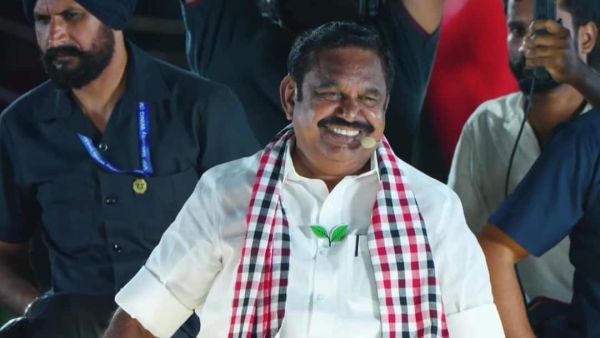
The EPS-Velumani rebellion has exposed not just a leadership crisis, but the deeper ideological and organisational decay within the AIADMK
The latest political drama in Tamil Nadu has once again pushed the All India Anna Dravida Munnetra Kazhagam into existential uncertainty. What began as murmurs of dissatisfaction after the Assembly defeat has now exploded into a full-scale internal war between party chief Edappadi K. Palaniswami and a rebel faction led by senior leaders SP Velumani and CVe Shanmugam. The confidence vote in favour of the Tamilaga Vettri Kazhagam government headed by C. Joseph Vijay has become the trigger for an open rebellion that could permanently fracture the party founded by MG Ramachandran.
The anti-defection petitions, counter-petitions, accusations of betrayal, and allegations of ministerial bargaining are not merely signs of factionalism. They reveal a deeper truth: the AIADMK is struggling to define what it stands for in the post-Jayalalithaa era. The current conflict is not simply about whether MLAs voted for or against a confidence motion. It is about legitimacy, authority, and the future ownership of one of India’s most influential regional parties.
Ever since the death of J. Jayalalithaa in 2016, the AIADMK has never truly recovered from a leadership vacuum. Jayalalithaa was not merely a political leader; she was the emotional and ideological centre of the party. Her charisma papered over contradictions, balanced competing caste equations, and maintained discipline within the organisation. Once she was gone, the underlying tensions surfaced rapidly.
The first major rupture came through the bitter feud between EPS and O Panneerselvam. Though EPS eventually emerged stronger organisationally, the scars never healed. The current revolt led by Velumani and Shanmugam demonstrates that Palaniswami’s authority inside the party is far less secure than it appears in public rallies or headquarters meetings.
The irony is striking. EPS once projected himself as the man who rescued the AIADMK from collapse after Jayalalithaa’s death. Today, his critics accuse him of turning the party into a personality-driven structure where dissent is punished and consultation has vanished. The rebels insist that decisions cannot be imposed unilaterally and that a General Council meeting must be convened to discuss the party’s electoral decline. Their argument resonates because the AIADMK’s recent political performance has been disappointing despite the anti-incumbency opportunities available against the Dravida Munnetra Kazhagam.
What makes the current rebellion more dangerous than previous factional disputes is the arithmetic. The rebel camp claims support from a majority of the AIADMK’s 47 MLAs. Whether that number holds or not, the perception itself weakens EPS politically. In legislative politics, perception often becomes reality. Once doubts emerge regarding a leader’s command over legislators, fence-sitters begin recalculating loyalties.
The cross-voting during the TVK government’s confidence motion has also revealed the changing nature of Tamil Nadu politics. The emergence of Vijay’s TVK has unsettled both the DMK and AIADMK. For decades, Tamil Nadu politics revolved around a bipolar Dravidian contest. Now, a third force with mass celebrity appeal threatens to disrupt that structure. Some AIADMK leaders may believe cooperation with TVK offers a better political future than remaining tied to a weakening leadership under EPS.
This explains Palaniswami’s furious allegation that rebel MLAs were “tempted” with ministerial positions and board appointments. Whether true or exaggerated, such accusations indicate deep mistrust within the party. More importantly, they expose how ideology has become secondary to survival and positioning. The AIADMK was founded by MGR as a populist alternative to the DMK, rooted in welfare politics and Tamil identity. Today, its internal discourse revolves around posts, disqualifications, and organisational control.
The legal battle over the whip and anti-defection law will likely continue for months. Both factions are using constitutional mechanisms as political weapons. Vijaybaskar’s claim that his faction represents the legislative majority and therefore has legitimacy as the “real” legislature party raises complex constitutional questions. Meanwhile, the EPS camp argues that only the officially recognised party leadership can issue a valid whip.
But beyond legalities lies the political reality that ordinary cadres are exhausted by endless infighting. The scenes outside the party headquarters, with heavy police deployment to prevent clashes, brought back memories of the ugly confrontations during the EPS-OPS struggle in 2022. Such images damage the AIADMK’s credibility as a disciplined alternative to the ruling establishment.
For grassroots workers, the biggest frustration is that the party appears disconnected from public concerns. Tamil Nadu faces pressing issues ranging from unemployment and industrial competition to federal tensions with the Centre and debates over language and education policy. Yet the opposition space is increasingly consumed by leadership wars. The AIADMK risks appearing more interested in internal vendettas than governance.
The BJP, too, will be closely watching these developments. The relationship between the AIADMK and Bharatiya Janata Party has long been uneasy, fluctuating between tactical cooperation and mutual suspicion. A fractured AIADMK could strengthen the BJP’s ambitions in Tamil Nadu, particularly if regional political fragmentation continues. Conversely, the DMK may benefit from an opposition divided against itself.
There is also a generational issue at play. Younger voters in Tamil Nadu are less emotionally attached to traditional Dravidian loyalties than previous generations. Vijay’s political rise reflects this changing mood. If the AIADMK continues to look trapped in endless factional feuds, it may lose an entire generation of voters seeking either stability or a fresh political narrative.
EPS still retains significant organisational strengths. He has loyal district secretaries, financial resources, and administrative experience as a former Chief Minister. The enthusiastic turnout of cadres at his residence demonstrates that he continues to command support within sections of the party base. However, political authority cannot survive indefinitely on expulsions and disciplinary actions alone. Purging rivals may temporarily consolidate power, but it rarely heals structural divisions.
The rebels, on the other hand, face their own dilemma. If they push the confrontation too far, they risk being seen as opportunists destabilising the party at a crucial moment. Their demand for collective leadership and internal democracy may carry some legitimacy, but aligning too closely with the ruling dispensation or appearing power-hungry could alienate loyal AIADMK supporters.
Ultimately, the AIADMK stands at a crossroads. One path leads toward reconciliation, organisational reform, and ideological renewal. The other leads toward fragmentation, legal warfare, and gradual political irrelevance. History shows that regional parties built around towering personalities often struggle after the departure of charismatic founders. But survival is still possible if institutions are strengthened and leadership transitions are managed wisely.
The tragedy for the AIADMK is that while its leaders fight over control of the party machinery, the larger political landscape of Tamil Nadu is changing rapidly around them. If this civil war continues unchecked, the party may discover too late that the real beneficiary of its collapse is not any internal faction but its political rivals waiting patiently outside.
-
Chinese couple turns wedding into wrestling match, with loser assigned housework

-
Dubai drone show creates Michael Jackson tribute

-
Man Posts On Late Wife’s LinkedIn That Companies Don’t Care About Overworked Employees

-
Daily Horoscopes For Each Zodiac Sign On Monday, May 18, 2026

-
IPL 2026: Vaibhav Suryavanshi hit most sixes in 12 innings, Abhishek’s record broken in just 2 years