The lopsided foundations of world growth will focus global finance ministers this week in the aftermath of the summit that attempted to reset trade ties between its two biggest economies.
While a relative sideshow to US President Donald Trump’s encounter with Chinese counterpart Xi Jinping that concluded on Friday, the Group of Seven meeting in Paris is no less ambitious as French officials position the forum to address structural misalignments underpinning the Beijing talks.
President Emmanuel Macron’s priority of tackling “imbalances” in the build-up to his own summit in June marking France’s presidency of the club takes aim at pressing economic issues defined as America’s big budget deficits, too little investment in Europe, and China’s vast trade surplus and insufficient domestic demand.
Despite the immediate backdrop of war, energy disruptions, trade tensions and even a global bond selloff last week that will feature in discussions, the French warn that failure to get beyond short-term issues and to grapple with deeper mismatches means tensions will only build. Worse still, economists see the seeds of a more systemic crisis without a concerted effort to re-balance financial and trade flows.
The G-7 is being touted by France as a rare forum for Europeans and the US to still have meaningful discussions. The Group of 20 — which includes China — was boycotted by Trump last year and is struggling with nebulous divisions that Macron warns may already herald its end.
“Diagnosis at the G-7 can help you start to have a collaborative strategy,” said Charles Lichfield, an analyst at the Atlantic Council in Washington. “I don’t think anyone expects a statement from the G-7 that basically says ‘we hate global imbalances’ to then be taken on gleefully by the Chinese, and everyone to agree to a set of solutions. But having the set of solutions out there is useful.”
It’s chance timing but symbolic all the same that the gathering — on Monday and Tuesday — takes place just after Trump’s encounter with Xi.
China announced over the weekend that it agreed with the US to lower levies on some products to promote bilateral trade, underscoring how ties between the world’s two largest economies are further stabilizing after the historic meeting of the leaders.
Similarly, the first day of the meeting coincides with the release of data likely to highlight China’s role in the imbalance equation, with retail sales there extending one of the worst starts to any year outside the pandemic, in contrast to accelerating industrial production.
To drumroll the G-7, a specially commissioned report by leading economists and analysis from the International Monetary Fund underscored the urgency of confronting skewed pillars of prosperity.
“Recent widening in global current account balances poses risks to both deficit and surplus countries in the form of lower productivity growth, trade wars, market volatility and financial crisis,” the economists, including former IMF official Gita Gopinath, wrote in March.
Even agreeing on shared diagnoses, let alone action, will be challenging when officials including US Treasury Secretary Scott Bessent meet on Monday.
Among the weaknesses identified by the economists, fiscal worries are troubling investors most. Last week, US two-year Treasury yields reached levels not seen since March 2025, Japan’s 30-year yield hit 4% for the first time since 1999, and the UK’s political crisis sent equivalent yields to a 28-year high.
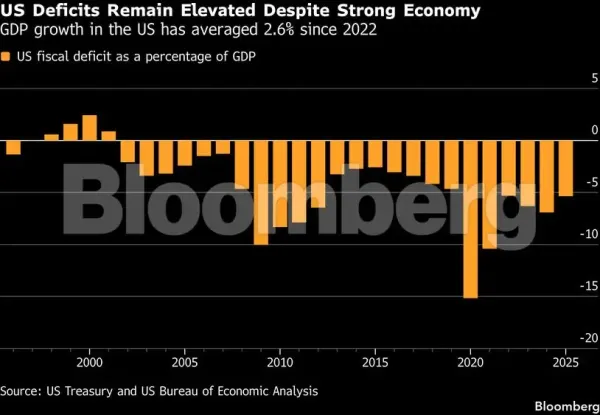
Of those, US fiscal expansion privately alarms global policymakers, with the IMF predicting the country’s borrowings to rise faster than any other advanced economy. American debt on one measure surpassed a key milestone of 100% of output in recent weeks.
Bessent is likely to repeat the long-stated Trump administration view that the best way of containing borrowings is through economic growth.
“You have to be super optimistic to think the Americans are going to do anything in addressing this,” said Erik Nielsen, a senior adviser at Independent Economics and a former IMF official. “It’s still a good thing that they talk about it.”
In an effort to broaden the conversation on imbalances, the French have invited India, Brazil, South Korea and Kenya to participate in talks on Tuesday, with a view to crafting a separate communique.
By way of delivery, the French are seeking consensus on the existence of imbalances and the risk they represent for growth, a finance ministry official familiar with the negotiations said.
As a further step, the person, who spoke on the condition of anonymity, said France wants major blocs to recognize their responsibilities, for Europe to commit more to investment, and the US to reducing its deficit. They will also aim to agree on long-term monitoring of imbalances.
Officials expect less tensions with the US in talks on reducing dependency on China for critical materials that are crucial inputs for industries including medical technology, defense and electric vehicles. China’s dominance has given it leverage in trade talks with the US and other countries.
The French want agreements on how to monitor the market to anticipate difficulties, and how to organize the sector, potentially with a toolbox of measures such as price floors, tariffs and quotas.
“It is an essential topic that can seem a bit marginal as it’s not huge amounts,” said French Finance Minister Roland Lescure, who will chair the G-7 meetings. “But it is essential, as it could derail our strategy to be as autonomous as possible.”
While a relative sideshow to US President Donald Trump’s encounter with Chinese counterpart Xi Jinping that concluded on Friday, the Group of Seven meeting in Paris is no less ambitious as French officials position the forum to address structural misalignments underpinning the Beijing talks.
President Emmanuel Macron’s priority of tackling “imbalances” in the build-up to his own summit in June marking France’s presidency of the club takes aim at pressing economic issues defined as America’s big budget deficits, too little investment in Europe, and China’s vast trade surplus and insufficient domestic demand.
Despite the immediate backdrop of war, energy disruptions, trade tensions and even a global bond selloff last week that will feature in discussions, the French warn that failure to get beyond short-term issues and to grapple with deeper mismatches means tensions will only build. Worse still, economists see the seeds of a more systemic crisis without a concerted effort to re-balance financial and trade flows.
The G-7 is being touted by France as a rare forum for Europeans and the US to still have meaningful discussions. The Group of 20 — which includes China — was boycotted by Trump last year and is struggling with nebulous divisions that Macron warns may already herald its end.
“Diagnosis at the G-7 can help you start to have a collaborative strategy,” said Charles Lichfield, an analyst at the Atlantic Council in Washington. “I don’t think anyone expects a statement from the G-7 that basically says ‘we hate global imbalances’ to then be taken on gleefully by the Chinese, and everyone to agree to a set of solutions. But having the set of solutions out there is useful.”
It’s chance timing but symbolic all the same that the gathering — on Monday and Tuesday — takes place just after Trump’s encounter with Xi.
China announced over the weekend that it agreed with the US to lower levies on some products to promote bilateral trade, underscoring how ties between the world’s two largest economies are further stabilizing after the historic meeting of the leaders.
Similarly, the first day of the meeting coincides with the release of data likely to highlight China’s role in the imbalance equation, with retail sales there extending one of the worst starts to any year outside the pandemic, in contrast to accelerating industrial production.
To drumroll the G-7, a specially commissioned report by leading economists and analysis from the International Monetary Fund underscored the urgency of confronting skewed pillars of prosperity.
“Recent widening in global current account balances poses risks to both deficit and surplus countries in the form of lower productivity growth, trade wars, market volatility and financial crisis,” the economists, including former IMF official Gita Gopinath, wrote in March.
Even agreeing on shared diagnoses, let alone action, will be challenging when officials including US Treasury Secretary Scott Bessent meet on Monday.
Among the weaknesses identified by the economists, fiscal worries are troubling investors most. Last week, US two-year Treasury yields reached levels not seen since March 2025, Japan’s 30-year yield hit 4% for the first time since 1999, and the UK’s political crisis sent equivalent yields to a 28-year high.
Of those, US fiscal expansion privately alarms global policymakers, with the IMF predicting the country’s borrowings to rise faster than any other advanced economy. American debt on one measure surpassed a key milestone of 100% of output in recent weeks.
Bessent is likely to repeat the long-stated Trump administration view that the best way of containing borrowings is through economic growth.
“You have to be super optimistic to think the Americans are going to do anything in addressing this,” said Erik Nielsen, a senior adviser at Independent Economics and a former IMF official. “It’s still a good thing that they talk about it.”
In an effort to broaden the conversation on imbalances, the French have invited India, Brazil, South Korea and Kenya to participate in talks on Tuesday, with a view to crafting a separate communique.
By way of delivery, the French are seeking consensus on the existence of imbalances and the risk they represent for growth, a finance ministry official familiar with the negotiations said.
As a further step, the person, who spoke on the condition of anonymity, said France wants major blocs to recognize their responsibilities, for Europe to commit more to investment, and the US to reducing its deficit. They will also aim to agree on long-term monitoring of imbalances.
Officials expect less tensions with the US in talks on reducing dependency on China for critical materials that are crucial inputs for industries including medical technology, defense and electric vehicles. China’s dominance has given it leverage in trade talks with the US and other countries.
The French want agreements on how to monitor the market to anticipate difficulties, and how to organize the sector, potentially with a toolbox of measures such as price floors, tariffs and quotas.
“It is an essential topic that can seem a bit marginal as it’s not huge amounts,” said French Finance Minister Roland Lescure, who will chair the G-7 meetings. “But it is essential, as it could derail our strategy to be as autonomous as possible.”