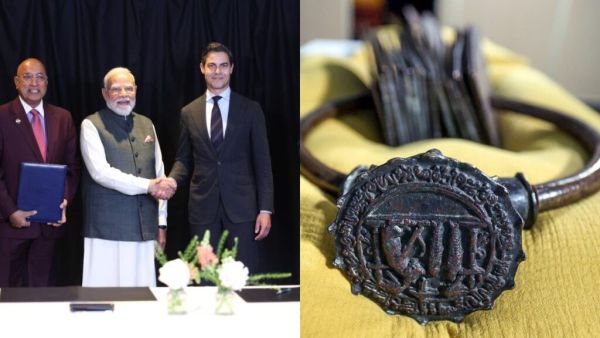
Nearly 1,000-year-old Chola-era copper plates, known to the world as ‘Leiden Plates’ or Chola Plates, have now returned to India. Netherlands has Prime Minister Narendra Modi He was formally handed over to India during his visit. These are not just ancient metal plates, but are counted among the most important historical documents of the administration, religious patronage, maritime trade and rich civilization of South India of the Chola Empire. India was trying for their return since 2012 and finally after years of diplomatic efforts, this cultural heritage was returned.
After all, what are Chola Plates and why are they so special?
Chola Plates are actually copper plates of the 11th century, on which inscriptions are engraved in Tamil and Sanskrit. These inscriptions belong to the period of the powerful rulers of the Chola Empire, King Rajaraja Chola I and his son Rajendra Chola I. These plates contain detailed records of the king’s orders, land donations, grants given to temples and Buddhist monasteries, tax arrangements and administrative decisions. Historians consider these as “official government records” of medieval India, because they give accurate information about the governance and social system of that period.
What do these plates reveal about the Chola Empire?
These copper plates show that the Chola rule was highly organized and administratively advanced. In these, there is mention of grants given to a Buddhist monastery located at Nagapattinam, which shows religious co-existence and cultural exchange during that period. According to historians, these inscriptions are also evidence of strong maritime trade relations between South India and South-East Asia. This makes it clear that the Chola Empire was not limited to South India only, but its influence extended to Sri Lanka and South-East Asia. This is the reason why they are considered an important symbol of India’s maritime civilization and global trade legacy.
What is the structure and historical process of these plates?
There are a total of 21 copper plates in this collection, whose weight is said to be about 30 kg. These are tied to a bronze ring bearing the royal Chola seal. It is said that King Rajaraja Chola I first issued these orders orally, which were written on palm leaves. Later his son Rajendra Chola I got them engraved on copper plates to give them a permanent form. The symbol of Rajendra Chola is also engraved on the ring connecting these plates. Experts believe that these documents are very important sources to understand the temple economy, tax system and administrative structure of that period.
How did you reach Netherlands from India?
In the 18th century, when Nagapattinam was under the control of the Dutch, a person named Florentius Camper took them to the Netherlands. He was associated with a Christian mission in India. After this, for decades these plates remained safe in the Netherlands and only researchers and historians were allowed to see them with special permission. With time these Tamil inscriptions became quite popular among experts and historians. After his mention in the famous Tamil historical novel Ponniyin Selvan, his recognition increased among the common people also. India started efforts for their return in 2012, which also got support in the 24th session of UNESCO’s ‘Intergovernmental Committee on Return and Restitution’.
Why is Modi government making it such a big issue?
The return of these “Chola Plates” by the Netherlands is being seen not only as the return of cultural heritage, but also as a big symbol of India’s “civilisational diplomacy” and “heritage nationalism”. Prime Minister Narendra Modi described it as “a moment of happiness for every Indian”. In the last few years, the Indian government has been running a major campaign to bring back stolen statues, ancient artefacts, manuscripts and temple heritage from abroad. Experts believe that the return of these original inscriptions will also promote new research on South Indian history, Chola administration and India’s ancient maritime power.
10 points: What is the historical importance of Chola plates?
1. The Netherlands returned 11th century Chola-era copper plates to India during Prime Minister Narendra Modi’s visit.
2. These historical copper plates are known as “Leiden Plates” or “Chola Plates” in Europe.
3. These plates are believed to belong to the reign of Chola emperor Rajaraja Chola I (985-1014 AD).
4. There are a total of 21 copper plates in this collection, whose total weight is about 30 kilograms.
5.Inscriptions in Tamil and Sanskrit languages are engraved on the plates, in which administrative and religious orders are recorded.
6. In these inscriptions, there is mention of grants and donations of land given to a Buddhist monastery in Nagapattinam.
7. Historians count these plates among the most important “official government records” of medieval India.
8. The plates are fastened with a bronze ring bearing the royal seal of Rajendra Chola I.
9. These artefacts were taken to the Netherlands by Florentius Camper during the Dutch occupation in the 18th century.
10. India had been trying to return these plates since 2012 and finally got them back after years of diplomatic efforts.
-
Kishan, Cummins shine to take SRH into play-offs with five-wicket win over CSK

-
Nationwide update over plan for all branches in the UK
-
UAE pharma sector poised for strong growth as localisation, AI reshape industry dynamics
-
'Masterpiece' series with star-studded cast dropping on ITVX in just days

-
Digital detox: Does it really work or is it just another wellness trend?