
In April 2020, when supermarket shelves thinned out and neighbourhood vendors disappeared after the lockdown was imposed in response to Covid-19, Tanvi and Ankur Agarwal in Mumbai found themselves relying on their small terrace garden.
“During the pandemic we were lucky that we had our own vegetable garden and hence we never faced issues like shortage or unavailability of vegetables,” they recall. “We spent almost all our time in the terrace garden during the lockdown. It was our sanctuary and the only thing that kept us grounded.”
What began as a personal coping mechanism soon morphed into a business idea. “Realising how much joy and calm those plants brought us, we felt a deep need to share that feeling with others. That’s why we launched Bombay Greens.”
Around the same time, in a very different setting, a single order set off another entrepreneurial journey. “A random order from a neighbour during lockdown led me to start Zoella in 2020, and it’s been six years since,” says Aayushi Malhotra, founder of Zoella Patisserie in Ghaziabad. “People couldn’t step out, and celebrations became smaller, but the need to celebrate didn’t go away. Cakes became a way to show up for loved ones even when you physically couldn’t.”
Pandemic Business
These stories played out across India six years ago. Confined to their homes, people began growing vegetables, baking cakes, adopting pets and working out in their living rooms. Confinement turned hobbies into livelihoods and the world saw a surge of first-time entrepreneurs, a new crop of startups and eventually a hobby economy itself.
Today, even in the context of the prime minister’s call to save energy in the current geopolitical climate and work from home, the picture for the OG pandemic businesses look very different. Some of these ventures have grown into stable, evolving enterprises, while others have quietly faded as normal life resumed. The trajectory of this “hobby economy” reveals less about the moment it was born in, and more about what it takes to survive beyond it.
India’s pandemic hobby economy, spanning home baking, pets, gardening, fitness at home, online gaming, creator-led hobby content and hobby commerce, is estimated to be over ₹1.5-2 lakh crore annually, according to industry estimates. That is no small change.
Here’s a look at how select sectors have shaped up beyond Covid-19.
Green shoots
In the early months of the pandemic, gardening was driven by necessity. Supply disruptions and safety concerns made people rethink their dependence on external sources for food. “Due to the shortage of fresh vegetables and fruits in the early stage of lockdown, people felt the need to grow their own vegetables to reduce dependency,” say the Agarwals. “Since most people were beginners, we launched DIY kits that had everything and did not require any visit to the nursery.” Content became as critical as product. “Since we couldn’t leave the house, we turned our terrace into a content studio. We filmed raw, honest tutorials and conducted online workshops,” they add.
Over time, the motivations changed. “The habit of gardening has shifted from a distraction to an intentional lifestyle choice,” they say. “People are still health-conscious and love growing their own food, but the focus is now on aesthetics and home décor—moving from ‘survival gardens’ to beautifully curated sanctuaries.”
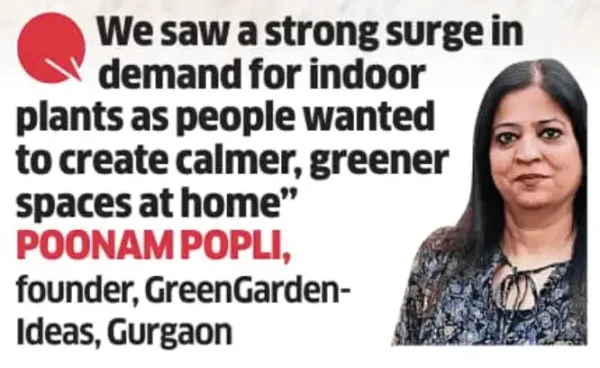
 A similar shift is visible in smaller, homegrown ventures. Poonam Popli, founder of Gurgaon-based GreenGardenIdeas, traces her business back to a moment of improvisation. “During Covid we had to visit someone’s place and had no clue about what to gift. My mom created a gift for a housewarming party and gradually she started taking orders and customised plants according to themes.”
Demand surged quickly. “We saw a strong surge in demand for indoor plants as people wanted to create calmer, greener spaces at home,” she adds.
Today, that demand has stabilised, not vanished. “Customers who started during Covid have continued, making plants a part of their lifestyle,” says Popli. “However, customers are now more aware and focus on quality and longevity. They go for informed buying rather than impulse purchases.”
India’s gardening ecosystem, including plants, tools and products, was worth under ₹7,000 crore before Covid and may be worth between ₹12,000 crore and ₹35,000 crore today, according to who you speak to in the industry.
To keep up, businesses have adapted. “We shifted focus to ready-to-place, curated plant arrangements and beginner-friendly options and actively guiding customers on plant care,” says Popli.
The category’s endurance lies in this shift, from selling products to enabling a lifestyle.
Have cake
If gardening was rooted in necessity, baking was driven by emotion.
“People couldn’t step out but the need to celebrate didn’t go away,” says Malhotra. “Home bakers were offering more personalised, less commercial options and that intimacy really resonated with people.”
For months, demand was relentless. With limited alternatives and heightened hygiene concerns, consumers turned to home kitchens for everything from birthday cakes to festive gifting.
But as restrictions eased, the market dynamics shifted sharply.
“There was saturation. Suddenly, everyone was a home baker,” says Malhotra. “This made pricing more competitive, customer expectations higher and differentiation much more important.”
Order volumes declined as consumers returned to offline options. “During Covid, order frequency was higher. Postpandemic, that frequency dipped slightly,” she notes. “However, the average spending per order has increased.”
The business has had to evolve accordingly. “Now the projects are more detailed, more customised, and higher in value. The business has shifted from being volume-driven to value-driven.”
For some entrepreneurs, scaling required stepping beyond the home.
Rhea Mirchandani, founder of Éclat Pâtisserie in Mumbai, entered the space almost accidentally. “My friend started a delivery app and told me to get on the app and start off with two orders in a week. Food from home really clicked.”
What began with tea cakes soon expanded.
 “As business grew, I eventually scaled to a cloud kitchen space. Now I am on every app. I plan to open a cafe.”
However, for many others, the economics proved unsustainable. Low-entry barriers meant intense competition, and without strong branding or operational scale, survival became difficult. The baking boom, more than any other category, has seen a quiet shakeout, even though, according to Euromonitor, India’s home-baking and baking-ingredients ecosystem grew from roughly ₹1,500 crore pre-pandemic to ₹4,000 crore-plus today.
Fitness test
Fitness trends during the pandemic were marked by urgency. With gyms shut, both trainers and consumers moved online almost overnight. But not everyone was prepared.
“The pandemic created a false sense that anyone with a phone and a fitness routine could become an online trainer,” says Yash Patel, founder of Askknatural and The Good Fats in Mumbai. “But sustaining it is a completely different game.”
Online training requires a different skillset. “You have to be a genuinely good counsellor, a strong communicator and build real trust through a screen,” he says. Patel believes the shift was already underway. “Covid was a catalyst, not the cause.”
Six years later, the industry has settled into a more stable structure. “Online is the most sustainable and lucrative model for a trainer today. Hybrid is second,” he says, pointing to better scalability and time efficiency.
Amit Subhash Sardal, a fitness and wellness educator in Mumbai, saw a clear divide emerge. “Once Covid hit, most of the trainers struggled with systems,” he says, adding that they moved online out of necessity. Only a subset adapted successfully. “There was another class of trainers who deliberately focused on learning better business systems. They are doing extremely well online.”
For consumers, hybrid training has become the norm. “A physical trainer to monitor technique, plus an online coach, who will make their overall fitness plan,” Sardal explains.
The shift toward flexible, tech-enabled fitness is here to stay.
Deloitte reckons that in 2019, India’s organised fitness industry was estimated at roughly ₹9,000-10,000 crore. By 2024, it topped ₹16,200 crore and is projected to reach ₹37,700 crore by 2030.
Tailwinds for petcare
Among all pandemic-driven categories, pet care has shown the strongest continuity.
Vineet Khanna, cofounder of Bengalurubased petcare company Supertails, says, “It was born from a simple observation during Covid— a generation of Indians was bringing pets home for the first time, with no one really guiding them.”
The company built a full-stack platform addressing that gap. “We built a single platform where a pet parent could consult a vet, refill a prescription and get the right food delivered.”
According to industry estimates, India’s pet care market in 2025 was $2.8-3 billion, up from $400-500 million in 2019.
Crucially, the business was designed for beyond the pandemic. “We never built for the lockdown; we built for the lifetime of a pet,” says Khanna.
That approach has paid off. “First-time parents still drive a large share of demand; spending per pet has risen sharply. The Indian pet parent has moved from ‘feeding a pet’ to ‘caring for a family member’.”
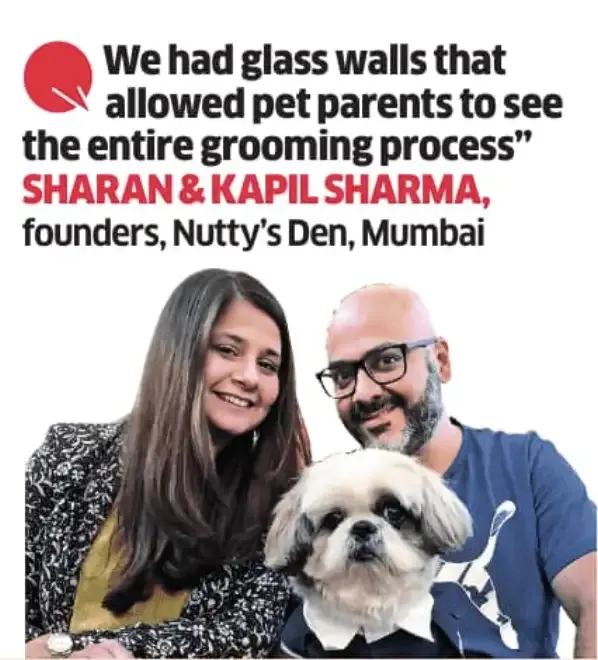
At the offline end, businesses like Nutty’s Den in Mumbai focused on experience and trust. “First-time pet parents felt an underlying anxiety about what happens behind closed doors when pets are handed over for grooming,” say Nutty’s Den founders Sharan and Kapil Sharma. “We designed a way that allowed pet parents to see the entire process.” The grooming section has glass walls, allowing pet parents to see how the dogs are handled by groomers, the products being used and the hygiene standards being maintained.
The Sharmas also leaned into conversational commerce. “We transitioned to a WhatsApp-first model, helping customers with everything from product discovery to concerns around pet care,” they say.
Even today, those behaviours persist. “WhatsApp-led engagement continues to be a strong and integral part of how we serve our customers.”
Retention has been strong as well. “About 70-80% of customers acquired during Covid continue to be active with us today.”
The aftermath
What is clear is that across categories, the pandemic created a surge of experimentation by consumers and entrepreneurs alike. Six years on, the outcomes are uneven.
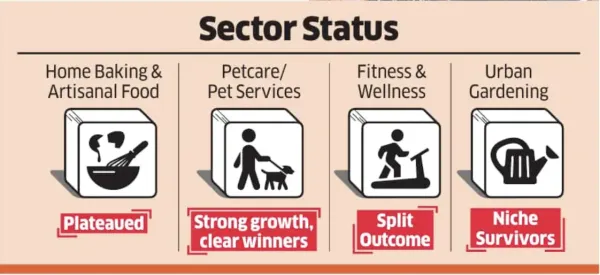
Gardening has transitioned into a slower, more intentional lifestyle category. Fitness has stabilised into hybrid models that blend online and offline. Pet care has expanded into a robust, service-led market with longterm demand.
Baking, however, illustrates the limits of momentum. Without structural advantages or clear differentiation, many ventures have struggled to sustain themselves beyond the initial boom.
Larger, well-capitalised companies like Ugaoo and Goofy Tails have scaled by building on existing capabilities—supply chains, product innovation and brand trust. Smaller entrepreneurs who have survived did so by specialisation, differentiation and building loyal communities.
What unites the survivors is their ability to evolve, from catering to impulse-driven demand to repeat behaviour, moving from product to experience, and from convenience to trust.
The hobby economy, in that sense, hasn’t faded. It has simply morphed.
“During the pandemic we were lucky that we had our own vegetable garden and hence we never faced issues like shortage or unavailability of vegetables,” they recall. “We spent almost all our time in the terrace garden during the lockdown. It was our sanctuary and the only thing that kept us grounded.”
What began as a personal coping mechanism soon morphed into a business idea. “Realising how much joy and calm those plants brought us, we felt a deep need to share that feeling with others. That’s why we launched Bombay Greens.”
Around the same time, in a very different setting, a single order set off another entrepreneurial journey. “A random order from a neighbour during lockdown led me to start Zoella in 2020, and it’s been six years since,” says Aayushi Malhotra, founder of Zoella Patisserie in Ghaziabad. “People couldn’t step out, and celebrations became smaller, but the need to celebrate didn’t go away. Cakes became a way to show up for loved ones even when you physically couldn’t.”
Pandemic Business
These stories played out across India six years ago. Confined to their homes, people began growing vegetables, baking cakes, adopting pets and working out in their living rooms. Confinement turned hobbies into livelihoods and the world saw a surge of first-time entrepreneurs, a new crop of startups and eventually a hobby economy itself.
Today, even in the context of the prime minister’s call to save energy in the current geopolitical climate and work from home, the picture for the OG pandemic businesses look very different. Some of these ventures have grown into stable, evolving enterprises, while others have quietly faded as normal life resumed. The trajectory of this “hobby economy” reveals less about the moment it was born in, and more about what it takes to survive beyond it.
India’s pandemic hobby economy, spanning home baking, pets, gardening, fitness at home, online gaming, creator-led hobby content and hobby commerce, is estimated to be over ₹1.5-2 lakh crore annually, according to industry estimates. That is no small change.
Here’s a look at how select sectors have shaped up beyond Covid-19.
Green shoots
In the early months of the pandemic, gardening was driven by necessity. Supply disruptions and safety concerns made people rethink their dependence on external sources for food. “Due to the shortage of fresh vegetables and fruits in the early stage of lockdown, people felt the need to grow their own vegetables to reduce dependency,” say the Agarwals. “Since most people were beginners, we launched DIY kits that had everything and did not require any visit to the nursery.” Content became as critical as product. “Since we couldn’t leave the house, we turned our terrace into a content studio. We filmed raw, honest tutorials and conducted online workshops,” they add.
Over time, the motivations changed. “The habit of gardening has shifted from a distraction to an intentional lifestyle choice,” they say. “People are still health-conscious and love growing their own food, but the focus is now on aesthetics and home décor—moving from ‘survival gardens’ to beautifully curated sanctuaries.”
Demand surged quickly. “We saw a strong surge in demand for indoor plants as people wanted to create calmer, greener spaces at home,” she adds.
Today, that demand has stabilised, not vanished. “Customers who started during Covid have continued, making plants a part of their lifestyle,” says Popli. “However, customers are now more aware and focus on quality and longevity. They go for informed buying rather than impulse purchases.”
India’s gardening ecosystem, including plants, tools and products, was worth under ₹7,000 crore before Covid and may be worth between ₹12,000 crore and ₹35,000 crore today, according to who you speak to in the industry.
To keep up, businesses have adapted. “We shifted focus to ready-to-place, curated plant arrangements and beginner-friendly options and actively guiding customers on plant care,” says Popli.
The category’s endurance lies in this shift, from selling products to enabling a lifestyle.
Have cake
If gardening was rooted in necessity, baking was driven by emotion.
“People couldn’t step out but the need to celebrate didn’t go away,” says Malhotra. “Home bakers were offering more personalised, less commercial options and that intimacy really resonated with people.”
For months, demand was relentless. With limited alternatives and heightened hygiene concerns, consumers turned to home kitchens for everything from birthday cakes to festive gifting.
But as restrictions eased, the market dynamics shifted sharply.
“There was saturation. Suddenly, everyone was a home baker,” says Malhotra. “This made pricing more competitive, customer expectations higher and differentiation much more important.”
Order volumes declined as consumers returned to offline options. “During Covid, order frequency was higher. Postpandemic, that frequency dipped slightly,” she notes. “However, the average spending per order has increased.”
The business has had to evolve accordingly. “Now the projects are more detailed, more customised, and higher in value. The business has shifted from being volume-driven to value-driven.”
For some entrepreneurs, scaling required stepping beyond the home.
Rhea Mirchandani, founder of Éclat Pâtisserie in Mumbai, entered the space almost accidentally. “My friend started a delivery app and told me to get on the app and start off with two orders in a week. Food from home really clicked.”
What began with tea cakes soon expanded.
However, for many others, the economics proved unsustainable. Low-entry barriers meant intense competition, and without strong branding or operational scale, survival became difficult. The baking boom, more than any other category, has seen a quiet shakeout, even though, according to Euromonitor, India’s home-baking and baking-ingredients ecosystem grew from roughly ₹1,500 crore pre-pandemic to ₹4,000 crore-plus today.
Fitness test
Fitness trends during the pandemic were marked by urgency. With gyms shut, both trainers and consumers moved online almost overnight. But not everyone was prepared.
“The pandemic created a false sense that anyone with a phone and a fitness routine could become an online trainer,” says Yash Patel, founder of Askknatural and The Good Fats in Mumbai. “But sustaining it is a completely different game.”
Online training requires a different skillset. “You have to be a genuinely good counsellor, a strong communicator and build real trust through a screen,” he says. Patel believes the shift was already underway. “Covid was a catalyst, not the cause.”
Six years later, the industry has settled into a more stable structure. “Online is the most sustainable and lucrative model for a trainer today. Hybrid is second,” he says, pointing to better scalability and time efficiency.
Amit Subhash Sardal, a fitness and wellness educator in Mumbai, saw a clear divide emerge. “Once Covid hit, most of the trainers struggled with systems,” he says, adding that they moved online out of necessity. Only a subset adapted successfully. “There was another class of trainers who deliberately focused on learning better business systems. They are doing extremely well online.”
For consumers, hybrid training has become the norm. “A physical trainer to monitor technique, plus an online coach, who will make their overall fitness plan,” Sardal explains.
The shift toward flexible, tech-enabled fitness is here to stay.
Deloitte reckons that in 2019, India’s organised fitness industry was estimated at roughly ₹9,000-10,000 crore. By 2024, it topped ₹16,200 crore and is projected to reach ₹37,700 crore by 2030.
Tailwinds for petcare
Among all pandemic-driven categories, pet care has shown the strongest continuity.
Vineet Khanna, cofounder of Bengalurubased petcare company Supertails, says, “It was born from a simple observation during Covid— a generation of Indians was bringing pets home for the first time, with no one really guiding them.”
The company built a full-stack platform addressing that gap. “We built a single platform where a pet parent could consult a vet, refill a prescription and get the right food delivered.”
According to industry estimates, India’s pet care market in 2025 was $2.8-3 billion, up from $400-500 million in 2019.
Crucially, the business was designed for beyond the pandemic. “We never built for the lockdown; we built for the lifetime of a pet,” says Khanna.
That approach has paid off. “First-time parents still drive a large share of demand; spending per pet has risen sharply. The Indian pet parent has moved from ‘feeding a pet’ to ‘caring for a family member’.”
At the offline end, businesses like Nutty’s Den in Mumbai focused on experience and trust. “First-time pet parents felt an underlying anxiety about what happens behind closed doors when pets are handed over for grooming,” say Nutty’s Den founders Sharan and Kapil Sharma. “We designed a way that allowed pet parents to see the entire process.” The grooming section has glass walls, allowing pet parents to see how the dogs are handled by groomers, the products being used and the hygiene standards being maintained.
The Sharmas also leaned into conversational commerce. “We transitioned to a WhatsApp-first model, helping customers with everything from product discovery to concerns around pet care,” they say.
Even today, those behaviours persist. “WhatsApp-led engagement continues to be a strong and integral part of how we serve our customers.”
Retention has been strong as well. “About 70-80% of customers acquired during Covid continue to be active with us today.”
The aftermath
What is clear is that across categories, the pandemic created a surge of experimentation by consumers and entrepreneurs alike. Six years on, the outcomes are uneven.
Gardening has transitioned into a slower, more intentional lifestyle category. Fitness has stabilised into hybrid models that blend online and offline. Pet care has expanded into a robust, service-led market with longterm demand.
Baking, however, illustrates the limits of momentum. Without structural advantages or clear differentiation, many ventures have struggled to sustain themselves beyond the initial boom.
Larger, well-capitalised companies like Ugaoo and Goofy Tails have scaled by building on existing capabilities—supply chains, product innovation and brand trust. Smaller entrepreneurs who have survived did so by specialisation, differentiation and building loyal communities.
What unites the survivors is their ability to evolve, from catering to impulse-driven demand to repeat behaviour, moving from product to experience, and from convenience to trust.
The hobby economy, in that sense, hasn’t faded. It has simply morphed.