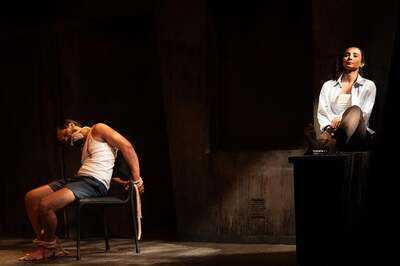
Death and the Maiden, an acclaimed drama of the 1970s is a socio-political comment of then conditions of Chile, happens to be one of the most popular works of playwright Ariel Dorfman. Dorfman served as a cultural advisor to President Salvador Allende before the military coup in Chile. The play, therefore, has chilling details and references that are quite nearly factual, coming from someone who probably saw everything too up, close, and personal.
A political thriller to begin, Death and the Maiden, goes beyond that by presenting in layers the emotional echelons which keep intriguing the viewer at varied junctures. The audience is forced to think and not just be a passive watcher.
Set against the backdrop of Chilean army coup and the rebellion that later led to a democratic government, Death and the Maiden walks you through the upheavals via three characters – Paulina and Gerardo Salas, and Dr Roberto Miranda.
Play starts on a note that Gerardo Salas, a lawyer, has been appointed as a member of the investigation committee by the President of the unnamed South American country. The committee is supposed to investigate crimes conducted during the previous dictatorial regime.
The happiness of this appointment is soon to be shadowed by the incidences that follow.
When Gerardo welcomes Dr Miranda as a guest, his voice and smell trigger unpleasant memories for Paulina, who was a political prisoner 15 years ago. Paulina is convinced that Dr Miranda is the man who oversaw her torture and multiple rapes. What follows is an electrifying three-way confrontation in which certainty and doubt, truth and revenge, are in constant tension.
Gerardo is caught in the crossfire between his guest and his wife. And the audience is in as much as a fix as him. Like Gerardo, the audience too, at times, finds it difficult to believe that she remembers the man and the details so vividly even after 15 years. Gerardo is particularly stunned because he believed that in last 15 years his love and compassion had managed to erase the emotional and physical wounds inflicted by the torture.
Paulina, however, is in a mood for trial and revenge.
This two-hour long play has another unseen character – Schubert and his music. The name of the play is also inspired by Schubert’s Der Tod und das Maedchen. His string quartet forms an integral part of the story as it unfolds. The play also ends with the symphony; highlight being the live String Quartet that plays it on the stage.
The brilliance of the play lies in its ambiguity. Dorfman’s writing is spare yet intensely charged. The action unfolds almost entirely in one room, but the emotional and political stakes feel immense.
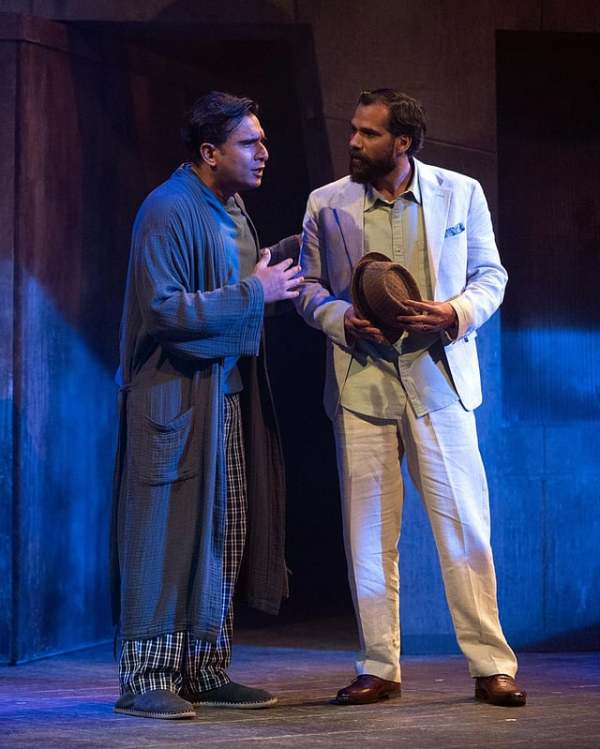
Dorfman never offers easy answers. Is Dr Miranda truly guilty, or is Paulina projecting her trauma onto an innocent man? Does justice require proof, or can moral certainty be enough? By refusing to resolve these questions neatly, the play forces the audience into the role of juror. Long after the curtain falls, the central dilemma continues to reverberate. And Schubert’s music keeps playing in your ears as you walk away.
Bruce Guthrie adorns the director’s cape for this Dorfman play, which has been his dream for quite some time. Apt characterisation and choice of actors is where he wins the first battle. His narrative of this thriller is enthralling. Costume changes, the way scenes melt into the next and the end – all keep you hooked. He is well assisted by the Movement Director and Intimacy Coordinator, Emilia Cadenasso.
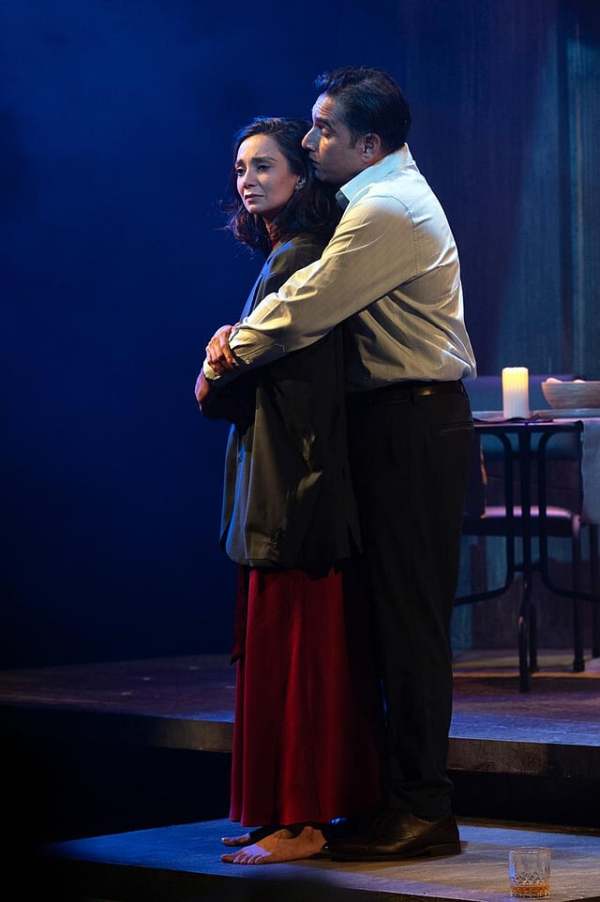
Vivek Gomber as Gerardo and Neil Bhoopalam as Dr. Miranda fit like a glove. Gomber’s restrained lawyer takes you through the story with ease. His portrayal of confusion and jury is pertinent. Bhoopalam excels as Dr. Miranda. The nuances that he brings to table are applaudable. Ira Dubey’s histrionics are good. Vocal coach Shernaz Patel’s hard work shows.
Ira is also the producer of the play, and the production values are outstanding. Simon Kenny’s sets and Pallavi Patel’s costumes are beguiling. Andrew T. Mackay uses Schubert so well that it becomes a character in the play. Live String Quartet at the end is the cherry on the cake.
Death and the Maiden is a masterpiece of political theatre. It is suspenseful enough to grip audiences like a courtroom thriller, yet emotionally and philosophically rich enough to provoke deep reflection about trauma, accountability, and the limits of forgiveness.
-
Make wasps stay away for good by placing 10p household item in your garden this spring

-
M-Cap: 9 of Top 10 Firms Lose Rs 3.12 Trillion; Bharti Airtel Only Gainer

-
CBI arrests another Pune teacher in 2026 NEET-UG paper leak case

-
Jon Rahm makes demand over PGA Championship claim that left him concerned

-
Jeremy Clarkson makes 'horrific' death admission: 'Just truly awful'