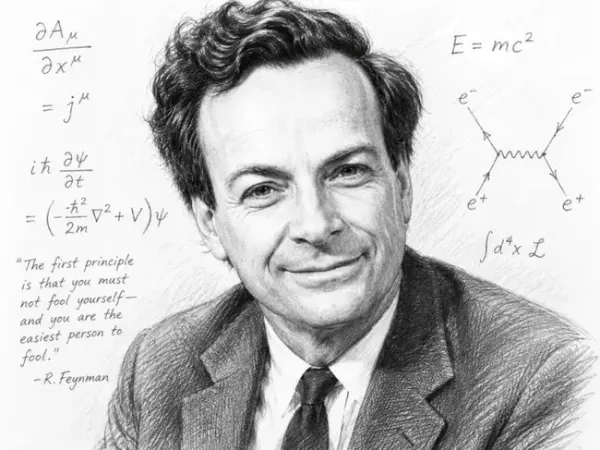
Quote of the Day: Richard Feynman was an American theoretical physicist who was widely regarded as the most brilliant, influential, and iconoclastic figure in his field in the post-World War II era. Born on May 11, 1918 in New York, he was one of the most brilliant and unconventional scientific minds of the 20th century. He apparently developed an early fascination with how things worked, often repairing radios as a teenager simply through experimentation and logic. His curiosity eventually led him to become a theoretical physicist whose work transformed modern science.
Feynman studied at the Massachusetts Institute of Technology and later earned his PhD from Princeton University. During World War II, he played a major role in the Manhattan Project, the secret U.S. initiative that developed the atomic bomb. Despite his immense intellect, Feynman became famous not only for his scientific achievements but also for his humor, honesty, and ability to explain difficult concepts in simple language.
Richard Feynman made groundbreaking contributions to quantum mechanics and particle physics. His work on quantum electrodynamics revolutionized the understanding of how light and matter interact, earning him the 1965 Nobel Prize in Physics alongside Julian Schwinger and Shin'ichirō Tomonaga.
Among his most enduring contributions are the famous “Feynman diagrams,” visual representations that simplified extremely complex particle interactions and became essential tools for physicists worldwide. Feynman was also a gifted teacher at California Institute of Technology, where his lectures inspired generations of students. His books, especially Surely You're Joking, Mr. Feynman!, revealed a playful and deeply human side to a scientific genius.
Quote of the Day by Nobel Prize winner Richard Feynman: “I believe that a scientist looking at nonscientific problems is just as dumb as the next guy”
Richard Feynman Quote: Context, meaning and interpretation
The quote reflects Feynman’s deep humility and skepticism toward intellectual arrogance. Although society often places scientists on a pedestal, Feynman rejected the idea that expertise in one field automatically makes someone wise in all areas of life. Feynman frequently criticized blind faith in authority and the tendency to assume that highly educated people possess universal wisdom. He believed that scientific expertise is limited to the specific domain in which a person has studied and tested ideas rigorously.
This quote emerged from his broader philosophy that human beings, regardless of intelligence or status, are vulnerable to bias, poor judgment, and emotional reasoning when operating outside their area of expertise. In many interviews and lectures, Feynman emphasized intellectual honesty, the willingness to admit uncertainty and ignorance rather than pretending to know everything.
At its core, the quote is a warning against overconfidence. Feynman reminds us that intelligence is not universal. A brilliant physicist may still misunderstand politics, relationships, economics, or ethics just like anyone else. Expertise does not erase human limitations.
The quote also encourages humility. True wisdom lies not in claiming authority over every subject, but in recognizing where one’s knowledge ends. In today’s world — where celebrities, influencers, and experts are often expected to comment on every issue imaginable — Feynman’s words remain remarkably relevant. They encourage people to think critically rather than accepting opinions simply because they come from someone famous or highly educated.
Feynman’s quote ultimately teaches that curiosity and humility should go hand in hand. The more we learn, the more we should recognize the vastness of what we still do not know.
Feynman studied at the Massachusetts Institute of Technology and later earned his PhD from Princeton University. During World War II, he played a major role in the Manhattan Project, the secret U.S. initiative that developed the atomic bomb. Despite his immense intellect, Feynman became famous not only for his scientific achievements but also for his humor, honesty, and ability to explain difficult concepts in simple language.
Richard Feynman made groundbreaking contributions to quantum mechanics and particle physics. His work on quantum electrodynamics revolutionized the understanding of how light and matter interact, earning him the 1965 Nobel Prize in Physics alongside Julian Schwinger and Shin'ichirō Tomonaga.
Among his most enduring contributions are the famous “Feynman diagrams,” visual representations that simplified extremely complex particle interactions and became essential tools for physicists worldwide. Feynman was also a gifted teacher at California Institute of Technology, where his lectures inspired generations of students. His books, especially Surely You're Joking, Mr. Feynman!, revealed a playful and deeply human side to a scientific genius.
Quote of the Day by Nobel Prize winner Richard Feynman: “I believe that a scientist looking at nonscientific problems is just as dumb as the next guy”
Richard Feynman Quote: Context, meaning and interpretation
The quote reflects Feynman’s deep humility and skepticism toward intellectual arrogance. Although society often places scientists on a pedestal, Feynman rejected the idea that expertise in one field automatically makes someone wise in all areas of life. Feynman frequently criticized blind faith in authority and the tendency to assume that highly educated people possess universal wisdom. He believed that scientific expertise is limited to the specific domain in which a person has studied and tested ideas rigorously.
This quote emerged from his broader philosophy that human beings, regardless of intelligence or status, are vulnerable to bias, poor judgment, and emotional reasoning when operating outside their area of expertise. In many interviews and lectures, Feynman emphasized intellectual honesty, the willingness to admit uncertainty and ignorance rather than pretending to know everything.
At its core, the quote is a warning against overconfidence. Feynman reminds us that intelligence is not universal. A brilliant physicist may still misunderstand politics, relationships, economics, or ethics just like anyone else. Expertise does not erase human limitations.
The quote also encourages humility. True wisdom lies not in claiming authority over every subject, but in recognizing where one’s knowledge ends. In today’s world — where celebrities, influencers, and experts are often expected to comment on every issue imaginable — Feynman’s words remain remarkably relevant. They encourage people to think critically rather than accepting opinions simply because they come from someone famous or highly educated.
Feynman’s quote ultimately teaches that curiosity and humility should go hand in hand. The more we learn, the more we should recognize the vastness of what we still do not know.