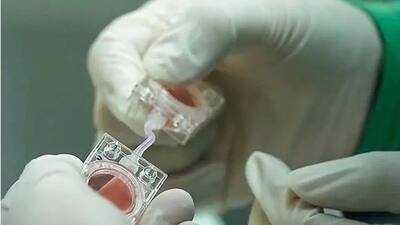
China is testing if humans can have babies in space
13 May 2026
China has sent artificial embryos to its space station as part of an experiment to determine if humans can reproduce in zero gravity.
The project, led by Yu Leqian, aims to understand how the absence of gravity affects early development.
This research is crucial for future human settlements beyond Earth.
Can humans survive and reproduce in space?
Research goals
Leqian, a professor at the Chinese Academy of Sciences's Institute of Zoology, explained that the main goal of this experiment is to understand how gravity affects embryos.
Once scientists have a better understanding of this effect, they can develop methods to control it.
"[We might] use certain technologies to mitigate the impact. This is our attempt to answer [the questions]: Can humans survive and reproduce in space? I hope the answer is yes," Yu said in an interview with CCTV.
A look at the experiment
Process
As per Yu, the artificial embryos used in the experiment were built from the stem cells which shared similar structures with real human embryos.
They were sent onboard the uncrewed cargo spacecraft Tianzhou-10 to the Tiangong on Monday.
These lab-grown structures may help the scientists study the biology of early human development.
After the experiment is finished, the samples shall be frozen and sent back to Earth for analysis.
-
Bihar Police Recruitment: Thousands of Special Assistant Positions Available

-
Kolkata: Protesters clash with police during demonstration against curbs on namaz, demolition drive

-
'Never-ending' childhood disease hitting UK adults - this could be reason why

-
Nigel Farage writes for Express: Open borders Burnham wants to drag you closer to the EU

-
Gujarat ATS, Crime Branch seize 180 kg silver consignment at Rajkot Airport