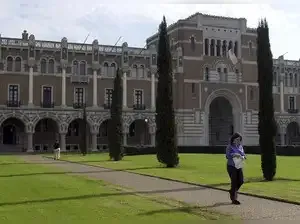
New Delhi: Rice University is exploring options to expand its footprint in India, including potential research and academic partnerships under the new National Education Policy framework, as the US institution sees strong growth in Indian student demand despite mounting visa-related uncertainty under the Trump administration.
“This is my third trip to India in the last four or five years,” Reginald DesRoches, president of Rice University, told ET in an interview. “Every time I come here, I learn more about the exciting things that are happening and the talent that’s here.”
DesRoches said the university’s India outreach is being driven by long-term strategic alignment in areas such as AI, health innovation, climate and energy research.
“For us, it’s really about forming partnerships with the best talent around the world,” he said. “And I can’t think of a more dynamic country with great talent than India.”
On whether Rice is considering a branch campus or institutional base in India, DesRoches said the university is “exploring all options right now”. “We have a number of different joint efforts with various institutions here, and over the coming years, we will figure out what makes the most sense as far as whether we have a physical presence or not,” he said.
The comments come as several global universities evaluate India expansion opportunities following the rollout of the National Education Policy (NEP), which permits foreign higher education institutions to establish campuses in the country.
Rice is also witnessing a sharp rise in interest from Indian students across programmes. According to university officials, the number of Indian students has surged 60% over the last four years. “There’s lots of demand across the board — at the undergraduate, master's and doctoral levels,” said DesRoches, attributing the growth partly to the university’s increasing visibility and partnerships in India.
Student outcomes remain a strong draw for Rice. “Somewhere around 95% of our students who are seeking employment, who aren’t going to graduate school, have a job once they leave Rice,” said DesRoches, noting that nearly 60% of Rice students are enrolled in science or engineering disciplines.
Addressing affordability concerns around private US education, DesRoches said Rice “heavily discounts tuition” and offers multiple scholarship options to international students. “There’s a sticker price of the university, then there’s the actual price,” he said. “We’re very proud of the affordability for students who don’t have the means to come to Rice.”
On the broader US political climate, DesRoches acknowledged that the return of the Trump administration has created “a lot of uncertainty” for international students, especially around visas. “The ability to get visas rapidly has been the biggest challenge,” he said. Rice has expanded resources within its Office of International Students to help applicants navigate visa processing and documentation timelines.
However, the university said it hasn’t yet seen a major impact on admissions or enrolment metrics. “We haven’t been impacted in terms of numbers so far,” DesRoches said. “This is the highest yield we’ve ever had at the undergraduate level in our history.”
He emphasised that deferred admissions linked to current geopolitical developments remain “very little” and limited to “low percentage points”.
Despite growing concerns around visa uncertainty and work authorisation, DesRoches argued that the US remains a compelling destination for global education. “This incoming class has over 55 countries represented,” he said. “There’s no better place, in my opinion, to study than to come to the US, be around people from all over the world who have the same interest around innovation and solving some of the most pressing problems.”
Rice officials also indicated that the university is doubling down on global engagement rather than retreating amid political scrutiny around international students and overseas research ties. “We’ve been building our global strategy over the last four years very aggressively, first in Europe, and now in India as an important accelerator of our global strategy,” a university official said separately.
DesRoches said international diversity remains “a foundational part of the Rice experience”, pointing to Houston’s multicultural ecosystem as a strategic advantage. “One in four people in Houston were born outside the US,” he said. “That really reflects the culture at Rice University also.”
On the future of India-US academic collaboration, DesRoches said he expects ties to strengthen significantly over the coming decade, especially in sectors such as climate technology, healthcare access, semiconductors and AI. “The challenges that people are working on in India very much dovetail with what we’re working on at Rice,” he said. “I just see the relationship getting stronger.”
“This is my third trip to India in the last four or five years,” Reginald DesRoches, president of Rice University, told ET in an interview. “Every time I come here, I learn more about the exciting things that are happening and the talent that’s here.”
DesRoches said the university’s India outreach is being driven by long-term strategic alignment in areas such as AI, health innovation, climate and energy research.
“For us, it’s really about forming partnerships with the best talent around the world,” he said. “And I can’t think of a more dynamic country with great talent than India.”
On whether Rice is considering a branch campus or institutional base in India, DesRoches said the university is “exploring all options right now”. “We have a number of different joint efforts with various institutions here, and over the coming years, we will figure out what makes the most sense as far as whether we have a physical presence or not,” he said.
The comments come as several global universities evaluate India expansion opportunities following the rollout of the National Education Policy (NEP), which permits foreign higher education institutions to establish campuses in the country.
Rice is also witnessing a sharp rise in interest from Indian students across programmes. According to university officials, the number of Indian students has surged 60% over the last four years. “There’s lots of demand across the board — at the undergraduate, master's and doctoral levels,” said DesRoches, attributing the growth partly to the university’s increasing visibility and partnerships in India.
Student outcomes remain a strong draw for Rice. “Somewhere around 95% of our students who are seeking employment, who aren’t going to graduate school, have a job once they leave Rice,” said DesRoches, noting that nearly 60% of Rice students are enrolled in science or engineering disciplines.
Addressing affordability concerns around private US education, DesRoches said Rice “heavily discounts tuition” and offers multiple scholarship options to international students. “There’s a sticker price of the university, then there’s the actual price,” he said. “We’re very proud of the affordability for students who don’t have the means to come to Rice.”
On the broader US political climate, DesRoches acknowledged that the return of the Trump administration has created “a lot of uncertainty” for international students, especially around visas. “The ability to get visas rapidly has been the biggest challenge,” he said. Rice has expanded resources within its Office of International Students to help applicants navigate visa processing and documentation timelines.
However, the university said it hasn’t yet seen a major impact on admissions or enrolment metrics. “We haven’t been impacted in terms of numbers so far,” DesRoches said. “This is the highest yield we’ve ever had at the undergraduate level in our history.”
He emphasised that deferred admissions linked to current geopolitical developments remain “very little” and limited to “low percentage points”.
Despite growing concerns around visa uncertainty and work authorisation, DesRoches argued that the US remains a compelling destination for global education. “This incoming class has over 55 countries represented,” he said. “There’s no better place, in my opinion, to study than to come to the US, be around people from all over the world who have the same interest around innovation and solving some of the most pressing problems.”
Rice officials also indicated that the university is doubling down on global engagement rather than retreating amid political scrutiny around international students and overseas research ties. “We’ve been building our global strategy over the last four years very aggressively, first in Europe, and now in India as an important accelerator of our global strategy,” a university official said separately.
DesRoches said international diversity remains “a foundational part of the Rice experience”, pointing to Houston’s multicultural ecosystem as a strategic advantage. “One in four people in Houston were born outside the US,” he said. “That really reflects the culture at Rice University also.”
On the future of India-US academic collaboration, DesRoches said he expects ties to strengthen significantly over the coming decade, especially in sectors such as climate technology, healthcare access, semiconductors and AI. “The challenges that people are working on in India very much dovetail with what we’re working on at Rice,” he said. “I just see the relationship getting stronger.”