Data from China’s Ministry of Education showed that 570,600 Chinese students studied abroad last year, down nearly 20% from the 2019 peak and returning to levels last seen around 2016.
The number had risen steadily from 544,500 in 2016 to 703,500 in 2019 before being heavily disrupted by the Covid-19 pandemic, according to Xinhua News Agency.
The figures, released by the Chinese Service Center for Scholarly Exchange last month, also highlighted changing attitudes toward overseas education among Chinese families.
According to the center’s report cited by China Dailyaverage spending per Chinese overseas student climbed to a 12-year high of 605,000 yuan (more than US$88,000) in 2026 due to global inflation and rising tuition fees. The report indicated that families remain willing to invest heavily in overseas education despite mounting costs.
Still, the decline in student numbers points to a broader strategic shift. Experts said economic pressures and policy barriers are reshaping study-abroad decisions.
Big Four losing appeal
Although the U.S. remains one of the leading destinations for Chinese students, enrollment has declined steadily since 2019, with intensified scrutiny during the Trump administration contributing to the downturn.
The country has now recorded five consecutive years of falling Chinese student enrollment amid tighter screening measures and proposed visa restrictions.
|
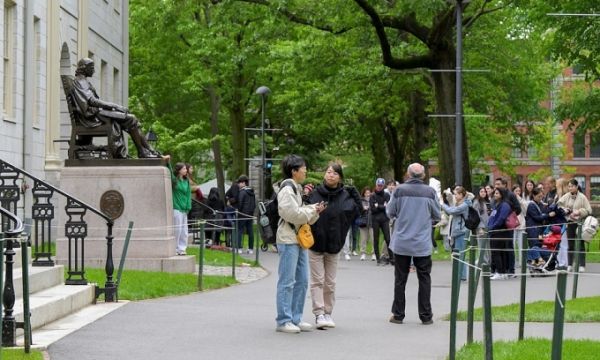
Students walk on the campus of Harvard University in Cambridge, Massachusetts, U.S., May 23, 2025. Photo by Reuters |
This year also marks the first time in more than a decade that the U.S. has fallen out of the top two preferred destinations for mainland Chinese students.
The 2026 Report on Chinese Students’ Overseas Study by New Oriental Education and Technology Group found that the U.K. and Hong Kong remained the top two destinations for mainland Chinese students in 2026. The U.S. fell to third place for the first time after ranking first between 2015 and 2019 and second from 2020 to 2025.
According to the 2026 China Study Abroad White Paper by EIC Education, preference for the U.S. dropped sharply from 30.9% in 2025 to 21.2% this year because of visa uncertainty and high costs. The U.S. now ranks fourth behind the U.K., Hong Kong and Australia.
But the U.K.’s position is not certain, as the proposed International Student Levy has “created confusion and an image of a greedy U.K.” among prospective Chinese students, Charles Sun, founder of education consultancy China Education International, told The PIE News.
At the same time, Canada’s caps on international study permits have also weakened their appeal among Chinese families.
In Australia, stricter student visa policies and rising fees have significantly dampened interest among Chinese applicants, with universities reporting a 39% year-on-year drop in applications from China in February 2026.
Sun said many in China viewed Australia as a “businessman rather than educator,” adding that “everybody is trying to extract money from international students.”
Beyond visa restrictions, changing student priorities are also reshaping global education flows.
Rather than focusing solely on prestige, Chinese families are increasingly prioritizing safety, return on investment and career prospects. The shift has fueled interest in destinations closer to home, including Hong Kong, Singapore and Malaysia, while many students are now applying to multiple countries to reduce risk.
“Families are becoming more rational … moving away from solely relying on rankings and instead evaluating costs, program duration and job prospects,” EIC Education’s White Paper said.
Domestic opportunities
Improving education quality and career opportunities within China have also reduced the perceived employment advantage of overseas graduates, said Grace Zhu, China director at international education consultancy Bonard.
“The employment advantages of overseas returnees are no longer obvious,” said Zhu, noting that companies are increasingly favoring practical skills over international diplomas, as quoted in a reported by Bonard’s website.
She pointed to recent efforts by China’s Ministry of Education to support returning students, including analyzing employment trends among overseas graduates and launching a national employment service platform for returnees.
The number of Chinese students returning home after graduation has been rising steadily in recent years.
Figures from China’s Ministry of Education further underscored the trend. In 2024, around 495,000 overseas graduates returned to China, up more than 19% from a year earlier.
According to the “2025 China Returnee Employment Survey Report” released in February by Chinese recruitment platform Zhaopin, the number of overseas-educated job seekers, particularly fresh graduate returnees, rose 12% year on year to an eight-year high.
-
What kind of trick is this? This player has been playing every match wearing the same underwear for 8 years

-
IPL 2026: Arshdeep Singh caught in controversy because of girlfriend Samreen Kaur’s picture, broke BCCI rule

-
VFS Global Launches More UK Premium Visa Centres in India for Faster Processing

-
Google India Officially Joins ‘Main Tera’ Trend With Viral ‘May 13’ Post; Wins Internet

-
Air Purifying Plants: 5 plants that purify the air naturally, will definitely be found in doctors’ homes. Doctors Consider 5 Plants to Naturally Purify Air in House