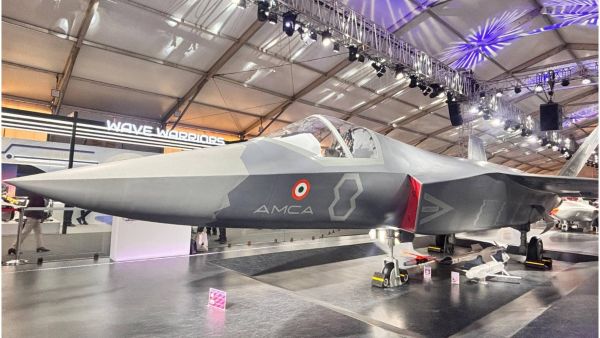
India’s ambitious fifth-generation stealth fighter aircraft programme is set to enter a crucial phase, with the government likely to issue the Request for Proposal (RFP) next month to three shortlisted private sector-led consortia competing for the Advanced Medium Combat Aircraft (AMCA) project, Defence Secretary Rajesh Kumar Singh said on Tuesday.
The RFP will formally invite detailed commercial and technical bids from the shortlisted industry teams for the development and production of the fighter aircraft.
Three Consortia Shortlisted for AMCA Programme
Speaking at a session organised by the Confederation of Indian Industry on “Geostrategy, Supply Chains and Strategic Resilience” in the national capital, Singh said the AMCA selection process had “fortuitously” resulted in three competing industry teams.
“We have ended up in the AMCA shortlisting process with three private sector-led consortia. Two of them are a happy blend of private and public, one is entirely private and hopefully they will receive RFPs in the next month or so,” he said.
The three consortia moving ahead in the process are led by Larsen & Toubro in partnership with Bharat Electronics Limited and Dynamatic Technologies; Tata Advanced Systems Limited, which has bid independently; and Bharat Forge, which has teamed up with BEML and Data Patterns.
Government Eyes Competition Beyond HAL
Singh said the government expects the AMCA process to create an additional fighter aircraft production line alongside Hindustan Aeronautics Limited.
“It will create the kind of healthy competition that this country needs to build its aerospace industry at a large scale,” he said.
As reported earlier, HAL was eliminated at the financial evaluation stage of the AMCA programme. The decision was linked to the state-run aerospace manufacturer’s existing order book, which is understood to be nearly eight times its annual turnover. Officials were concerned about the company’s ability to take on additional high-risk development commitments.
The development also comes as HAL continues to face delays in delivering the Tejas Mk-1A fighter aircraft, with deliveries running more than two years behind schedule.
Pricing Likely to Decide Final Selection
Sources said the final selection is expected to follow the lowest-cost or L1 model instead of the quality-and-cost-based selection system (QCBS) that has been used in some recent unmanned aerial vehicle programmes.
Under the proposed process, companies meeting the required technical benchmarks will compete primarily on pricing, which is expected to become the decisive factor in the final award.
Private Sector May Get Larger Role in Missile Production
The defence secretary also indicated that the government may expand the private sector’s role in missile manufacturing, including possible technology transfers for certain categories of ballistic missiles.
The sector has traditionally remained dominated by Bharat Dynamics Limited, which manufactures several of India’s conventional missile systems.
“Missile production is the other area where we have for the most part given orders largely to one public sector company,” he said. “Given the changing nature of warfare and the use of missiles as a conventional warfare tool, the willingness to transfer technology to the private sector for various types of ballistic missiles is something for which in my view the time has come.”
-
Govt ramped up domestic production, minimized burden: Hardeep Puri
-
IPL 2026: Cummins backs SRH batters despite 82-run defeat vs GT

-
Import duty increased on gold and silver, government’s big decision after PM Modi’s appeal, new rates applicable from today

-
West Bengal: Crude bomb found in Naihati amid ongoing NIA terror probe

-
Delhi HC hears ex-AAP MLA Naresh Balyan’s bail plea in MCOCA case