
On April 1, 2026 India imposed severe restrictions on uncertified internet-connected CCTV cameras, effectively banning dominant Chinese brands such as Hikvision and Dahua from the domestic market.
These Chinese giants, among others, once controlled nearly a third of the market and their exit is opening a big vacuum in the Indian market. And the question now is can homegrown CCTV players and Indian security companies fill the gap before major security gaps leave buildings and institutions exposed.
India’s restrictions, framed as the mandatory STQC (Standardisation Testing and Quality Certification) norms introduced by the MeitY, has created fresh opportunities for local manufacturers, semiconductor startups, and AI surveillance firms — an ecosystem that comprises four layers: optics, sensors, SoCs, and memory.
Indian Incumbents Shore Up Their BaseAmong the biggest beneficiaries of the policy shift are Indian surveillance manufacturers that had already invested in local assembly, compliance, and distribution infrastructure.
The India CCTV market size was valued at $4.8Bn in 2025 and is estimated to grow from $5.75Bn in 2026 to $ 14.25Bn by 2031, according to research firm Mordor Intelligence.
Market share of CP PLUS owner Aditya Infotech, a listed company, rose from 20.2% in FY25 to 45.4% by Q3 FY26 amid tightening certification norms and the gradual exclusion of non-compliant players.
The company said it is witnessing sharply rising demand for Indian alternatives, especially in government and enterprise deployments where cybersecurity and data sovereignty are becoming central considerations.
“The market is steadily shifting from price-led competition to trust, cybersecurity, and compliance-driven decision-making,” a CP PLUS spokesperson told Inc42.
Aditya Infotech added that surveillance remains the core revenue driver for the company, with increasing demand for IP-based cameras and intelligent AI-powered systems. The company is also scaling its manufacturing capacity to 2.5 million units per month by Q2 FY27 and investing heavily in AI-enabled surveillance technologies.
Beyond manufacturing, Indian firms are increasingly positioning themselves as end-to-end security technology providers rather than low-cost assemblers.
Sparsh CCTV, an OEM which operates largely in critical infrastructure sectors such as railways, airports, highways, oil and gas, and defence, said the new certification regime aligns closely with its long-standing ‘Made in India’ strategy.
The company focuses heavily on video management systems, analytics, and AI software rather than only hardware assembly.
According to Sparsh Sehgal, the chief growth officer at the company, the STQC certification process has significantly raised entry barriers for newer and smaller players due to the high compliance and investment requirements involved.
Sparsh CCTV is now expanding its manufacturing footprint aggressively. “The company currently operates facilities in Haridwar and is building a new unit in Kashipur, aiming to scale production capacity from roughly one million cameras annually to nearly one million cameras per month over time,” Sehgal told us.
She also pointed to a deeper transition underway within the Indian surveillance stack: the gradual development of indigenous semiconductor capabilities.
The company said it is currently working with SoC manufacturers such as Qualcomm and Umbrella, but are now also evaluating other domestic ecosystem partners to integrate indigenous chip components into future surveillance products.
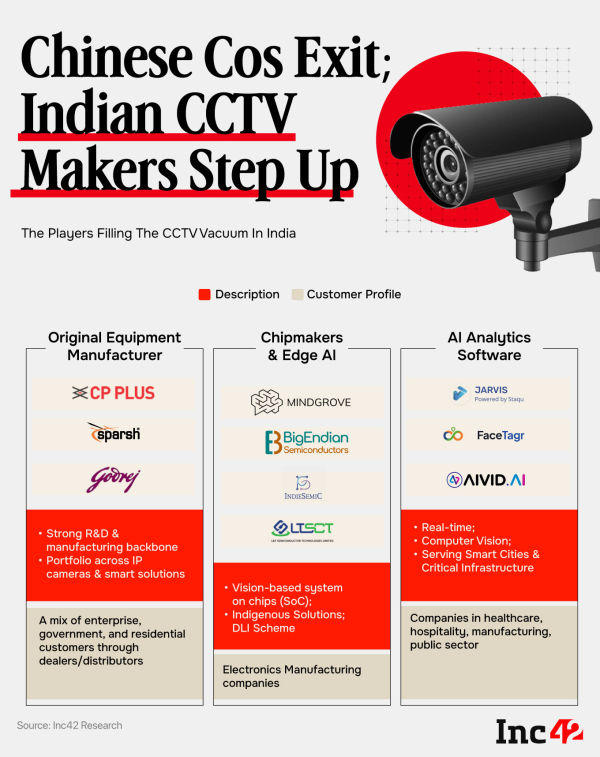
As Indian OEMs attempt to reduce dependence on Chinese supply chains, homegrown and indigenous semiconductor startups and chip design companies are increasingly positioning themselves as the next layer of the opportunity.
Bengaluru-based BigEndian Semiconductors is developing so-called Vision AI chips, secure chipsets targeted at surveillance, industrial monitoring, access control, and related edge AI applications. Notably, the company raised $6 Mn (around ₹57.1 Cr) in its pre-Series A funding round led by IAN Alpha Fund just earlier this month.
BigEndian plans to deploy the fresh capital to commercialise its first system-on-chip (SoC) for surveillance equipment. Cofounder and CEO Sunil Kumar said the regulatory reset is accelerating demand for trusted domestic alternatives.
“India’s chip opportunity in the surveillance segment alone could touch nearly $1 Bn as camera penetration expands across sectors,” Kumar pegged the growth estimates.
BigEndian is currently building ARM-based chips and plans to launch its offerings by mid-2025. The company also sees potential beyond India, including in Africa, Southeast Asia, and Latin America “We aim to eventually address nearly 25% of India’s surveillance chip requirements over the next three to five years,” the CEO told Inc42.
Meanwhile, Chennai-based Mindgrove Technologies is developing a dedicated CCTV system-on-chip called Vision SoC targeted specifically at India’s surveillance market. Currently in the prototyping stage, the startup said it already has three serious customers evaluating the chip, alongside several additional companies in early-stage discussions. The company, which is one of the beneficiaries of the Central Government’s design-linked incentive (DLI), expects its chip to enter the market by early-to-mid 2027.
“It gives us a useful place to build towards because we no longer have to guess whether the market exists,” Shashwath TR, cofounder and CEO, said.
L&T Semiconductor Technologies is also building India-designed SoCs for AI-powered CCTV and IP camera systems. According to L&T Semiconductor Technologies’ CEO Sandeep Kumar, the regulatory changes have reinforced the ‘importance of trusted and indigenous semiconductor infrastructure for surveillance applications’. Last year, the subsidiary of Larsen & Toubro partnered with CP PLUS to develop and produce indigenous Indian IP SoCs for high-resolution AI-powered surveillance cameras.
Other Indian semiconductor players are also beginning to enter the surveillance ecosystem. For instance, IndieSemiC Technology recently partnered with US-based surveillance company Prizor to develop secure CCTV and smart surveillance systems targeted at infrastructure, industrial facilities, logistics, and enterprise deployments.
All said, the startup acknowledged that Indian semiconductor firms cannot realistically compete with Chinese players solely on pricing. The industry partners said that ‘near-Chinese firms’ pricing, localised ecosystem support, and government-led indigenous push is likely to help customers favour them over other competitors, especially US and Taiwanese-based.
Booster Shot For AI Video AnalyticsThe ripple effects of the Chinese CCTV restrictions are not limited to hardware manufacturers and chipmakers.
Indian AI surveillance and video analytics startups also see the policy shift as an opportunity to reposition surveillance systems as intelligent digital infrastructure rather than commodity hardware.
Staqu Technologies, which has developed AI-powered surveillance platform JARVIS, said the market conversation has fundamentally shifted after the new certification regime.
“Earlier, conversations were mostly around camera count and cost. Now, customers are asking about trusted infrastructure, local deployment, data residency, audit logs, cybersecurity, non-Chinese dependencies, and AI capability,” the startup’s cofounder and CEO Atul Rai said.
The company believes AI software can significantly offset hardware cost disadvantages by shifting the value proposition from recording footage to generating actionable intelligence.
Industry players broadly agree that India’s surveillance ecosystem is now entering a new phase. Challenges remain. Indian companies still face dependence on imported memory, sensors, and certain advanced semiconductor components.
Scaling Indian chip manufacturing and achieving cost parity with China will also take years of investment and ecosystem development.
[Edited by Nikhil Subramaniam]
The post The CCTV Gold Rush: Indian Startups, OEMs Race To Fill Surveillance Vacuum appeared first on Inc42 Media.
-
Israeli report accuses Hamas of 'systematic, widespread' sexual violence on Oct 7

-
Quote of the day by American psychologist Carl Rogers: 'When someone really hears you without passing judgment...' Life lessons from world-famous psychologist about empathy, human connection & emotional safety

-
Crores Worth of Assets Seized as Srinagar Police Wage War on Narcotics Networks

-
Manchester City Head Coach Pep Guardiola Expects Crystal Palace To Be 'Professional' Against Arsenal In Premier League Title-Race Finale

-
Neymar Headlines Brazil's Preliminary Squad For FIFA World Cup 2026, Chelsea Sensation Estevao Excluded