
For years, the Gulf sold itself as the one corner of the world where money never stopped moving.
Lunch tables that once hosted IPO pitches and billion-dollar takeover conversations began emptying out. Investment bankers who spent the past three years selling the Gulf as the world’s safest growth story suddenly found themselves fielding calls about evacuation plans, insurance exposure and whether regional assets deserved a geopolitical discount again.
For the United Arab Emirates, the economic fallout from the US-Israel conflict with Iran is no longer confined to oil prices or shipping routes. It has hit at something the country spent years building - its image as the Middle East’s ultimate capital sanctuary.
Also Read: War puts brakes on UAE realty boom as Dubai projects face delays
The war is slowing deals, freezing listings, rattling investors and testing whether Dubai and Abu Dhabi can continue commanding the premium valuations that transformed them into global financial magnets after the pandemic.
Only months ago, Gulf bankers were preparing for what many expected would be their biggest year since the global financial crisis. IPO pipelines were swelling, sovereign wealth funds were deploying capital aggressively and international firms were racing to establish offices in the UAE.
Now many of those assumptions are being rewritten.
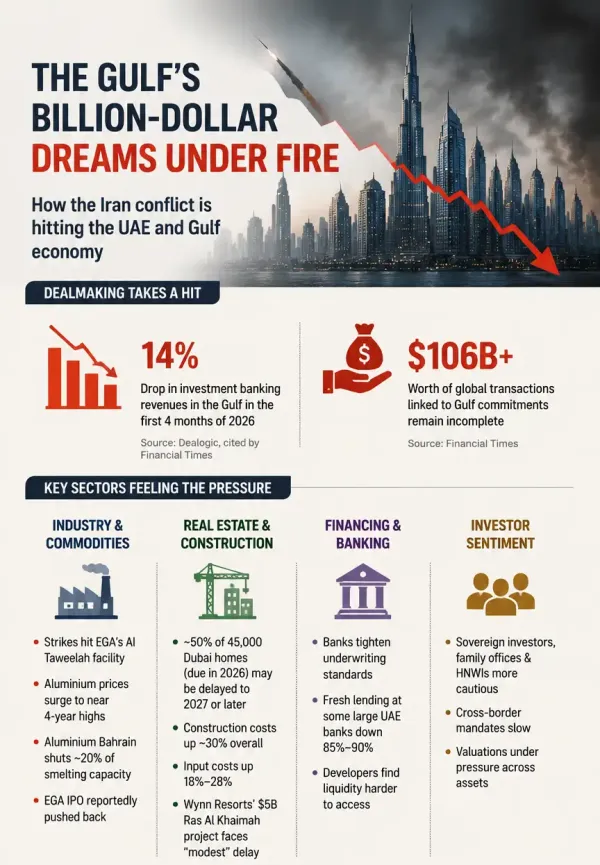
Investment banking revenues in the Gulf dropped 14% in the first four months of 2026 despite a strong start to the year, according to Dealogic data reported by the Financial Times. The newspaper also reported that more than $106 billion worth of global transactions dependent on Gulf commitments remain incomplete as investors reassess risk across the region.
Also Read: Dubai realty slows amid geopolitical shocks
The sudden reversal is exposing how deeply the Gulf’s financial rise depended not just on liquidity, but on perception.
For much of the post-pandemic era, Dubai and Abu Dhabi benefited from a rare convergence of crises elsewhere. Europe battled recession fears. China’s slowdown weighed on Asian markets. High interest rates choked dealmaking in the US.
The Gulf looked different.
Oil wealth insulated governments from economic shocks, sovereign funds kept investing and Gulf exchanges became some of the world’s busiest IPO venues. Dubai in particular emerged as a haven for hedge funds, crypto firms, family offices and private equity groups fleeing volatility elsewhere.
That trade is now under pressure.
The strongest example may be Emirates Global Aluminium, once expected to anchor one of the UAE’s biggest IPOs in recent years.
Bloomberg reported earlier this year that the aluminium producer had begun discussions with investors for a possible listing in Abu Dhabi. Then Iranian strikes hit the company’s Al Taweelah operations near Abu Dhabi in late March, disrupting production and sending shockwaves through global commodity markets, according to Bloomberg.
Aluminium prices surged close to four-year highs after facilities linked to Gulf producers were damaged during the conflict, The Economic Times reported, reviving fears over supply-chain vulnerability in one of the world’s most strategically important industrial corridors.
The IPO has now been reportedly pushed back.
Aluminium Bahrain has shut down close to 20% of its smelting capacity.
That shift is becoming increasingly common across the UAE’s dealmaking landscape.
Several planned listings have quietly slowed as issuers wait for volatility to ease and investors demand lower valuations.
Bloomberg reported that global banks including Goldman Sachs, JPMorgan Chase and Citigroup activated contingency measures after missiles and drones entered Gulf airspace earlier this year. Some firms reportedly shifted staff into remote working arrangements while reassessing regional operational risks.
Even Dubai’s property sector, among the clearest winners of the city’s post-pandemic boom, is beginning to feel the pressure.
Bloomberg reported that developers including Binghatti Holding and Omniyat Holdings held discussions with investors after their bonds weakened amid concerns over regional instability. The Economic Times reported that construction financing is becoming more expensive while some overseas buyers are adopting a wait-and-watch approach towards luxury real estate investments in Dubai.
The strain is becoming increasingly visible in the UAE’s construction and real estate sectors, long considered pillars of Dubai’s economic boom.
Nearly half of the 45,000 residential units expected to be handed over in Dubai this year could now be delayed until 2027 or later, according to data cited by Anarock Middle East, as supply-chain disruptions and rising costs slow project execution.
Construction costs across the UAE have climbed sharply since the conflict escalated, with industry estimates pointing to increases of nearly 30% overall. Because the country relies heavily on imported materials, input costs across several construction categories have surged between 18% and 28%, squeezing developer margins and delaying financing decisions.
Even marquee projects are beginning to feel the pressure. Last week, Wynn Resorts confirmed a “modest” delay in the opening of its $5 billion integrated resort in Ras Al Khaimah, set to become the UAE’s first legal casino, which had originally been scheduled to open in the first quarter of 2027.
At the same time, developers dependent on financing backed by escrow balances are finding liquidity harder to access as banks tighten underwriting standards amid rising geopolitical and market risks.
The impact is now spreading into private capital markets as well.
Also Read: UAE companies struggle to raise fresh loans as war drags on
Alternative investment firms seeking Gulf money told the Economic Times that sovereign investors, family offices and wealthy individuals have become more cautious since the conflict escalated. Some cross-border investment mandates are slowing as governments and institutions preserve liquidity amid uncertainty around oil flows, defence spending and regional stability.
Fresh lending at some large UAE banks has plunged by as much as 85-90% in certain cases as lenders turn increasingly cautious amid prolonged war-related uncertainty, according to data compiled by digital business lending platform Biz2X.
One of the clearest signs of stress emerged outside the UAE itself.
Also Read: Indian banks avoid fresh Gulf bets as Iran crisis drags on
Reuers had reported citing sources that Australia’s Macquarie Group had walked away from a Kuwait oil pipeline transaction worth as much as $7 billion because of concerns linked to the Iran conflict, highlighting how geopolitical tensions are beginning to reshape dealmaking decisions across the wider Gulf.
Yet the Gulf’s financial story is not collapsing, at least not yet.
The region still commands enormous wealth. Sovereign funds across the Gulf oversee an estimated $5 trillion in assets, according to the Financial Times, giving governments powerful buffers against market stress. Abu Dhabi’s state-backed investment machine continues pursuing overseas acquisitions, while global firms including Bain Capital and Hillhouse Investment are still establishing UAE operations despite the conflict, the newspaper reported.
That resilience is precisely why investors are not fleeing the Gulf entirely. But they are demanding something the region spent years convincing markets it no longer needed to pay - a risk premium.
Lunch tables that once hosted IPO pitches and billion-dollar takeover conversations began emptying out. Investment bankers who spent the past three years selling the Gulf as the world’s safest growth story suddenly found themselves fielding calls about evacuation plans, insurance exposure and whether regional assets deserved a geopolitical discount again.
For the United Arab Emirates, the economic fallout from the US-Israel conflict with Iran is no longer confined to oil prices or shipping routes. It has hit at something the country spent years building - its image as the Middle East’s ultimate capital sanctuary.
Also Read: War puts brakes on UAE realty boom as Dubai projects face delays
The war is slowing deals, freezing listings, rattling investors and testing whether Dubai and Abu Dhabi can continue commanding the premium valuations that transformed them into global financial magnets after the pandemic.
Only months ago, Gulf bankers were preparing for what many expected would be their biggest year since the global financial crisis. IPO pipelines were swelling, sovereign wealth funds were deploying capital aggressively and international firms were racing to establish offices in the UAE.
Now many of those assumptions are being rewritten.
Investment banking revenues in the Gulf dropped 14% in the first four months of 2026 despite a strong start to the year, according to Dealogic data reported by the Financial Times. The newspaper also reported that more than $106 billion worth of global transactions dependent on Gulf commitments remain incomplete as investors reassess risk across the region.
Also Read: Dubai realty slows amid geopolitical shocks
The sudden reversal is exposing how deeply the Gulf’s financial rise depended not just on liquidity, but on perception.
For much of the post-pandemic era, Dubai and Abu Dhabi benefited from a rare convergence of crises elsewhere. Europe battled recession fears. China’s slowdown weighed on Asian markets. High interest rates choked dealmaking in the US.
The Gulf looked different.
Oil wealth insulated governments from economic shocks, sovereign funds kept investing and Gulf exchanges became some of the world’s busiest IPO venues. Dubai in particular emerged as a haven for hedge funds, crypto firms, family offices and private equity groups fleeing volatility elsewhere.
That trade is now under pressure.
IPO delays signal wider UAE market stress
The strongest example may be Emirates Global Aluminium, once expected to anchor one of the UAE’s biggest IPOs in recent years.
Bloomberg reported earlier this year that the aluminium producer had begun discussions with investors for a possible listing in Abu Dhabi. Then Iranian strikes hit the company’s Al Taweelah operations near Abu Dhabi in late March, disrupting production and sending shockwaves through global commodity markets, according to Bloomberg.
Aluminium prices surged close to four-year highs after facilities linked to Gulf producers were damaged during the conflict, The Economic Times reported, reviving fears over supply-chain vulnerability in one of the world’s most strategically important industrial corridors.
The IPO has now been reportedly pushed back.
Aluminium Bahrain has shut down close to 20% of its smelting capacity.
That shift is becoming increasingly common across the UAE’s dealmaking landscape.
Several planned listings have quietly slowed as issuers wait for volatility to ease and investors demand lower valuations.
Bloomberg reported that global banks including Goldman Sachs, JPMorgan Chase and Citigroup activated contingency measures after missiles and drones entered Gulf airspace earlier this year. Some firms reportedly shifted staff into remote working arrangements while reassessing regional operational risks.
Dubai real estate and construction sector begin feeling war impact
Even Dubai’s property sector, among the clearest winners of the city’s post-pandemic boom, is beginning to feel the pressure.
Bloomberg reported that developers including Binghatti Holding and Omniyat Holdings held discussions with investors after their bonds weakened amid concerns over regional instability. The Economic Times reported that construction financing is becoming more expensive while some overseas buyers are adopting a wait-and-watch approach towards luxury real estate investments in Dubai.
The strain is becoming increasingly visible in the UAE’s construction and real estate sectors, long considered pillars of Dubai’s economic boom.
Nearly half of the 45,000 residential units expected to be handed over in Dubai this year could now be delayed until 2027 or later, according to data cited by Anarock Middle East, as supply-chain disruptions and rising costs slow project execution.
Construction costs across the UAE have climbed sharply since the conflict escalated, with industry estimates pointing to increases of nearly 30% overall. Because the country relies heavily on imported materials, input costs across several construction categories have surged between 18% and 28%, squeezing developer margins and delaying financing decisions.
Even marquee projects are beginning to feel the pressure. Last week, Wynn Resorts confirmed a “modest” delay in the opening of its $5 billion integrated resort in Ras Al Khaimah, set to become the UAE’s first legal casino, which had originally been scheduled to open in the first quarter of 2027.
Banks tighten financing as Gulf geopolitical risks rise
At the same time, developers dependent on financing backed by escrow balances are finding liquidity harder to access as banks tighten underwriting standards amid rising geopolitical and market risks.
The impact is now spreading into private capital markets as well.
Also Read: UAE companies struggle to raise fresh loans as war drags on
Alternative investment firms seeking Gulf money told the Economic Times that sovereign investors, family offices and wealthy individuals have become more cautious since the conflict escalated. Some cross-border investment mandates are slowing as governments and institutions preserve liquidity amid uncertainty around oil flows, defence spending and regional stability.
Fresh lending at some large UAE banks has plunged by as much as 85-90% in certain cases as lenders turn increasingly cautious amid prolonged war-related uncertainty, according to data compiled by digital business lending platform Biz2X.
One of the clearest signs of stress emerged outside the UAE itself.
Also Read: Indian banks avoid fresh Gulf bets as Iran crisis drags on
Reuers had reported citing sources that Australia’s Macquarie Group had walked away from a Kuwait oil pipeline transaction worth as much as $7 billion because of concerns linked to the Iran conflict, highlighting how geopolitical tensions are beginning to reshape dealmaking decisions across the wider Gulf.
Yet the Gulf’s financial story is not collapsing, at least not yet.
The region still commands enormous wealth. Sovereign funds across the Gulf oversee an estimated $5 trillion in assets, according to the Financial Times, giving governments powerful buffers against market stress. Abu Dhabi’s state-backed investment machine continues pursuing overseas acquisitions, while global firms including Bain Capital and Hillhouse Investment are still establishing UAE operations despite the conflict, the newspaper reported.
That resilience is precisely why investors are not fleeing the Gulf entirely. But they are demanding something the region spent years convincing markets it no longer needed to pay - a risk premium.