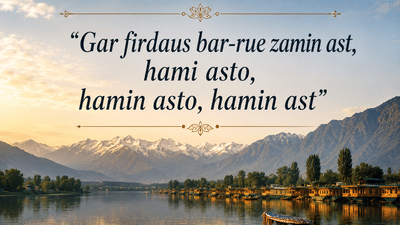
Seven hundred years after his death, Amir Khusro is still everywhere. His qawwalis echo through the Nizamuddin Dargah in Delhi every Thursday night. His verses appear in Bollywood films. His riddles are passed down like family heirlooms. And one couplet of his, atleast widely attributed to him, has probably appeared on more tourism brochures, Instagram captions, and WhatsApp forwards than anything else written in medieval India.
Gar firdaus bar-rue zamin ast, hamin asto, hamin asto, hamin ast.
"If there is a paradise on earth, it is this, it is this, it is this."
The man behind the words
To understand the couplet, you need to understand who Khusro was. Born in 1253 in Patiali, near modern-day Uttar Pradesh, to a Turkic father and a Rajput mother, he grew up straddling two worlds, and he never stopped straddling them. According to the Encyclopaedia Iranica, he is considered "the greatest Persian-writing poet of medieval India" — and yet he wrote with equal passion in Hindavi, the forerunner of today's Hindi and Urdu. He once said of himself: "I am a Turk of Hindustan, I answer in Hindavi"(Turkish: Turk-e-Hindustani am, man Hindavi goyam jawab). That dual identity wasn't a conflict for Khusro. It was his whole point.
He served as court poet to seven successive rulers of the Delhi Sultanate, according to Britannica, which is a remarkable feat of survival in an era when rulers changed violently and frequently. But the most important relationship of his life was with Nizamuddin Auliya , the Sufi saint whose dargah still draws thousands of pilgrims in Delhi. Khusro was his most devoted disciple, and when Nizamuddin died in 1325, Khusro followed him just six months later. His tomb sits right beside his master's — a detail that tells you everything about where his loyalties truly lay.
The mystery of authorship
Here's where things get complicated. The couplet is almost universally attributed to Khusro in popular culture — but academic and literary historians aren't so sure. Research suggests the couplet inscribed in gold on the walls of the Diwan-i-Khas in the Red Fort is actually attributed to Saadullah Khan, Shah Jahan's prime minister — not Khusro at all. Some accounts credit Emperor Jahangir, said to have been overwhelmed upon first seeing Kashmir . So you have three different claimants across two different centuries.
In Khusro's worldview India is love. He spent his literary life insisting that India was extraordinary. His masnavi Nuh Sipihr (Nine Skies) contains vivid, loving descriptions of India's seasons, flora, fauna, and cultures. He was called Tuti-e-Hind, "The Parrot of India", that compared his eloquence to a sweet-talking parrot and confirmed his canonical status as a poet of the subcontinent.
What makes the couplet remarkable isn't just its beauty, it's the audacity of it. In a literary tradition where paradise was always elsewhere, always celestial, always out of reach, here was someone saying: no, look around. It's here. That repetition, hamin ast, hamin ast, hamin ast, isn't padding. It's insistence. It's the kind of insistence that only comes from someone who genuinely believed what he was saying.
Centuries later, it's hard to disagree.
-
RBI to pay biggest-ever dividend to central government, decided May

-
India hikes gold and silver import duty to 15%

-
Bayer's FarmRise app reaches over 50L farmers in India

-
RBI Governor Sanjay Malhotra warns Indian fuel prices could rise

-
Anthropic nearing Stainless acquisition and seeking at least $30B funding