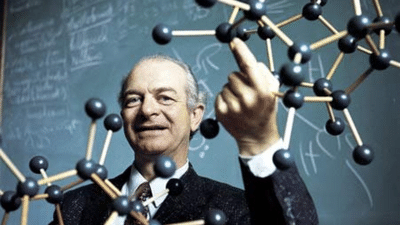
Linus Pauling won the Nobel Prize in Chemistry and then another one for peace activism. He wasn't someone who had one brilliant idea and rode it for life. Instead, he did what he's telling us to do in this quote: he generated ideas constantly, threw a lot of them at the wall, and let some stick. The rest? He moved on. That's how actual innovation works, and it's almost nothing like how most of us approach problem-solving.
We're taught that good ideas are rare, precious things. You're supposed to sit quietly, think deeply, and eventually a fully formed brilliant idea descends on you like inspiration from the gods. But that's not reality. That's a fairy tale we tell about genius. Real genius is mostly just showing up with a notebook and being willing to generate fifty mediocre ideas so you can find one that's actually worth pursuing.
“The best way to have a good idea is to have lots of ideas”
There's a reason Pauling's advice works, and it's not mystical. When you commit to generating lots of ideas, you're mathematically increasing your odds of hitting something good. It's not complicated math. If you generate ten ideas, maybe one is worth developing. If you generate a hundred ideas, you're probably getting five that have real potential. More attempts means more chances for something useful to emerge.
But there's something else happening too. The first ideas you have are usually the ones you've already thought of. They're the obvious paths, the well-worn solutions that everybody else is considering. When you keep generating ideas—when you push past the easy answers and force yourself to keep thinking—that's when you start getting somewhere interesting. The 40th idea doesn't come from your mainstream thinking. It comes from unusual angles. It comes from making weird connections. It comes from combining things that aren't normally combined.
This is actually how scientific breakthroughs happen. You don't get there by being careful and thoughtful. You get there by being prolific. You try things. Some fail spectacularly. Some fail quietly. And occasionally, something works in an unexpected way that opens up an entirely new direction.
-
Wild elephant scare returns in Malnad region, chased villagers

-
Punjab Board PSEB Class 12th Result 2026 Announced

-
Former Mohun Bagan president 'Tutu' Bose dies at 79 after cardiac arrest
-
Vat Savitri Vrat 2026: Observing the Vat Savitri Vrat for the first time? These tips are absolutely essential for new brides..

-
PSEB Class 12 Toppers 2026 OUT: Suhani & Divanshi Tops Humanities, Supneet Kaur Scores 100% In Science; Check Full List Here