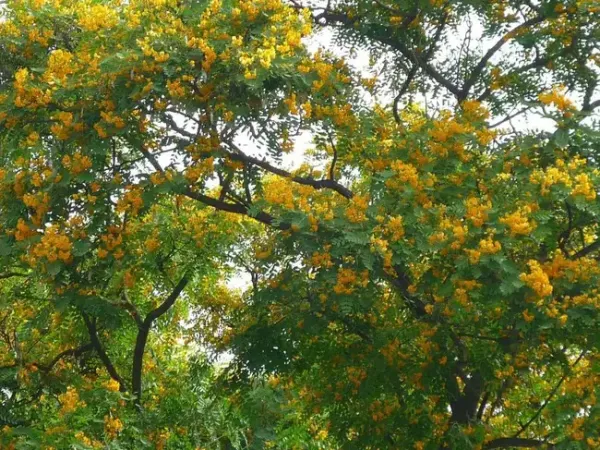
Every year, just before Delhi’s summer becomes unbearable, something magical quietly takes over the city. Roads suddenly glow yellow, sidewalks disappear beneath fallen petals, and trees that looked ordinary for most of the year burst into dramatic cascades of golden flowers. This seasonal transformation has once again captured the internet’s attention after an Indian Forest Service officer shared stunning observations online. But these bright yellow blooms are more than just beautiful. For many people across India, they are also seen as nature’s own calendar, signalling that the monsoon season is slowly inching closer.
IFS officer Ramesh Pandey recently took to X to describe Delhi’s changing landscape as summer intensifies. He wrote about how seemingly inconspicuous trees suddenly become covered with hanging clusters of golden flowers, resembling chandeliers suspended from branches as temperatures rise across the capital.
The viral post quickly sparked conversations online, with many users identifying the tree as Amaltas, also known as Cassia fistula or the Indian laburnum.
One user pointed out that in Marathi, the tree is called Bahava. According to local traditions, when Bahava trees become fully covered with bright yellow blossoms, it is believed that the monsoon rains are only a couple of months away. This connection between blooming cycles and changing seasons is why many people affectionately refer to the tree as nature’s calendar.
During late spring and early summer, especially in hot and dry weather, the tree blooms heavily with long hanging clusters of bright yellow flowers. At peak bloom, many trees appear almost entirely golden, with very few leaves visible beneath the flowers.
The tree is especially important in Kerala, where it is officially recognised as the state flower. Interestingly, the golden shower tree also holds national importance in Thailand. Known there as 'ratchaphruek', Cassia fistula is both the national tree and the national flower of the country. Its vibrant yellow flowers symbolise Thai royalty and are deeply connected with cultural identity.
Tree's adaptability
Apart from its visual beauty, the tree is also known for its adaptability. It grows well in dry climates, thrives in full sunlight, and tolerates drought conditions relatively well. According to botanical information, the flowering becomes even more spectacular in regions that experience clear seasonal contrasts between summer and winter temperatures.
IFS officer Ramesh Pandey recently took to X to describe Delhi’s changing landscape as summer intensifies. He wrote about how seemingly inconspicuous trees suddenly become covered with hanging clusters of golden flowers, resembling chandeliers suspended from branches as temperatures rise across the capital.
The viral post quickly sparked conversations online, with many users identifying the tree as Amaltas, also known as Cassia fistula or the Indian laburnum.
One user pointed out that in Marathi, the tree is called Bahava. According to local traditions, when Bahava trees become fully covered with bright yellow blossoms, it is believed that the monsoon rains are only a couple of months away. This connection between blooming cycles and changing seasons is why many people affectionately refer to the tree as nature’s calendar.
Significance of the tree in India
The striking tree has deep cultural and botanical significance beyond Delhi’s streets. Cassia fistula, commonly known as golden shower tree, Indian laburnum, or kani konna, belongs to the Fabaceae family and is native to the Indian subcontinent and nearby parts of Southeast Asia. It is widely grown as an ornamental tree in tropical and subtropical regions because of its dramatic flowering season.During late spring and early summer, especially in hot and dry weather, the tree blooms heavily with long hanging clusters of bright yellow flowers. At peak bloom, many trees appear almost entirely golden, with very few leaves visible beneath the flowers.
The tree is especially important in Kerala, where it is officially recognised as the state flower. Interestingly, the golden shower tree also holds national importance in Thailand. Known there as 'ratchaphruek', Cassia fistula is both the national tree and the national flower of the country. Its vibrant yellow flowers symbolise Thai royalty and are deeply connected with cultural identity.