The Philippine House of Representatives (HoR) voted toimpeach Vice President Sara Duterte anew on Monday, with 255 votes in the affirmative, 26 against, and nine abstentions.
This development was one of three major events in a chaotic day for Philippine politics that included a sudden change in leadership at the Philippine Senate and a botched arrest attempt against a Senator making an appearance after more than six months of hiding from an International Criminal Court (ICC) arrest warrant.
The HoR has formally endorsed and ordered the transmission of Articles of Impeachment against Duterte to the Philippine Senate. The more important questions now are: Will the new Senate leadership delay or refuse to conduct an impeachment trial, as its predecessors did in 2025? Or will it still hold a trial but eventually absolve the vice president?
Stay up to date with the latest news. Follow KT on WhatsApp Channels.
Let's break down the issues:
What happens now with a new Senate configuration?Minutes before the HoR was due to vote to impeach Duterte, her allies at the Senate made a surprise move to replace the sitting leadership with their own. In a quick vote, they ousted Senator Vicente Sotto III and his allies from the leadership and replaced it with Senator Alan Peter Cayetano, a former running mate of Duterte patriarch and former president Rodrigo Duterte, who is currently detained by the International Criminal Court for charges of crimes against humanity.
Political observers quickly noted the new Senate configuration is expected to delay, even refuse to hold an impeachment trial, as its predecessor did in 2025. It may even apply a more subtle approach by still holding a trial but absolve Duterte nonetheless, regardless of the volume of incriminating evidence gathered by the HoR.
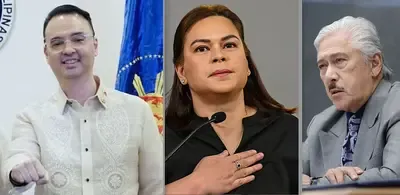
(L-R) Senator Alan Peter Cayetano, Vice President Sara Duterte and Senator Vicente Sotto III
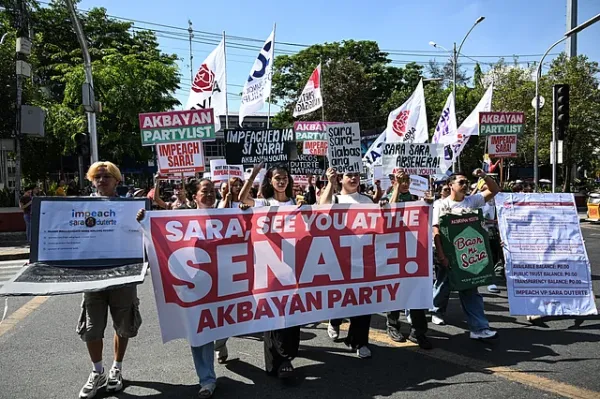
Will there still be accountability?The coup d’etat at the Senate on Monday may hold hostage the country’s most important accountability mechanism. The Makabayan (Patriotic), a bloc of progressive lawmakers, expressed fear, saying it was a “brazen manipulation of the impeachment process.”
“There is no credible interpretation of this sequence of events other than a calculated political intervention to protect the powerful at the expense of accountability,” they said.
The progressive lawmakers said Monday’s events only showed the “extreme rottenness” of the Philippine political system. “(The) impeachment process—a constitutional mechanism for holding corrupt officials to account—is held hostage by competing reactionary political factions maneuvering for advantage. This is not governance. This is a struggle among dynasties and political blocs over power and survival, with the Filipino people's demand for justice caught in the crossfire."
Makabayan asked the Filipino people to oppose any manipulation of the impeachment trial that may lead to Duterte’s acquittal.
What happened to the first impeachment?VP Duterte was first impeached last year but it did not proceed to a full trial by the Senate, that was dominated by senators aligned with the Duterte camp. They petitioned the Supreme Court to issue a restraining order on questions whether the HoR violated the one-year-ban rule by accepting three separate complaints and consolidating it into one.
This year, the HoR and its Committee on Justice took extra care to follow the procedures laid by the Supreme Court, taking eight public hearings to determine sufficiency in form, substance, grounds and probable cause before approving its report and attached articles of impeachment.
Why was VP Duterte impeached again?Duterte had been charged of misuse of public funds, grave threats and betrayal of public trust, bribery and corruption, and unexplained wealth. She refused to attend the eight hearings conducted by the CoJ, instead choosing to issue blanket denial of any wrongdoing.
According to the Philippine Constitution, an impeachment proceeding and trial is a unique and formal political process to charge a public official with high crimes, serious misconduct, or betrayal of public trust. It is a mechanism for accountability rather than a criminal proceeding, much less a political circus.
In the Philippines, the HoR receives impeachment complaints from citizens. It also conducts hearings to establish impeachable grounds and, if found sufficient, transmit it to the Senate for a full trial.
Impeachable Philippine officials are the president, the vice-president, members of the Supreme Court, the Ombudsman and members of the Constitutional Commissions, such as the Civil Service Commission, the Commission on Elections and the Commission on Audit.
Previously, former Philippine president Joseph Estrada and at least two other Supreme Court chief justices faced impeachment trials by the Senate. The three eventually lost their positions, either by practical abdication, resignation or conviction.
If the impeachment trial at the Senate will proceed, and the senators find Duterte guilty of the impeachable charges, she will be removed from office and permanently barred from holding any Philippine government position.
 Explainer: Philippines VP Duterte’s impeachment, anti-corruption or political spectacle Philippine VP Sara Duterte impeached for second time in two years Philippines VP Duterte spent P125 million in 24 hours, witness claims during impeachment hearing
-
Police hunt two men after teenage girl sexually assaulted

-
'More cases of hantavirus expected' WHO chief warns as eighth passenger tests positive
-
Widespread Salmonella Recall Linked to Contaminated Milk Powder in the U.S.

-
Natural Remedies for Premature Gray Hair: Insights from Baba Ramdev

-
When will Believe Me return as ITV confirms episode schedule