
Gurugram founder Nistha Tripathi, of 24NorthStar, shared a LinkedIn post saying Indian workplaces often reward long hours instead of productivity. She said employees feel guilty leaving at 6 pm and described differences with European teams that log off at 5 pm without pressure. Her post sparked mixed reactions online.
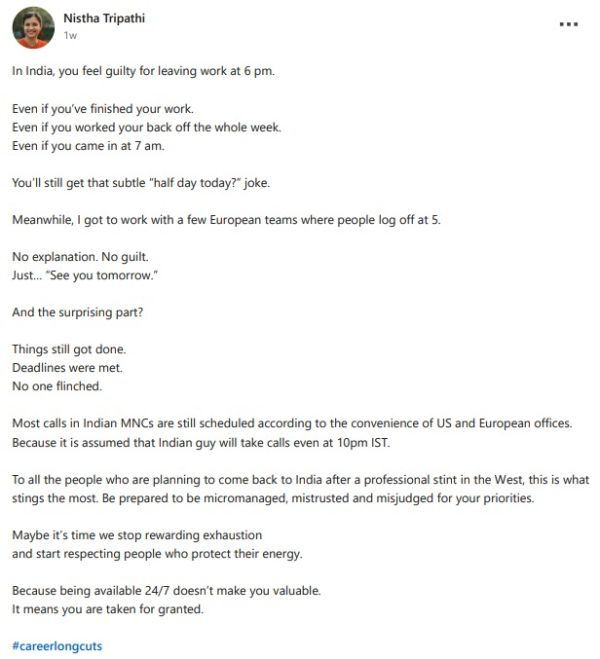
A Gurugram-based founder has started a wide online discussion after sharing her views on Indian workplace culture. Nistha Tripathi, founder of 24NorthStar, posted on LinkedIn about how employees in India often feel guilty for leaving office at 6 pm, even after finishing their work. In her post, she said that many workers still feel pressure when they log off on time. She wrote that people often hear small jokes like “half day today?” even if they have worked hard or arrived at 7 am.

Tripathi explained that in some European teams she worked with, employees leave at 5 pm without any guilt. She said they simply say, 'See you tomorrow' and the work still gets completed. According to her, deadlines are met and tasks are handled properly.
Meeting culture and late calls
She also spoke about meeting schedules in Indian multinational companies. She said many calls are planned according to US and European time zones. Because of this, Indian employees are often expected to join meetings late at night, sometimes at 10 pm IST.
Tripathi said that people returning to India after working abroad may find it hard to adjust. She mentioned that some may face more supervision, less trust, and judgement about their priorities.
In her view, workplaces should stop rewarding exhaustion. She said being available 24/7 does not make someone more valuable. Instead, it can make employees feel taken for granted.
Her post included the message that companies should respect people who protect their time and energy.
Mixed reactions online
The post received mixed responses on LinkedIn. Many users agreed with her points and shared similar experiences. Some said they had also faced pressure to stay late, even when their work was finished.
One user wrote that productivity should be measured by output, not by clock-out time. Another said that employees in India are often judged by how long they sit in the office, instead of how well they complete tasks.
However, not everyone agreed fully. Some users said that comparing Indian and Western work cultures without considering economic and cultural differences was not fair. They argued that each country has its own system and working style.
One commenter said India is still a developing economy and that Western countries also had very long working hours during their growth periods. Another user said Indian workplaces often include social breaks, such as group lunches, which build team bonding.
Some people also said that many Indian offices have improved in recent years. They mentioned that younger workers now try to leave on time and focus more on balance.
A few users shared their personal stories of working abroad. One said that in Canada, managers respected boundaries and did not question employees who left after completing their tasks. Another said that adjusting back to an always-on culture in India was difficult after working overseas.
Wider debate on work-life balance
The discussion shows that work-life balance remains an important topic. Many professionals believe that commitment should be measured by results, not by long hours.
Supporters of Tripathi’s view said companies should focus on trust, clear goals and productivity. They believe employees perform better when they are not under constant pressure.
Others feel that every country’s work culture develops based on its own needs. They say improvement should continue, but changes must consider local conditions.
Tripathi ended her post by encouraging organisations to value efficiency and energy protection rather than constant availability.
The post continues to attract attention, with people sharing opinions across professional networks.
-
Kotak Education Foundation Unveils Kotak Junior Scholarship “Future Ka Golden Ticket” offering 1,000 Scholarships for Class 10+ Students in Mumbai

-
Won't beat around the bush, I'll just say fielding and bowling again: Iyer after loss to DC

-
TCS Nashik case: NCW flags sexual harassment, workplace bullying and failure of POSH mechanisms

-
Allahabad HC seeks UP govt's action plan to curb 'Chinese manjha', officials summoned

-
PM Modi, other dignitaries arrive in Guwahati for NDA govt's oath taking