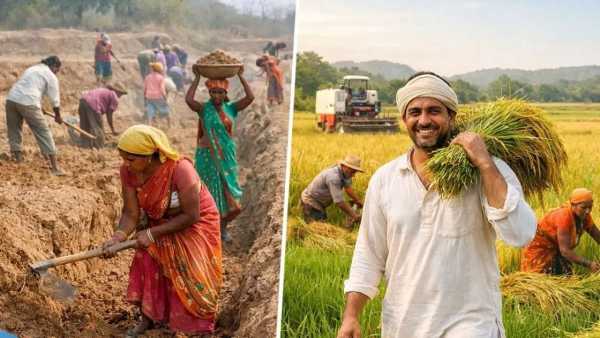
VB G-Ram-G is being implemented in the entire country from July 1. This will replace MNREGA.
The central government on Monday announced that the new 'Vikas Bharat Guarantee Act' for Employment and Livelihood Mission (Rural), or VB-G RAM G Act, 2025, will come into force across India from July 1. This Act will replace the Mahatma Gandhi National Rural Employment Guarantee Act (MGNREGA). The government has introduced this law as a 'next generation rural development framework', which is in line with the vision of 'Develop India 2047'. Under this, it has been promised to increase guaranteed wage employment from 100 to 125 days a year, and rural employment will also be more strongly linked to infrastructure creation, climate adaptation and village-level planning.
However, opposition parties and labor rights activists have expressed concern over the abolition of MNREGA. He argues that the existing law had evolved into a 'rights-based social security framework'. He also warned that increasing digitalization, face-authentication based attendance and administrative restructuring could create obstacles for vulnerable sections of the workforce.
What changes will happen under the new law?
Under the new Act, every rural household whose adult members volunteer to do unskilled manual labor will have the right to 125 days of guaranteed wage employment in a financial year. Under MNREGA this limit was 100 days. The central government said the scheme will focus on four main categories of works: water security projects, core rural infrastructure, livelihood-related infrastructure and works to mitigate the impacts of extreme weather. Under MNREGA, the works were divided into broad categories like water conservation, anti-drought measures, irrigation, restoration of traditional water bodies, land development and flood control.
The law also introduces the concept of 'Developed Gram Panchayat Plans' (VGPPs). These plans will be prepared by Gram Panchayats and approved by Gram Sabhas, which will serve as convergence-based local development plans. According to the government, all work to be done under this Act should emanate from these 'rural development plans', so as to ensure "need-based and full coverage-focused" rural development.
How will this change happen?
The central government has said that the transition from MGNREGA to the new law will be “smooth and seamless”. MNREGA will formally end from July 1, 2026. Exactly from this date VB-G RAM G Act will also become effective. The ongoing work under MNREGA will continue and will be included in the new framework. The government has said that priority will be given to completing incomplete public assets and ongoing projects. The existing job cards of workers whose e-KYC has already been completed will also remain valid until the new “Rural Employment Guarantee Card” is issued. The government has also made it clear that if the ongoing work is not enough to meet the demand of the workers, then new work can also be started in this period of change.
What hasn't changed?
It is still necessary to provide work within 15 days of seeking work, failing which workers become entitled to unemployment allowance, which is paid by state governments. Wages will still be paid through Direct Benefit Transfer (DBT) directly into bank or post office accounts, and this payment should be made every week or within two weeks of the closure of the master roll. In this law, the provision of giving compensation for delay in payment of wages has also been retained.
What are the new administrative features?
Attendance at work places will now be recorded through a system based on 'face authentication'. However, the government has said that some relaxation will be given in cases of poor connectivity, technical problems or other genuine difficulties. Another important feature is that there will be a ban on starting work during the busiest farming seasons. State governments will issue information in this regard, so that there is no shortage of laborers at the time of sowing and harvesting.
How will the funding be done?
The funding pattern for the states under the scheme is as follows: 90:10 for North-Eastern and Himalayan States; 60:40 for other states and union territories with assemblies; And 100 percent central funding for Union Territories without legislature.
The limit of expenditure on materials has been fixed at 40 percent at the district level. Under MGNREGS, 100 per cent of the wages were paid by the central government, while the cost of materials was shared between the Center and states in the ratio of 75:25.
Why is this new law needed?
The government argues that this new framework modernizes rural employment by linking livelihood support, infrastructure creation and climate change resilience. Officials say that the purpose of this law is not to be limited to just a “demand-based wage program”, but to move towards a development model that links various schemes and in which better planning can be done at the village level.
Including infrastructure related to reducing the impact of extreme weather is also being considered as the answer to the growing challenges related to climate change in rural India. The Center has also highlighted the provisions of enhanced employment guarantee of 125 days and uninterrupted work availability during the transition period.


-
Bikers escape narrowly as electric pole explodes in Chikkamagaluru

-
NHS new 'revolutionary' 60-second jab treats 14 cancers as Dr Hilary shares 'good news'

-
Resurfaced GMB clip shows furious Jess Phillips refuse to answer Keir Starmer question

-
Tamil Nadu: DMK's Udhayanidhi Stalin reiterates call for 'eradication' of Sanatana Dharma

-
The UK's top 100 curry restaurants for 2026 named - is your local on the list?