
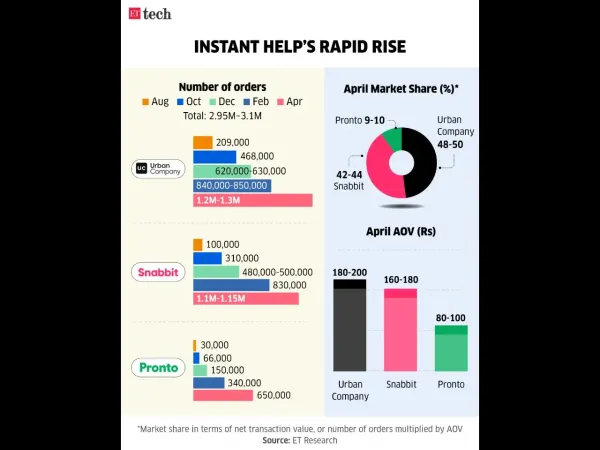
Instant house help startups Urban Company, Snabbit and Pronto together crossed 3 million monthly bookings in April skirting over disruptions due to labour shortage during just-concluded state elections, industry executives said. The three platforms clocked 3-3.1 million bookings in the month, up from around 2 million in February, according to data reviewed by ET.
The growth came as the two larger players — Urban Company and Snabbit — raised prices for their instant help services, pushing up post-discount average order values (AOVs). Pronto, which recently raised $20 million in funding doubling its valuation to $200 million, continued to trail on pricing and ticket size. Snabbit also closed a $56-million funding in April at a $350 million valuation.
“The months of March and April saw meaningful supply-side disruptions due to labour shortages, prompting platforms to raise prices in some mature micro markets,” a senior industry executive said. “At the same time, competition for workers remained intense as companies aggressively vied for a limited pool of service professionals.”
Urban Company’s InstaHelp service recorded a net AOV of Rs 180-200 in April, while Lightspeed-backed Snabbit saw AOVs of Rs 160-180, executives said. Pronto, meanwhile, clocked AOVs in the Rs 80-100 range. To be sure, Pronto’s lower AOVs are largely due to its pricing structure, with the company offering lower-priced 30-minute service packs unlike rivals that primarily operate on hourly pricing.
Also Read: Instant domestic help apps face worker unavailability amid rapid scaling, high competition
Market share over profitability
Gurugram-based Urban Company, though the last entrant in the segment, retained its lead in both monthly order volumes and net transaction value (NTV). The company clocked 1.2-1.3 million orders in April, while Snabbit recorded 1.1-1.15 million orders. Pronto lagged at around 650,000 orders in April, though executives said it has been scaling up rapidly.
In terms of NTV, which is calculated by multiplying order volumes with post-discount AOVs, Urban Company commanded a 48-50% market share in April. Snabbit followed with a 42-44% share, while the remaining 9-10% was accounted for by Pronto.
Queries sent to the founders of Urban Company, Pronto and Snabbit did not elicit a response.
The pricing trends come amid a broader debate around the long-term economics of the category. In a May 4 report, brokerage firm BofA Global Research said the category would need to stabilise at a net AOV of around Rs 250 per hour to achieve sustainable economics, adding that such a model could deliver gross margins of about 50% at utilisation levels of 75%.
In April, two executives pegged a range of $10-12 million of monthly cash burn by the three players combined — largely like $10-11 million recorded in February. “The March burn number had increased but discounts and subsidies to consumers were pulled back in April on account of worker unavailability,” one of the executives cited above said.
Urban Company’s aggressive expansion of InstaHelp was the primary factor behind the deeper losses in the March quarter, when it clocked a 57-fold year-on-year jump in net loss at Rs 161 crore.
The company's cofounder and CEO Abhiraj Singh Bhal said InstaHelp’s losses would remain elevated as it prioritises market share over short-term profitability. “In the short run, you can either optimise for market share or optimise for on-paper elegance. We are not choosing elegance. We are optimising to win and capture market share, which means if we have to match irrationality from time to time, we are fully prepared to do so,” he said on Friday during an earnings call.
The demand top out
Even as the sector continues to grow at a rapid pace — Urban Company grew from near zero at the start of FY26 to 2.7 million orders in January-March quarter — there are still question marks over the industry’s addressable market in the long term, investors said.
BofA Global Research noted that the sector’s eventual addressable market could support 4-6 million orders per day across 30-40 million households.
The instant house help market is broadly seen as being split into three use cases — ad hoc, supplementary and primary.
Ad hoc users treat the service as an emergency backup when their regular help is unavailable, using it 1-3 times a month, where availability matters more than quality, an executive said, while supplementary users rely on it 4-6 times monthly as a top-up service. Primary users, who book services 18-20 days a month, are the ones who have shifted most household spending to these platforms.
“Right now, most users are coming in for ad hoc or supplementary needs, and that’s the easiest wedge for these platforms,” said a venture capital investor who looked at one of the companies, but ultimately passed on the deal. “The bigger question is whether consumers will eventually rely on these apps as their primary source of domestic help. It’s still very early, and pricing will be critical in deciding how large this market can really get.”
The sector is currently operating with heavy discounts as companies focus on category creation, said Puneet Kumar, CEO of Mirae Asset Venture India, which led Snabbit’s latest funding round.
He said an average job duration of 1.3 hours already translates into a net AOV of more than Rs 250, adding that consumers appear comfortable paying around Rs 200 per hour, while pushing prices beyond that becomes difficult unless job sizes increase.
The focus should be on tracking the right operating metrics and understanding consumers’ willingness to pay. “Ultimately, you need 60% utilisation for the service to really make money. If you start doing smaller jobs, it becomes very difficult because there's also dead time spent travelling between jobs. The focus should be on the number of service hours as the real metric, rather than the number of jobs,” Kumar added.
Adding more to cart
Amid concerns over the eventual scale of the 10-minute house help market, startups are expanding into adjacent services to deepen customer engagement. Platforms are now exploring categories such as cooking and car washing alongside core cleaning offerings. Snabbit and Pronto are piloting cooking services in Bengaluru, while Pronto has already entered car washing by creating a separate network of male service professionals for the category.
Urban Company, however, said that it plans to stay focused on its core instant help offering.
“Our focus remains on the core segments. We know that some of our competitors are experimenting with some of these adjacencies, but we are focused on the core. We believe the player that will win the core segment in the micro markets, that's essentially the turf to win. And that is where all our attention and focus is right now. We have limited resources — monetary and people — and we want to focus on them towards winning the main segment in the main micro markets,” Urban Company’s Bhal said.
BofA Global Research said it estimates the addressable market of InstaHelp to be higher than Urban Company’s core business — of services such as beauticians, handymen, home cleaning — by FY30. “This theoretically would allow InstaHelp to be a higher value driver to the stock price subject to execution and stable competition,” it said.
The growth came as the two larger players — Urban Company and Snabbit — raised prices for their instant help services, pushing up post-discount average order values (AOVs). Pronto, which recently raised $20 million in funding doubling its valuation to $200 million, continued to trail on pricing and ticket size. Snabbit also closed a $56-million funding in April at a $350 million valuation.
“The months of March and April saw meaningful supply-side disruptions due to labour shortages, prompting platforms to raise prices in some mature micro markets,” a senior industry executive said. “At the same time, competition for workers remained intense as companies aggressively vied for a limited pool of service professionals.”
Urban Company’s InstaHelp service recorded a net AOV of Rs 180-200 in April, while Lightspeed-backed Snabbit saw AOVs of Rs 160-180, executives said. Pronto, meanwhile, clocked AOVs in the Rs 80-100 range. To be sure, Pronto’s lower AOVs are largely due to its pricing structure, with the company offering lower-priced 30-minute service packs unlike rivals that primarily operate on hourly pricing.
Also Read: Instant domestic help apps face worker unavailability amid rapid scaling, high competition
Market share over profitability
Gurugram-based Urban Company, though the last entrant in the segment, retained its lead in both monthly order volumes and net transaction value (NTV). The company clocked 1.2-1.3 million orders in April, while Snabbit recorded 1.1-1.15 million orders. Pronto lagged at around 650,000 orders in April, though executives said it has been scaling up rapidly.
In terms of NTV, which is calculated by multiplying order volumes with post-discount AOVs, Urban Company commanded a 48-50% market share in April. Snabbit followed with a 42-44% share, while the remaining 9-10% was accounted for by Pronto.
Queries sent to the founders of Urban Company, Pronto and Snabbit did not elicit a response.
The pricing trends come amid a broader debate around the long-term economics of the category. In a May 4 report, brokerage firm BofA Global Research said the category would need to stabilise at a net AOV of around Rs 250 per hour to achieve sustainable economics, adding that such a model could deliver gross margins of about 50% at utilisation levels of 75%.
In April, two executives pegged a range of $10-12 million of monthly cash burn by the three players combined — largely like $10-11 million recorded in February. “The March burn number had increased but discounts and subsidies to consumers were pulled back in April on account of worker unavailability,” one of the executives cited above said.
Urban Company’s aggressive expansion of InstaHelp was the primary factor behind the deeper losses in the March quarter, when it clocked a 57-fold year-on-year jump in net loss at Rs 161 crore.
The company's cofounder and CEO Abhiraj Singh Bhal said InstaHelp’s losses would remain elevated as it prioritises market share over short-term profitability. “In the short run, you can either optimise for market share or optimise for on-paper elegance. We are not choosing elegance. We are optimising to win and capture market share, which means if we have to match irrationality from time to time, we are fully prepared to do so,” he said on Friday during an earnings call.
The demand top out
Even as the sector continues to grow at a rapid pace — Urban Company grew from near zero at the start of FY26 to 2.7 million orders in January-March quarter — there are still question marks over the industry’s addressable market in the long term, investors said.
BofA Global Research noted that the sector’s eventual addressable market could support 4-6 million orders per day across 30-40 million households.
The instant house help market is broadly seen as being split into three use cases — ad hoc, supplementary and primary.
Ad hoc users treat the service as an emergency backup when their regular help is unavailable, using it 1-3 times a month, where availability matters more than quality, an executive said, while supplementary users rely on it 4-6 times monthly as a top-up service. Primary users, who book services 18-20 days a month, are the ones who have shifted most household spending to these platforms.
“Right now, most users are coming in for ad hoc or supplementary needs, and that’s the easiest wedge for these platforms,” said a venture capital investor who looked at one of the companies, but ultimately passed on the deal. “The bigger question is whether consumers will eventually rely on these apps as their primary source of domestic help. It’s still very early, and pricing will be critical in deciding how large this market can really get.”
The sector is currently operating with heavy discounts as companies focus on category creation, said Puneet Kumar, CEO of Mirae Asset Venture India, which led Snabbit’s latest funding round.
He said an average job duration of 1.3 hours already translates into a net AOV of more than Rs 250, adding that consumers appear comfortable paying around Rs 200 per hour, while pushing prices beyond that becomes difficult unless job sizes increase.
The focus should be on tracking the right operating metrics and understanding consumers’ willingness to pay. “Ultimately, you need 60% utilisation for the service to really make money. If you start doing smaller jobs, it becomes very difficult because there's also dead time spent travelling between jobs. The focus should be on the number of service hours as the real metric, rather than the number of jobs,” Kumar added.
Adding more to cart
Amid concerns over the eventual scale of the 10-minute house help market, startups are expanding into adjacent services to deepen customer engagement. Platforms are now exploring categories such as cooking and car washing alongside core cleaning offerings. Snabbit and Pronto are piloting cooking services in Bengaluru, while Pronto has already entered car washing by creating a separate network of male service professionals for the category.
Urban Company, however, said that it plans to stay focused on its core instant help offering.
“Our focus remains on the core segments. We know that some of our competitors are experimenting with some of these adjacencies, but we are focused on the core. We believe the player that will win the core segment in the micro markets, that's essentially the turf to win. And that is where all our attention and focus is right now. We have limited resources — monetary and people — and we want to focus on them towards winning the main segment in the main micro markets,” Urban Company’s Bhal said.
BofA Global Research said it estimates the addressable market of InstaHelp to be higher than Urban Company’s core business — of services such as beauticians, handymen, home cleaning — by FY30. “This theoretically would allow InstaHelp to be a higher value driver to the stock price subject to execution and stable competition,” it said.