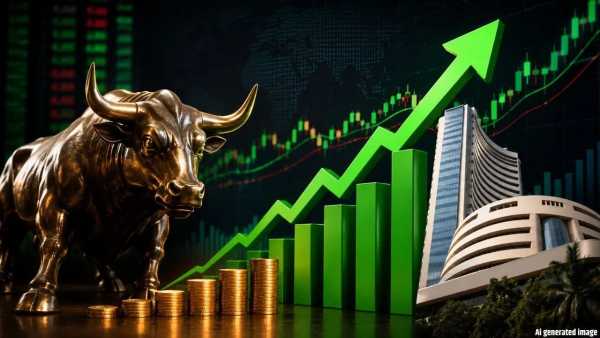
Veteran stock market expert Ramdev Aggarwal said that by the year 2036, Sensex can reach the level of 3 lakh points.
As bulls and bears clash on Dalal Street amid geopolitical turmoil in the Middle East, Motilal Oswal Financial Services Chairman Ramdev Agarwal said India is a Ferrari in the global market, and remains one of the world's best hunting grounds for multi-bagger stocks.
Speaking at the Grow India Investor Festival 2026, Ramdev Aggarwal said that decades of compounding, rising financialization and structural growth trends have laid a strong foundation for the Indian market. Aggarwal said that I have seen the Sensex increase from 100 to 80,000 in 40 years. There is no logic for me to believe that this journey will be different in the next 40 years.
The markets of South Korea and Japan have recently witnessed a tremendous surge and have reached record levels. Whereas the Indian stock market has given comparatively low returns. Many analysts said that due to AI boom, many of these markets are seeing strong earnings, which is attracting FPI investment in those markets. While Aggarwal reiterated that India's long-term structural path remains unique, he also acknowledged that some sectors are currently benefiting from AI-based earnings cycles.
Making a comparison between India's Sensex and South Korea's Kospi—both of which were launched in January 1980—Agarwal pointed out that while the Korean benchmark index stands at around 5,000 points today, the Sensex has crossed 80,000. He said in this event that the form may be for some time, but the class is forever. India is the right path.
Market experts said that in the last two decades, India's market capitalization in dollar terms has grown at the rate of about 14 percent annually, whereas for the US market it has been about 7 percent. He further said that every five to six years, you double. This is its speed.
Why are more multibaggers made in India?
The Chairman of MOFSL said that their investment philosophy has always been to find businesses that operate in fast-growing industries within fast-growing economies. Citing an internal study inspired by Thomas Phelps' book 100 to 1 in the Stock Market, Agarwal said about 20 per cent of the companies included in the NSE 500 delivered annual returns of more than 25 per cent for a decade — essentially becoming 10-multibaggers. He said that in S&P 500 this figure was only around 7%.
He said that multi-bagging happens only where growth is fastest. You find most multi-baggers in a country that is growing the fastest and in an industry that is growing the fastest. According to this experienced market player, vision, courage and patience – these three things are the formula to identify big winner stocks. He further said that whenever you bet on a big stock, most of the time you are alone. To stick with that stock, you must be convinced.
Agarwal said investors often underestimate how compounding works in the long run. He said that if a stock gives 100 times returns in two decades, most of the wealth is usually created in the last few years. He said that you wait till 19 years, because most of the compounding happens in the 19th and 20th years only.
In which company did you make the initial investment?
Ramdev Aggarwal recalls his initial investment in Bharti Airtel. In 2003, after studying the economics of network business and talking to Sunil Bharti Mittal, the market expert became convinced that India's mobile revolution would create huge value.
At that time, India, with a population of more than a billion, had only around 50 million fixed-line phones. Agarwal estimated that Bharti Airtel could earn a profit of Rs 27,00028,000 crore in the next five years, even though its market capitalization at that time was only around Rs 5,000 crore.
Despite the doubts of his colleagues and friends, he bought shares of Bharti Airtel at a price of around Rs 1930 per share. He recalled that I was alone the whole time. Although he had sold some shares early under pressure, he retained a large portion as the share value had increased manifold. His last exit took place several years later at a price of around Rs 650, giving him a return of around 25 times.
Next Generation Winners
Aggarwal said that India's growing capital market ecosystem can create the next wave of multi-baggers (shares giving multiple returns). He said that we are adding about 3 million new customers every month… We already have more than 220 million demat accounts. By 203132, we may reach 500600 million.
He said that increasing participation of retail investors will create opportunities for brokers, exchanges, asset managers, wealth platforms and depositories. He also admitted that despite having a deep understanding of the sector, he missed out on taking advantage of the tremendous rise in BSE. He laughingly said that the share price increased almost 50 times, and I did not earn a single penny. Today's Quick Commerce is similar to Bharti Airtel in 2003
Aggarwal drew parallels between India's quick commerce industry and the early days of telecom. He said that companies operating in this sector are still going through a huge cash-burn, but its underlying network effects can eventually create much bigger businesses.
What types of companies should you stay away from?
Despite his penchant for growth, Agarwal said he applies some strict filters when valuing a business. They avoid companies with 'return on equity' less than 20 per cent, and pay special attention to the 'receivables cycle' as an indicator of business quality.
He said that if the 'return on equity' is 9 or 10 percent, then I do not even want to go to the meeting. He further said that the quality of management is the biggest filter for him. Referring to those promoters, he said that not only will they themselves be ruined, they will also take you along with them. Aggarwal also stressed that it is more important to visit factories and see the functioning there with one's own eyes, rather than relying only on management presentations.
Will Sensex cross 3 lakh by 2036?
Aggarwal appeared quite optimistic about India's long-term macroeconomic direction. He estimated that per capita income could double in the next six to seven years. This experienced player of the stock market believes that due to continuously increasing earnings and increasing participation of people in financial assets, the Sensex can touch the figure of 1.5 lakh by 2030, and possibly reach 3 lakh by 2036. He said that it is more certain that the Sensex will reach 3 lakh in 12 years than it is that it will reach 1.5 lakh in six years. In this program he said that compounding works like this.


-
Sharjah court order valid in India, Telangana High Court rules in fraud case

-
Jaishankar to inaugurate UN exhibition on India’s mathematical contributions
-
Saudi: Aramco sees 25 pc more profit after shifting exports from Hormuz

-
PSEB 10th Result 2026: Punjab Board Matric Results Today At 12:30 PM, Direct Link Here

-
Former Thai Prime Minister Thaksin let out of prison early