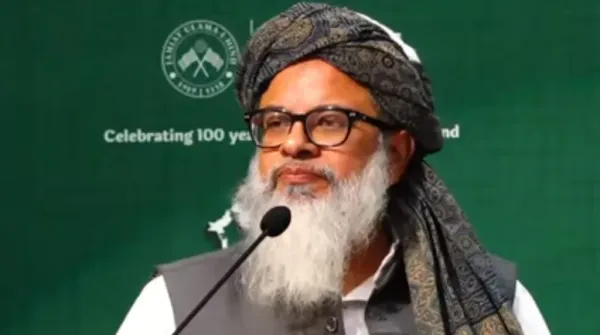
New Delhi: After the major changes in the politics of West Bengal, now Jamiat Ulema-e-Hind has shown the newly elected Chief Minister of the state Suvendu Adhikari the mirror of his constitutional responsibilities. Jamiat President Maulana Mahmood Madani has said in clear words that the Chief Minister should respect the spirit of the oath which he has taken in front of the Governor and the people of the state. He stressed that power is not the trust of any one class but of the entire society and there should be no scope for discrimination in it.
Actually, this statement has come at a time when the politics of Bengal is at a new turning point. Maulana Madani reminded Suvendu Adhikari that during the oath taking ceremony, he had taken a pledge with God as his witness that he would do justice to all the citizens without any fear, favoritism, affection or hatred. According to Madani, this oath is not just a legal process, but a public declaration of the moral responsibility of that high position, sitting on which no person can favor any particular religion or group.
Oath and Ethics: Will this work only for Hindus?
Maulana Madani expressed deep concern over the old controversial statement of the Chief Minister, in which he had reportedly said that he would “work only for Hindus”. Madani bluntly said that such things are against the secular fabric and democratic values of India. In fact, in a democracy the government is not the property of any one religion. As soon as he assumes the post of Chief Minister, that person becomes the representative of Hindu, Muslim, Sikh, Christian and every small and big section of the society.
It is being told that Jamiat has also cited Prime Minister Narendra Modi’s famous slogan “Sabka Saath, Sabka Vikas, Sabka Vishwas” on this issue. Maulana Madani raised the question that if the Chief Minister talks about discrimination on the basis of religion, is it not contrary to the Prime Minister’s claim? He expressed hope that the Prime Minister will clarify his position on this contradiction, because if the government really wants to win “everyone’s trust”, then it will have to bring fairness in both its language and behavior.
Development has no religion: the mathematics of 80 vs 20
Apart from writing and speeches, Jamiat believes that the people of Bengal are now fed up with the politics of hatred. According to local people and political experts, the public is now hungry for real development and effective governance. Maulana Madani clarified, “We are not saying that the government should work only for Muslims, but our demand is that it should work for the whole of Bengal.”
He presented a very humanistic argument for development. Madani said that development neither stops at the door of the mosque nor at the door of the temple. Basic amenities like clean water, roads, better education and employment cannot be divided on the basis of religion. He says that if development really reaches ‘eighty percent’ of the people, then the remaining ‘twenty percent’ will also not remain untouched by it. Just as clean air does not stop for a person of any one religion, similarly the policies of the government should also be universal.
Jamiat’s stance: not protest, demand for justice
At the end of his address, Maulana Madani also made clear the future strategy of the organization. He clarified that Jamiat Ulema-e-Hind does not oppose any government only for political reasons. Wherever public welfare and justice is visible, the organization will welcome it. However, he also warned that if there was communal discrimination or ignoring of constitutional principles in governance, then justice would be fought through democratic and legal means.
Overall, this message of Maulana Madani is not only an admonition for the new Chief Minister of Bengal, but it also reminds of the basic spirit of Indian democracy where the respect and rights of every citizen should be protected. Now it remains to be seen how far the new government lives up to these constitutional expectations.
-
Russian Woman Reveals American Foods She Does Not Understand

-
Daily Horoscopes For Each Zodiac Sign On Monday, May 11, 2026

-
Urvil Patel: Echo of Urvil’s blast reached even Kohli, saw stormy batting before his match, Video
-
Congress’s Bhakta Das hails ‘reel to real’ CM Vijay in Tamil Nadu
-
SAARC stalled over terrorism, not just Pakistan, says Veena Sikri