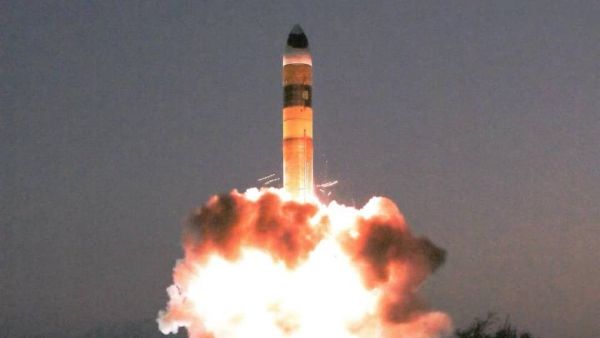
India on Friday successfully conducted the flight-test of an advanced Agni missile equipped with Multiple Independently Targeted Re-Entry Vehicle (MIRV) technology from Dr APJ Abdul Kalam Island off the coast of Odisha. The test was carried out on May 8, 2026, marking a significant boost to India’s strategic defence capabilities.
According to officials, the missile was tested with multiple payloads aimed at different targets spread across a vast geographical area in the Indian Ocean Region. The trial demonstrated the missile’s ability to strike multiple strategic targets using a single launch system.
The entire trajectory of the missile, from lift-off to the impact of all payloads, was monitored through a network of telemetry and tracking systems deployed at multiple ground-based and ship-based stations. Flight data confirmed that all mission objectives were successfully achieved during the test.
The missile has been developed by laboratories of the Defence Research and Development Organisation (DRDO) with support from domestic industries. Senior DRDO scientists and personnel from the Indian Army witnessed the trial.
Defence Minister Rajnath Singh congratulated the DRDO, the Indian Army and industry partners on the successful test, stating that the achievement would significantly strengthen India’s defence preparedness amid evolving security challenges.
The MIRV technology allows a single ballistic missile to deliver multiple nuclear warheads to different, separate targets, significantly increasing firepower and evading defences. Key features include exoatmospheric deployment, specialized maneuvering "buses," and the ability to combine warheads with decoys to overwhelm interceptors.With this successful trial, India once again demonstrated the capability to target multiple strategic targets using a single missile system, the ministry said. This missile is developed by DRDO laboratories with the support of industries across the country. The trial was witnessed by senior scientists of DRDO and the Indian Army personnel.